


Bring your DAGs to the CAT: good and bad controls in competition litigation
November 24, 2026
Anyone who has worked on economic expert evidence in competition litigation is familiar with the question: "Did you control for X?" For example, in the context of a cartel damage claim, did the model leave out something that affects prices and that also moved with the cartel, so that its effect is wrongly attributed to the cartel? This is the known omitted variable problem, which courts and practitioners take seriously to the extent that it is often a core part of cross-examination, and even the European Commission's Practical Guide on quantifying harm (the ‘Guide’) stresses the need to account for all relevant factors that affect prices.
The mirror image of this problem receives much less attention. Putting in a variable that should not be there can bias the estimate just as badly as leaving out one that should be. Experts are routinely pressed on the variables they leave out, and far less often on the ones they put in. The result is a strong pull towards including everything available, on the assumption that adding controls is the careful, conservative choice. It is not.
In a new paper, DAGs in the courtroom: good and bad controls in competition litigation, Peter Bönisch and I set out why, and how to tell good controls from bad ones. This post summarises our main arguments in terms that we hope are as useful to lawyers as to economists: some controls remove bias, others create it, and a model that fits the data better is not necessarily closer to the truth. Telling the two kinds of controls apart is mainly a matter of being explicit about what causes what. Our paper suggests a visual tool for doing this. We do not reinvent the wheel, we simply draw attention to corners of empirical work that are often neglected. We use cartel overcharge estimation as the example, but our points equally apply to causal regressions in any expert report.
The kitchen sink problem
An overcharge regression tries to answer a simple question: how much higher was the price because of the cartel? To answer it, the expert has to strip out the effect of everything else that moved the price over the same period: input costs, demand, seasonality and so on. The variables used to do this are called controls.
It is often tempting to include every control available (throw everything in the kitchen sink): every cost index, every demand indicator, every firm characteristic. It looks thorough, adding variables rarely makes the fit worse, and it pre-empts the "did you control for X?" question. But the cartel itself may have affected some of those variables, and including them can bias the estimate. We call these bad controls.
Fit is not the same as the right answer
In our view, the risk of omitting an important variable receives more attention than the risk of including a bad control because two distinct tasks tend to get blurred together.
• The first is working out which variables are legitimate to include at all, given what we believe about how the market and the cartel operated. Economists call this identification. It is a question about economics and the facts of the case, and the data alone cannot answer it.
• The second is choosing the model that best fits the data, typically by looking at R² (roughly, the share of price movements the model explains) or at whether each variable is "statistically significant".
Identification has to come first, and the two tasks can point in opposite directions. Without prioritising identification as the first step, even perfect data can deliver biased results. A variable that should not be in the model can improve the fit, and a variable that is needed might have little impact on model fit.
A two-minute guide to DAGs
The tool we use to make the first task explicit is a directed acyclic graph, or DAG. The name might be off-putting, but the idea is simple. A DAG is a diagram of what the expert assumes causes what. Each box is a factor, and each arrow says “this directly affects that”. Arrows only point one way, and no factor can loop back to cause itself. The missing arrows matter as much as the ones drawn: each says “this has no direct effect on that”. Take a non-legal example: ice cream sales and sunburn cases rise and fall together. Ice cream does not cause sunburn. Hot weather drives both.
Image
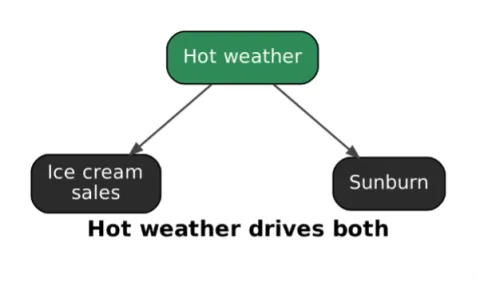
Figure 1. A DAG of ice-cream-and-sunburn
To find out whether ice cream really causes sunburn, you would need to compare days with the same weather. In the jargon, you would "control for" the weather. Hot weather is a confounder: something that drives both the thing you are studying and the outcome, and would mislead you if ignored.
The value of drawing a diagram like the one above is that every assumption is out in the open. An arrow is a claim about the world. It can be challenged, supported by documents, or argued over, which is the kind of dispute lawyers and tribunals are used to resolving.
Three kinds of control: one good, two bad
Now take a cartel case. The expert wants to estimate the effect of the cartel on price, and has three candidate controls.
Image

Figure 2. The dashed arrow is what we want to estimate: the effect of the cartel on price. Green is a good control, red is a bad one.
Steel prices (a confounder: control for it). Steel is an input whose price is set in a world market that the cartel did not influence. Say, that, in this example, it affects the defendants' prices, and the economic conditions behind it may also have affected when the cartel formed. Like hot weather in the ice cream example, leaving it out would lead to biased conclusions.
The defendants' own purchasing costs (a mediator: leave it out). Suppose the cartel also coordinated how its members bought inputs, and that this pushed up their costs and, in turn, prices. These costs sit on the path from the cartel to the price: they are part of how the cartel caused harm. If the expert controls for them, the model treats that part of the price increase as unrelated to the cartel, and the estimate misses it.
Market share (a collider: leave it out). When the cartel raised prices, some customers switched away, so the defendants' market share fell. Market share is a result of both the cartel and the price. Controlling for something caused by both creates a false link between them, which can bias the estimate of a real effect, or produce an apparent effect where there is none. A useful shorthand to summarise this is to ask the question: was this variable fixed before the cartel, or did the cartel (or the prices it caused) move it? If the cartel may have moved it, including it needs a justification.
This is not an argument for stripping models down. A variable that affects price but has nothing to do with the cartel, such as a cost that moves for unrelated reasons, does not bias the estimate and can make it more precise. What matters is having the right controls, not having fewer of them.
A worked example: the Commission's Guide, taken literally
The Commission's 2013 Practical Guide is a widely used reference for quantifying damages, and its regression section (paragraphs 69–81) is the closest thing to official guidance on choosing controls, which makes it a useful test case for our arguments.
Paragraph 69 describes regression as a way of separating the effect of the infringement from other variables "not affected by the infringement", and gives examples of these other variables: raw material costs, changes in customer demand, product characteristics and market concentration. A footnote adds more candidates: customer and order sizes, production technology, the size and cost structure of the firms, and advertising.
Paragraph 78 then states: "When undertaking a regression analysis, it is important to consider all variables that are relevant in the specific case." Footnote 76 warns against including "clearly irrelevant" variables, because they could wrongly lower damages, "even down to zero".
The Guide is not blind to the problem we describe. Paragraph 81 warns that if the explanatory variables were themselves affected by the infringement, "biased results may occur", and footnote 80 suggests the right fix. But these qualifications sit in subordinate clauses and technical caveats, and the Guide offers no way of telling whether a variable was affected.
The difficulty starts with the test the Guide implies. Footnote 76 warns against irrelevant variables, but in our view that puts the danger in the wrong place. Relevance is necessary for a good control, but it cannot tell a good control from a bad one. A variable with no effect on price makes the estimate less precise without biasing it. The variables that can bias an overcharge estimate are often highly relevant to price, sometimes precisely because the cartel affected them. A mediator, a collider and a variable driven by the price itself would all pass the question “does industry knowledge say this affects price?”, and all could improve the fit of the model.
This matters because many of the factors the Guide lists are things a cartel could have changed. Technology, firm size, cost structure, advertising and order sizes are decisions made by the defendants or their customers, and whether each is a legitimate control depends on timing and on how the cartel operated. Order sizes that reflect fixed characteristics of customers, such as their type or industry, can be a sensible control. If the cartel allocated customers or withdrew volume discounts, it will itself have changed order sizes. Firm size or market concentration measured before the cartel can capture differences between firms or markets that also affected prices. Measured during the cartel, the same variables partly reflect the cartel’s effect on entry, exit and market shares. Costs driven by input prices set in other markets, such as raw materials or energy, are usually good controls. Costs that rose because of coordinated purchasing, weaker pressure to be efficient or the lower volumes the cartel produced are part of the harm.
The question in each case is not whether a given factor matters for price, but whether the cartel could have moved it. The Guide’s own illustration contains a variable of exactly this kind. Paragraph 77 describes a regression for a flour cartel that controls for cereal prices, energy and labour costs, and for the introduction of a more efficient milling and packaging technology during the infringement period. Technology adopted during an infringement is the kind of variable a cartel could have influenced. In that example it may well have been unrelated to the cartel, but the Guide does not ask. Tabel 1 offers a short summary of when the Commission’s suggested variables are good or and when they are bad controls.
Table 1. The Commission's list of controls (good or bad?)
| Factor in the Guide | Bad control if… | Good control if… |
| Customer and order sizes | the cartel allocated customers or withdrew volume discounts, so it changed order sizes | it reflects fixed customer characteristics (type, industry) that pre-date the cartel |
| Production technology | the cartel weakened incentives to invest, or members standardised technology as part of the scheme | the technology was in place before the cartel |
| Size of the firms | it is measured during the cartel, when the cartel and customer reactions to it were shifting shares | it is measured before the cartel |
| Cost structure | the cartel raised costs (coordinated purchasing, less pressure to be efficient), or costs moved with the volumes the cartel reduced | it means input prices set in other markets (raw materials, energy) |
| Advertising | cartel members shifted competition into advertising, or set it in response to price and demand | rarely; only with an outside source of variation, such as an industry campaign decided before the cartel |
| Market concentration | it is measured during the cartel, when the cartel affected entry, exit and shares | it is measured before the cartel |
To see what including “all variables that are relevant” can do, in our paper we built a simulated market around the factors the Guide lists. The appeal of such a simulation is that we know the true overcharge.
The Guide does not say these factors are affected by the cartel, and in many real cases some of them will not be. For the simulation, we assume a structure in which several of them are. In our set-up, the size of the firms before the cartel is a genuine confounder, affecting both whether the firms collude and the price. We assume the cartel led the firms to adopt a different production technology, which in turn raised the price. Order sizes depend on the cartel and on customer demand, which the analyst cannot observe and which also affects price. Average cost depends on the cartel and on the price. Under different assumptions, some of these factors would be legitimate controls. The point of the exercise is that a relevance test cannot tell the two situations apart. The DAG in Figure 3 visualises these assumptions in a concise way.
Image
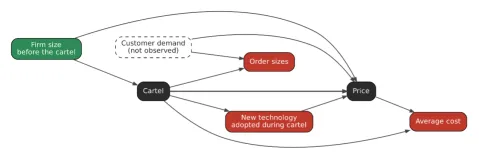
Figure 3. The Commission's "other factors" in one DAG. Only firm size before the cartel (green) is a legitimate control. The cartel changed technology; order sizes and average cost are results of both the cartel and price or demand.
Every one of these factors genuinely affects price, so all would pass a relevance test. The true overcharge is 1.2. Table 2 lists the estimates from our simulation, as well as the model fit when adding each of the variables shown in Figure 3.
Only the model with the one legitimate control recovers the true value. Adding technology strips out the part of the overcharge that worked through technology. Adding average cost alone more than halves the estimate. The model with every factor has the best fit and the least accurate estimate: 0.36 against a true 1.2. In this example, choosing a specification by fit would select the one furthest from the true value.
Table 2. Simulated overcharge and fit of the model
| What the model controls for | Estimated overcharge | Fit (R²) |
| Nothing | 1.44 | 0.54 |
| Firm size before the cartel (the right model) | 1.20 | 0.60 |
| + technology adopted during the cartel | 1.00 | 0.66 |
| + order sizes | 0.99 | 0.64 |
| + average cost | 0.56 | 0.73 |
| Everything on the list (paragraph 78 read literally) | 0.36 | 0.77 |
True overcharge = 1.2. Each "+" row adds that factor to firm size.
Some less obvious traps
The paper also discusses several less obvious ways in which a sensible-looking specification can go wrong. A common rule of thumb is that variables fixed before the cartel began are safe to include. This is usually true, but there are exceptions. Suppose the defendants were linked through a trade association before the cartel started, and that these links made collusion easier without affecting prices directly. If an unobserved factor, such as demand conditions, affects both the cartel and prices, controlling for the trade-association links can increase the bias from that unobserved factor. The fact that a variable pre-dates the cartel therefore makes it more likely to be safe, but does not guarantee it.
A similar problem arises with proxies. Experts often use a stand-in for something they cannot observe directly, for example using an economic activity index to capture demand. This is helpful only if the proxy was not itself affected by the cartel. A national GDP figure will usually be unaffected by a single cartel, but an index of the industry’s own output may not be. If the cartel restricted output, the index partly reflects the cartel and acts as a mediator rather than a proxy. One way to check is to see whether the variable shifts when the cartel starts or ends.
Finally, lagged prices raise a related issue. Because prices are persistent, dynamic specifications often include last year’s price as a control, and this usually improves the fit. During the cartel, however, last year’s price was already inflated by the cartel, and that inflation carries forward and accumulates. A model that controls for the lagged price attributes to the cartel only the new increase in each year. In our example the true cumulative overcharge is 2.5, while the model with the lagged price estimates 1.0. The expert can correct for this by converting the estimate into a long-run effect.
None of these problems need show up in the regression output. The estimate can be precise and the fit good. They become apparent only when one considers how each variable, and each choice of data, relates to the cartel.
What lawyers can ask
Our framework does not contradict the Guide. It makes its qualifications usable. We suggest reading paragraph 78 as "all variables that are relevant and not affected by the infringement", which is what paragraphs 69 and 81 already imply, and treating the footnote list as candidates rather than required controls. A lawyer working on the case does not need to be an econometrician to test an expert's choice of controls. But for each variable in the model, the expert should be able to answer three simple questions:
1. What problem does this control solve? What bias would leaving it out create, and in which direction?
2. Why does it both drive price and move with the cartel period? If it drives price but is unrelated to the cartel period, it is still useful because it sharpens the estimate. If it moves with the cartel period but doesn’t drive price, it adds nothing and can blur or distort the overcharge. Passing this question is not enough on its own; see question 3.
3. How do you know the cartel did not move it? Was it fixed before the cartel? Is it set outside the industry? If it changes when the cartel starts or ends, what outside cause explains that? Could the cartel have affected it directly, through output, capacity or allocation, or through the higher prices?
These questions apply both to a variable the expert left out and to one they put in. A useful practical step would be for experts to exchange DAGs, or agree a shared one, in their joint statement. That would not force them to agree. Instead, it would move the argument to "should there be an arrow from the cartel to this variable?", which documents, witness evidence and industry facts can help answer.
Final thoughts
None of this will make disagreement between experts go away. Two economists can look at the same market and draw different arrows, and that is often where the real dispute in a case lies. When that disagreement is argued in terms of fit and statistical significance, it cannot be resolved, because those statistics do not answer the causal question. A DAG puts the economic assumptions behind each control on the table, where the other side can challenge them and a tribunal can weigh them against the documents and other evidence.
The first draft of our paper, with the formal derivations and the simulations behind every example, is here. Comments and counter-examples are very welcome.
The views expressed are the authors' own and cannot be attributed to Compass Lexecon, its clients, or any other party the authors are affiliated with.
Comments (0)
Your email address will not be published.
Become a contributor!
Interested in contributing? Submit your proposal for a blog post now and become a part of our legal community!
Contact Editorial Guidelines



You may also like

November 23, 2026



November 18, 2026


November 13, 2026