The FSR 2.0: Less Red Tape, More Enforcement?
November 18, 2026
Almost three years after the start of its application, the EU's Foreign Subsidies Regulation (FSR) is entering its next phase. What began as a novel instrument to tackle distortions of competition caused by subsidies granted by third countries has quickly become an important consideration for mergers, public procurement and overall business activities across the internal market. Yet, the FSR has also become known for something else: extensive reporting obligations, complex information-gathering exercises and substantial administrative burdens, often in cases that ultimately raise no substantive competition concerns.
We talked about these and many more issues at the conference The Foreign Subsidies Regulation three years on – Where are we now, and where are we heading? on 16 November 2026 in Brussels. For those of you who did not make it, here are my five cents.
My presentation focused on the findings of the independent Study on the Simplification and Review of the Foreign Subsidies Regulation, prepared by LE Europe, data+law and the University of Vienna (to which I contributed as a member of the research team) and the impact the study had on the European Commission's first FSR review, published on 14 July 2026. Important disclaimer: The views expressed in this post are personal and do not necessarily reflect those of the European Commission or the other study contributors.
Overall, the study provides an interesting perspective on the future of the FSR because it particularly brings together two different types of evidence: the practical experiences of stakeholders and the Commission's actual enforcement practice. What can we learn from these findings, which recommendations have been reflected in the Commission's reform agenda, and what might the FSR 2.0 look like from a competition law and policy perspective?
The post will show that for the next phase of the FSR, two developments could proceed simultaneously: less red tape through more targeted notification requirements, and more sophisticated substantive enforcement through increasingly developed theories of harm, balancing assessments, and judicial scrutiny.
Some Important Findings from the FSR Study
The external study commenced in June 2025 and ran for six months. It brought together economic and legal analysis in three research workstreams:
(1) Stakeholder surveys examining the practical application of the FSR, administrative burdens and opportunities for simplification;
(2) Comparative international legal research on foreign subsidy-control frameworks and relevant international developments; and
(3) Analysis of the Commission's enforcement practice in concentrations and public procurement.
The international comparison – section (2) – highlights the continued diversity of subsidy-control systems worldwide. The EU's comprehensive State aid-control framework remains distinctive, and international convergence towards comparable regulatory systems has been gradual. The study also found no observable change in third-country subsidy behaviour attributable to the FSR.
For the purposes of this post, however, the most interesting findings concern (1) the stakeholder surveys and (3) the analysis of actual enforcement cases. Also, just selected findings can be presented here. If you want more, you must read the ~200 pages after all. The following contains some original graphics from the study.
Stakeholder Surveys: Is the FSR Creating Too Much Red Tape?
First, the administrative burden is substantial.
Image
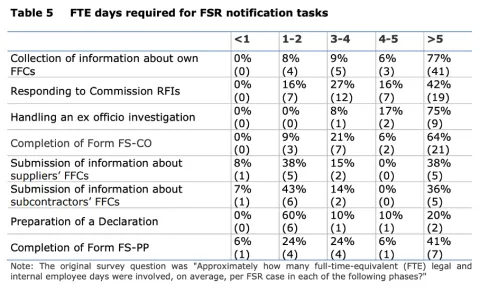
Of the respondents answering the relevant question, 77% reported spending more than five full-time-equivalent working days per case collecting information on their own foreign financial contributions (FFCs). Moreover, 72% considered the broad definition of FFCs an extremely significant challenge.
Image
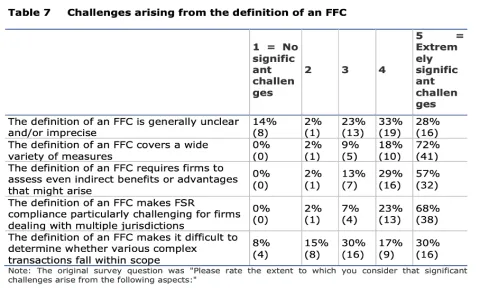
Some personal opinion here. On the one hand, this is hardly surprising. The FSR's definition of a financial contribution is considerably broader than the notion of a foreign subsidy. Businesses must therefore identify and collect information on contributions that may ultimately neither confer a benefit nor distort competition. The distinction between financial contributions and subsidies makes sense from a substantive legal perspective. However, it can, apparently, create significant difficulties at the notification stage, where companies must gather information across complex corporate groups and multiple jurisdictions.
On the other hand, one wonders how a multinational company can be run successfully without knowing where its income, resources and benefits are coming from. Admittedly, this may partly be an accounting or bookkeeping issue, and certain FFC matters, particularly around taxation, can be difficult to untangle. But given all the geopolitical tensions out there, the companies complaining about the red tape might ultimately thank the Commission for having forced them to get a better overview of their own business and possible unwanted dependencies.
Image
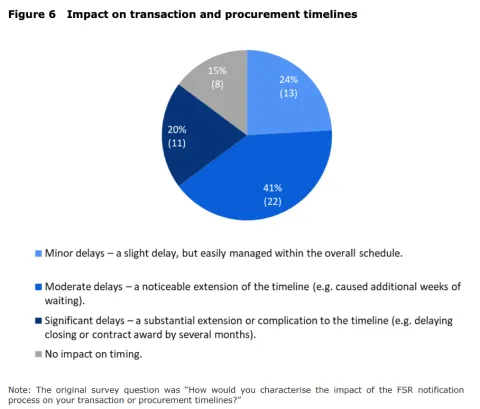
Still, the consequences go beyond administrative costs: 85% of respondents reported delays associated with FSR notification requirements, ranging from relatively minor delays to postponements of several months. As I will show later, timelines, however, have been going down and the information-gathering heavy stage of FSR enforcement might be over soon.
Second, practitioners consider the notification thresholds insufficiently targeted.
Image
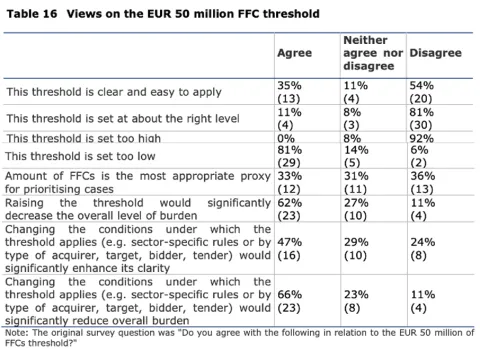
Among merger practitioners, 81% considered the €50 million FFC notification threshold too low. A similar concern emerged in public procurement, where 68% considered the €4 million FFC threshold too low.
Image
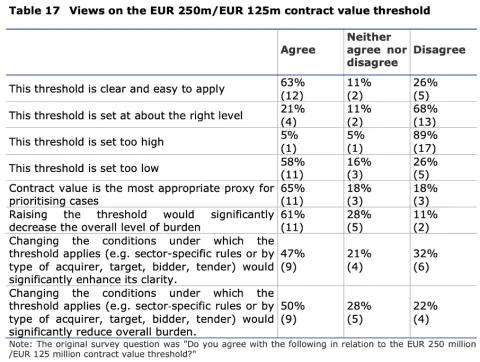
Interestingly, the €500 million EU turnover threshold for concentrations was generally considered appropriate. This suggests that stakeholders' principal concern was not necessarily the size of the transactions subject to review, but the broad scope of FFCs triggering notification obligations.
Third, and consequently, there is considerable support for concrete simplification measures.
For concentrations, 97% of responding merger practitioners supported introducing a simplified Short Form FS-CO, comparable to simplified notifications under EU merger control. For public procurement, 95% supported the introduction of annual declarations for regular bidders, including respondents favouring such a mechanism subject to conditions.
The overall message is clear: stakeholders do not necessarily reject the objectives of the FSR. Rather, they question whether its current reporting obligations are sufficiently proportionate to the risks addressed.
Enforcement Practice: Do the Notifications Translate into Substantive Competition Concerns?
This leads directly to the more interesting question: Does the Commission's actual case practice support these concerns?
The study's analysis of enforcement cases offers a particularly valuable counterpoint to the stakeholder surveys. For concentrations, the research examined a sample of 90 cases from a population of 149, alongside a separate in-depth case study. For public procurement, the analysis covered 2,503 filings at dataset level, together with detailed examinations of ordinary cases and investigation decisions. The findings are revealing.
First, timelines are going down.
Image
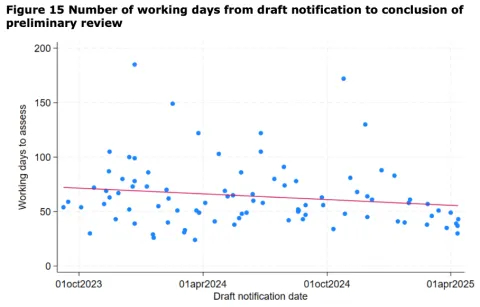
The median period between draft notification and the conclusion of preliminary review decreased from 61 to 49 working days across the periods examined. This improvement was largely attributable to a reduction in median pre-notification time from 36 to 24 working days. That is a reduction of approximately one-third in pre-notification duration. This suggests a learning process on the part of the Commission, notifying and third parties or rather: everybody involved. Nevertheless, pre-notification continues to account for a substantial part of the overall review timeline.
Second, adjusting notification thresholds could considerably reduce filing volumes.
Image
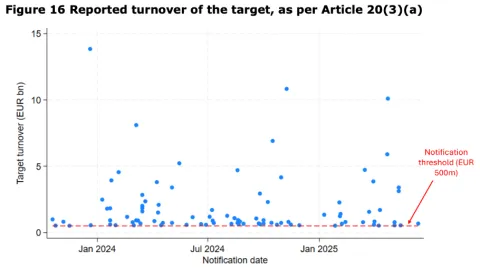
A significant proportion of notified cases were close to the €500m EU turnover threshold or the €250m procurement value threshold. The study estimates that increasing the EU turnover threshold for concentrations from €500 million to €600m would reduce notifications by 16%, while raising it to €750m would reduce notifications by 36%. A comparable exercise for public procurement suggests that increasing the contract-value threshold from €250 million to €500 million could reduce filings by approximately 41% among cases with usable contract-value information.
Image
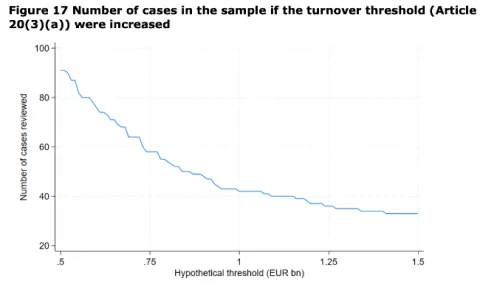
These are hypothetical, sample-based calculations rather than forecasts. In particular, a reduction in notification volumes must be assessed against the risk of missing potentially distortive foreign subsidies. Nevertheless, they demonstrate that threshold adjustments could have a substantial impact on administrative burdens.
This also creates an interesting contrast with the stakeholder surveys: although practitioners were relatively comfortable with the existing merger turnover threshold, the case-based evidence suggests that raising this threshold might offer significant simplification potential.
Third, the substantive assessments themselves reveal a considerable gap between reported financial contributions and actual foreign subsidies or distortions.
While we have learned more meantime from the cases that were published after the study period, such as ADNOC/Covestro, Lisbon Metro or JD.com/CECONOMY, some findings of early enforcement to highlight.
One particularly striking finding concerns investment funds. In 27 merger cases, capital commitments were identified as potentially falling within Article 5(1)(d) FSR, concerning subsidies directly facilitating an acquisition. However, the relevant commitments were found to have been made on market-equivalent (pari passu) terms and therefore did not confer a benefit. In other words, none of these 27 cases involved capital commitments that ultimately qualified as foreign subsidies.
Similarly, in the 90-case merger sample, fewer than five cases required a substantive distortion assessment under Article 4 FSR. These findings must be interpreted carefully. The sample did not include the separately analysed e&/PPF in-depth investigation, in which the Commission identified distortive foreign subsidies. Moreover, the absence of a distortion finding does not necessarily mean that the underlying notification was unnecessary.
Nevertheless, the results demonstrate the importance of distinguishing between three separate concepts: a foreign financial contribution, a foreign subsidy and a distortion of competition. Not every financial contribution is a subsidy, and not every subsidy distorts competition. This is particularly relevant for the treatment of investment funds, where information requirements may extend to other funds or portfolio companies even where the relevant contributions cannot benefit the acquiring entity. The study consequently identifies opportunities to make reporting more proportionate and to clarify the relationship between financial contributions and the transaction under assessment.
For public procurement, the picture is somewhat different. Of the 2,503 filings examined, approximately 84% were declarations rather than notifications. Only three cases had proceeded to in-depth investigations during the period studied, and all three bidders withdrew from the procurement procedures. The substantive analysis of the procurement cases also highlights how the Commission examines the relationship between potentially distortive subsidies and the ability to submit an unduly advantageous tender. In some cases, potential subsidy amounts exceeded the relevant bid value by more than 4.5 times. The Commission considered the size and nature of potential subsidies alongside bid prices, competing offers and possible intra-group financing. Here, too, the analysis suggests that the FSR's substantive assessment is considerably more nuanced than the mere existence of foreign financial contributions.
Suggestions
Taken together, the findings point towards several areas for improvement.
The first suggestion of the study relates to more targeted FFC reporting. Reporting obligations could be narrowed for contributions unlikely to raise substantive concerns, particularly in the context of investment funds and financial contributions that cannot benefit the acquiring entity.
The second concerns notification thresholds. Both stakeholder feedback and case-based simulations support reconsidering the existing thresholds, although the precise approach differs between mergers and public procurement.
Third, procedures could be simplified. This includes simplified merger notifications, less repetitive public procurement declarations and more efficient pre-notification processes.
Fourth, the study identifies opportunities for greater legal certainty in substantive assessments. In particular, questions surrounding the relationship between financial contributions and transactions, the treatment of tax measures and the most efficient sequence of assessment steps deserve further clarification.
Finally, the stakeholder surveys suggest that shortening the three-year look-back period could substantially reduce information-gathering burdens.
The common objective is not to weaken the substantive reach of the FSR, but to concentrate administrative resources on cases that genuinely merit closer scrutiny.
The Commission's July 2026 Review: Towards an FSR 2.0?
How much of this was taken up by the Commission? The short answer is: quite a lot!
The accompanying press release to the July 2026 Report outlines a range of potential adjustments, several of which closely reflect the study's findings.
The early Commission proposals include:
Image
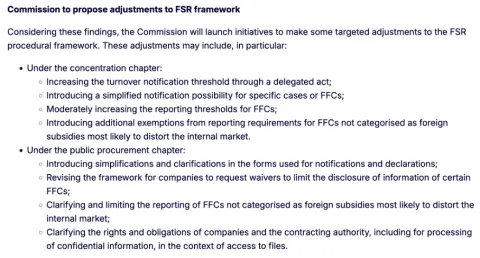
(see Press Release IP/26/1606)
This can be compared with the study recommendations:
| Study recommendation | Commission Report + Press Release | Assessment |
| 1. Target FFC reporting: Exempt low-risk FFCs, particularly for investment funds. | Considers exemptions for low-risk FFCs and reduced procurement reporting. | Strong alignment |
| 2. Raise thresholds: Increase FFC, merger turnover and procurement contract-value thresholds. | Considers higher merger turnover and FFC reporting thresholds, but not other thresholds. | Partial alignment |
| 3. Shorten look-back period: Reduce from three years to one. | Not mentioned. | Not addressed |
| 4. Simplify procedures: Streamline merger notifications, procurement declarations and substantive assessments. | Considers simpler notifications and forms, but not all proposed measures. | Partial alignment |
| 5. Improve legal certainty: Clarify FFC definitions, transaction links and distortion assessments. | Supports procedural clarification and substantive guidance, but not all specific proposals. | Partial alignment |
For concentrations, the Commission announced that it would explore increasing the €500 million EU turnover threshold, introducing simplified notification possibilities, moderately raising FFC reporting thresholds and providing further reporting exemptions for lower-risk FFCs.
For public procurement, possible adjustments include simplified notification and declaration forms, improved waiver procedures and narrower reporting requirements.
There is therefore considerable alignment with the study's overall direction.
At the same time, several specific recommendations have not been expressly endorsed.
In particular, the Commission did not announce an increase in the €50 million merger or €4 million procurement FFC notification thresholds. Nor did it specifically propose increasing the €250 million procurement contract-value threshold, shortening the three-year look-back period to one year or introducing annual procurement declarations.
The distinction between notification and reporting thresholds is particularly important here: raising the threshold for information that must be reported does not necessarily reduce the number of transactions subject to mandatory notification.
The Commission's July announcement envisaged further consultation and targeted adjustments later in 2027. The measures outlined at that stage were possibilities under consideration, not adopted reforms. The direction nevertheless seems clear: less emphasis on collecting every conceivable financial contribution, and more emphasis on identifying those that may actually distort competition.
The Commission’s proposals together with a public consultation are expected to be published in the next couple of weeks – an FSR Christmas present!
Looking into the Crystal Ball
But what does this mean for the future development of FSR law? From a competition law and policy perspective, I envisage several particularly interesting developments ahead.
First, we might see more sophisticated theories of harm.
The FSR's early substantive enforcement has been strongly influenced by concerns about unlimited state guarantees and the financial advantages they may provide.
The e&/PPF decision already demonstrated that the Commission distinguishes between distortions in the acquisition process and distortions arising after the acquisition.
This distinction will become increasingly important, also later in the guidelines and further already mentioned case law. A foreign subsidy may not affect the purchase price or the acquisition itself but may nevertheless strengthen the competitive position of the combined entity after the transaction.
As the FSR matures, we can expect more elaborate theories of harm (have a look at the paper by Claici et al. and also from us Hornkohl/Mattiolo) and more detailed assessments of the relationship between foreign subsidies and competitive advantages. Indeed, recent developments already point in this direction. The Commission's November 2026 conditional approval of JD.com's acquisition of CECONOMY and the publication of the Lisbon Metro procurement decision provide further insight into how different types of financial support, including grants, preferential financing and tax measures, may be assessed. The interesting question is how the Commission will develop coherent and predictable theories of distortion beyond the relatively straightforward cases involving unlimited guarantees.
Second, we are likely to see the first applications of the balancing test.
Another crucial issue is the balancing test under Article 6 FSR. As previously discussed on this blog (here and here) the balancing test allows the Commission to weigh the negative effects of a foreign subsidy against its positive effects.
This raises fundamental questions. Which positive effects should be considered? How should they be quantified? What weight should be attached to broader EU policy objectives? And how much discretion should the Commission enjoy?
The Commission's January 2026 FSR Guidelines provide further clarification, but the practical application of the balancing test remains an area where substantive case law will be particularly valuable. The balancing test could ultimately become one of the FSR's most distinctive features, particularly where competition concerns intersect with industrial or other policy objectives.
Third, we will further learn how much State aid and competition law is in the FSR.
A third question concerns the legal nature of the FSR itself. The Regulation to some degree borrows from concepts familiar to EU State aid and competition law: benefit, specificity, competitive advantage and distortion. However, the FSR is not simply EU State aid law applied to third-country subsidies. Its objectives, institutional structure and legal context differ significantly. Nor can the traditional competition law assessment of market conduct necessarily be transferred directly to foreign financial support.
Future enforcement and judicial review will therefore have to clarify the relationship between existing doctrines and the FSR's autonomous legal framework. This is particularly important for the interpretation of benefit and selectivity, the causal relationship between subsidies and distortions, and the standard of proof required to establish competitive harm. Will the FSR increasingly resemble an extension of established EU competition and State aid principles? Or will a genuinely distinct body of FSR doctrine emerge? Most likely, we will see elements of both.
Fourth, is there potential for more ex officio enforcement and call-in powers?
The simplification endeavours discussed above may also change the balance between mandatory notifications and other enforcement tools. If fewer transactions require notification, the Commission may increasingly rely on ex officio investigations and its powers to request notification of otherwise non-notifiable transactions or procurement procedures. This would allow the Commission to maintain scrutiny of potentially distortive subsidies while reducing routine administrative requirements.
The key challenge will be ensuring that businesses benefit from greater procedural proportionality without facing excessive uncertainty about potential intervention outside the ordinary notification framework. In other words, less mandatory reporting does not necessarily mean less enforcement.
Fifth, and finally: is there room for more private enforcement?
One of my pet projects is highlighting the potential role of the FSR before national courts. Although the Commission has central responsibility for investigating foreign subsidies and determining whether they distort the internal market, this does not mean that national courts have no role in enforcing FSR-related obligations.
An interesting first example is the Belgian Council of State's judgment of 31 August 2026, concerning the award of a casino concession in Brussels. The case involved a challenge by an unsuccessful bidder that had complied with the FSR's declaration requirements. The contracting authority had awarded the concession despite failures to comply with the applicable FSR notification or declaration obligations.
In its judgment, the Council of State emphasised that the relevant requirements under Articles 28 and 29 FSR apply directly to procurement procedures within their scope. In particular, contracting authorities must ensure compliance with the applicable notification or declaration requirements and transmit the relevant documents to the Commission. Where missing documents are not remedied in accordance with the applicable procedure, the tender must be rejected as irregular. The Council of State suspended the award decision because the contracting authority had failed to comply with its FSR obligations.
Importantly, the judgment did not involve a national court independently determining whether a foreign subsidy distorted competition. Rather, it concerned the consequences of failing to comply with directly applicable FSR procedural requirements. Nevertheless, it demonstrates that the FSR may already have important consequences in litigation between private parties before national courts.
This raises further questions about the potential development of private enforcement, the role of competitors in challenging FSR-related non-compliance and the relationship between national courts and the Commission's exclusive competence to assess distortive foreign subsidies (see for an in-depth discussion here). For competition lawyers, this could become one of the most interesting areas of future FSR development.
Comments (0)
Your email address will not be published.
Become a contributor!
Interested in contributing? Submit your proposal for a blog post now and become a part of our legal community!
Contact Editorial Guidelines


You may also like


November 13, 2026


November 11, 2026