


The Predictive Path of Justice: Can Prediction Markets Solve the Arbitration Efficiency Crisis?
May 12, 2026
What if a commercial dispute that would typically take years and cost millions of dollars could be resolved in days, not by a tribunal, but by a prediction market? International arbitration is facing an efficiency crisis as costs are rising and timelines are stretching.
The solution may not lie in yet another procedural reform, but in a mechanism borrowed from finance and forecasting: prediction markets. This post explores how aggregating the judgment of incentivized experts into a market price could transform dispute resolution — and what that means for the future of international arbitration.
From Sports Betting to Legal Insight
To the uninitiated, prediction markets may call to mind consumer platforms such as Polymarket or Kalshi, where anyone can place a bet on the outcome of political or sporting events. These apps have recently attracted significant public scrutiny for their potential to incentivize harmful behavior or distort public discourse. But the underlying mechanism, when properly designed, is neither frivolous nor speculative. It is a serious tool for aggregating information, and arbitration offers a compelling use case for it.
The core idea, first proposed in the 1990s by economist Robin Hanson, is straightforward. When people with relevant knowledge are given a financial incentive to be right, their collective judgment tends to be more accurate than that of any individual expert. This is not the "wisdom of the crowd" in the naïve sense of averaging opinions — it is a competitive process in which those with better information or sharper analytical skills profit at the expense of those without. Because participants have real money on the line, researchers have found that prediction markets consistently outperform surveys and expert panels across a wide range of domains.
In practice, companies such as Google have used internal prediction markets to forecast product launch deadlines and user adoption targets, with results that outperformed the estimates of individual experts. In legal settings, FantasySCOTUS (originally conceived as a game) demonstrated that aggregated predictions by legal professionals can closely approximate the actual decisions of the US Supreme Court.
Unlike sports betting, prediction markets are not a zero-sum game. Even though some traders will lose, there is a net gain for society — the information produced during the process is useful for decision-making by parties not trading in the market. If this mechanism can accurately price the probability of a Supreme Court ruling or a regulatory change, could a version of it be applied to the outcomes of international arbitration?
A Prediction Market-Based Arbitration Mechanism
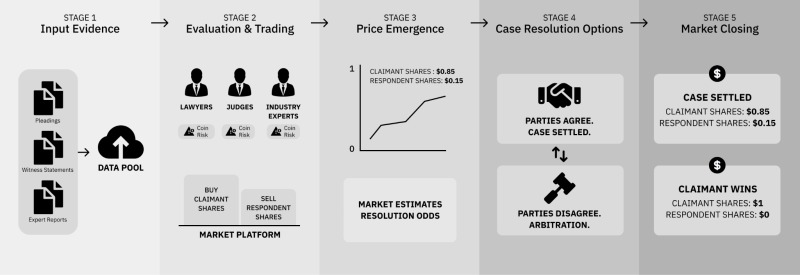
In a traditional arbitration, only the parties, their counsel, and the tribunal have access to the evidence. The model proposed here opens that process to a wider pool of independent evaluators (practicing lawyers, retired judges, and industry experts) who assess the case and express their view through a simple mechanism — they buy shares tied to the outcome they believe is most likely.
Each evaluator chooses between two positions: “Claimant Shares” or “Respondent Shares”, analogous to backing one of two companies based on their expected performance. If they believe the Respondent has a strong defense, they buy Respondent Shares, which will pay off should the Respondent prevail. As more experts trade, a consensus price emerges. If Claimant Shares trade at $0.85, the market signals 85% collective confidence that the Claimant will win.
The most immediate practical benefit is settlement. The central obstacle to early resolution is usually that both sides believe they will win. A neutral market price cuts through that ambiguity, giving both parties a credible reference point and reducing the incentive to spend years reaching the same conclusion through formal proceedings.
The payout structure keeps evaluators honest. If the case settles, participants are rewarded in proportion to their position — the earlier and more accurately they called it, the greater the return. If the case proceeds to arbitration, the final award determines everything. Claimant Shares pay out at full value ($1) while Respondent Shares expire worthless ($0). There is no reward for following the crowd.
Now, arbitration specialists may notice that this is not an entirely new idea. Third-party litigation funders have been doing something structurally similar for decades — analyzing cases, estimating outcomes, and putting capital behind their predictions. The difference is that a prediction market makes this process transparent, competitive, and accessible to more people, not just to well-capitalized funders with proprietary models.
Of course, critics will point to confidentiality, as opening a prediction market around a dispute raises legitimate concerns about the exposure of sensitive information. But the solution lies in controlled access. Unlike public prediction markets, an arbitration-specific platform would be restricted to a verified pool of accredited legal professionals, bound by NDAs and whose participation is recorded on a blockchain for accountability.
Image
When AI Agents Meet Prediction Markets
A practical challenge for specialized prediction markets is attracting enough participants to produce a reliable price signal. A major event like an election draws millions of traders; a niche commercial dispute may draw only a handful. This problem can now be solved through AI. Rather than personally reviewing every case, a retired judge or senior arbitration counsel could train a digital assistant on their legal reasoning and track record, one that analyzes new cases and trades autonomously on their behalf, allowing a single expert to participate in dozens of cases at once through their “agentic associates”.
One might ask: if AI agents are doing the trading, does the logic of having real money on the line still hold? And why not just use an AI model to make the assessment? The answer lies in what the market mechanism adds. Empirical research has shown that different AI models frequently reach opposite conclusions on the same legal case. No single model has a monopoly on legal judgment. A market of competing agents, each built on different data and trained by different experts, produces a result that is more robust than any individual output, for the same reason that a panel or a jury tends to outperform a single decision-maker. Diversity of perspective reduces blind spots and produces more balanced conclusions.
And crucially, when an agent misjudges a case, it loses real money belonging to its owner, creating a direct incentive to review and refine how it reasons.
The practical result is significant. A party could obtain a preliminary assessment drawing on the equivalent of multiple expert opinions in minutes, at a fraction of the cost of traditional legal advice. Prediction markets thus represent one of several emerging dispute assessment tools entering the arbitration toolkit (alongside institution-led mechanisms such as the SCC Express and the AAA's AI Resolution Simulator) but with a key difference. Rather than relying on a single neutral or model, they aggregate the competitive, incentivized judgment of multiple independent evaluators.
A New Step in Arbitration’s “Predictive Turn”
In his 1897 work, The Path of the Law, Justice Oliver Wendell Holmes wrote: "The prophecies of what the courts will do in fact, and nothing more pretentious, are what I mean by the law."
The legal industry has been applying that logic with technology for decades. Since the late 2000s, platforms such as Premonition have used AI to analyze historical decisions and estimate the likely outcome of cases, giving lawyers a data-driven foundation for advice that once depended entirely on experience and intuition. Prediction markets are the next step in that story. But where AI looks backward, extrapolating from past data, prediction markets aggregate the live judgment of multiple evaluators, each with a financial stake in being right and subject to the kind of adversarial scrutiny no single model can replicate.
International arbitration is facing a legitimacy problem that procedural reform alone has struggled to solve. Critics have long argued that the system has drifted from the flexible, efficient alternative it was designed to be. For some parties, the consequences are concrete, as the cost of pursuing a legitimate claim often exceeds what winning it would be worth.
Prediction markets will not solve every problem in that picture. They are unlikely to be the right tool for disputes that turn on novel points of law, constitutional interpretation, or questions where reasonable experts simply disagree on principle.
But for the broad category of commercial disputes that come down to how a tribunal would read a contract or weigh evidence, they complement the emerging toolkit with something distinctive: a fast, affordable assessment generated not top-down by an institution, but through the competitive judgment of multiple incentivized evaluators.
What that looks like in practice is still to be written — a pre-filing stress-test for counsel, a settlement catalyst, a due diligence tool for third-party funders, a pathway for smaller claims that today never get pursued. The answer is probably all of the above, and others we have not yet thought of. What seems clear is that prediction markets are a new layer of intelligence that could make arbitration faster, cheaper, and more accessible, as part of a broader predictive turn already reshaping how the legal industry thinks about risk, evidence, and judgment.
Federico Ast is the founder and CEO of Kleros, a decentralized dispute resolution platform whose technology is also used for prediction markets.
Comments (0)
Your email address will not be published.





You may also like


September 24, 2026


September 22, 2026


September 20, 2026