The Contents of Revista Română de Arbitraj, Volume 19, Issue 4 (2025)
May 2, 2026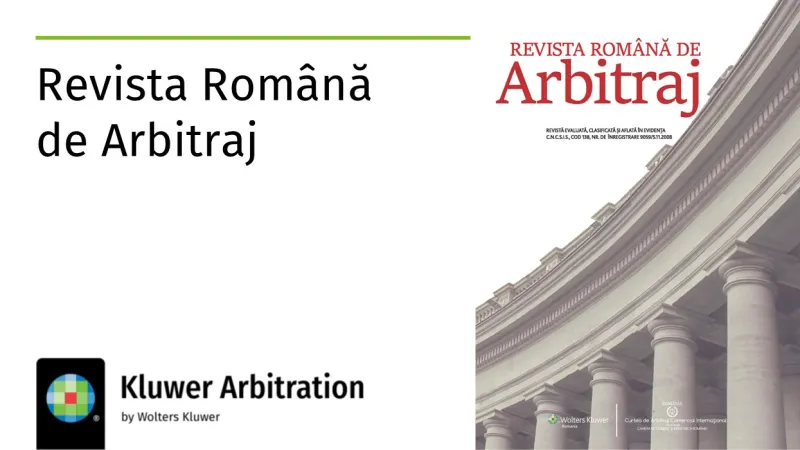
Wrapping up the latest developments for the past trimester of 2025, we note the announcement coming from ICSID (International Centre for Settlement of Investment Disputes) on 17 October 20201 on its 2025 Annual Report,2 offering a comprehensive overview of the Centre’s activities during the fiscal year 2025 (FY2025), which covered the period from 1 July 2024 to 30 June 2025. The year 2025, the year of the 60 th anniversary of the ICSID Convention, records the highest number of registered proceedings during a single fiscal year (109, including new cases and post-award remedies), the highest number of administered cases in a fiscal year (347), and the second highest number of concluded cases in a fiscal year (81). The largest share of cases registered in FY2025 involved States in Sub Saharan Africa (24%), followed by States in Central America and the Caribbean (19%), South America (18%), Eastern Europe and Central Asia (12%), Western Europe (9%), North America (7%), South and East Asia and the Pacific (6%), and the Middle East and North Africa (5%).3 87% of ICSID registered cases were brought by juridical entities, 9% by individuals, 3% by a combination of individuals and juridical entities, and 1% involved a conciliation proceeding brought by a State.4 As to industries involved, 43% of new cases involved the oil, gas, and mining (majority of 19 cases) industries. The construction sector 15% of disputes, electric power and other energy sources 12%. Cases related to the information and communication sector accounted for 8%, the finance sector represented 5%, the transportation sector represented 3% of newly registered cases, and 1% of cases concerned the services and trade sector.5 In regard to diversity of arbitrator appointments, individuals of 48 nationalities were represented, with the largest percentage of 39% being from Western Europe, 22% from South America while having Eastern Europe and Central Asia being represented only in 1% of appointments,6 with women accounting for 30% of all appointments made in ICSID cases in FY2025.7 In FY2025, 51% of the disputes decided by ICSID tribunals resulted in no damages being awarded to the investor (e.g., due to dismissal of claims on jurisdictional grounds, findings of no liability, or liability without damages). In 15% of cases, damages awarded ranged from USD 10 million to USD 49 million, while in 12% of cases, damages awarded ranged from USD 100 million to USD 499 million. In 10% of cases, damages awarded were under USD 10 million, and another 10% of cases saw awards between USD 50 million and USD 99 million. Two percent of cases resulted in damages awarded between USD 500 million and USD 999 million.8
The SCC Arbitration Institute issued on 20 October 20259 an informative Report on Settlements in cases administered under the SCC Rules with an analysis of settlement patterns in arbitrations conducted under the SCC Arbitration Rules and the SCC Expedited Arbitration Rules between 2021 and 2023.10 It indicates that 16.1% of all proceedings administered under the SCC Rules during the examined period were concluded through confirmed settlement, with more than one in six arbitrations ending in settlement, with a significantly higher rate in proceedings under the SCC Arbitration Rules (18.5%) compared to cases administered under the SCC Expedited Arbitration Rules (11.5%). Parties that settled cut their dispute resolution process short by an average of 8.3 months (48.5%) under the SCC Arbitration Rules, effectively halving the duration of their dispute resolution process. As to the origin of parties, this Report registered UK with the highest settlement rate, as six of 20 parties agreed on a settlement (30%), followed by Finland (26.3%), Norway (21.4%), Denmark (14.3%), and Poland (11.8%). It also reveals settlement patterns and the optimal time for negotiation, with the highest settlement rates occurring immediately before referral of the case to the Arbitral Tribunal or after the conclusion of the phase of written submissions and finding that no settlements were observed once the parties had participated in the hearing on the merits. One other conclusion is that the amount in dispute did not affect the likelihood of settlement.
The SCC Arbitration Institute released its traditional Practice Note on the SCC Board decisions on challenges to arbitrators 2020 – 2024 on 11 November 2025,11 showcasing the legal standard that applies to challenges to arbitrators in cases administered by the SCC, comments on the statistics on challenges, summarising the decisions on challenges based on the arbitrator’s alleged relationship with a party, counsel, and/or others involved in the arbitration and also based on the arbitrator’s conduct during the arbitral proceedings or based on alleged breaches of confidentiality/political statements, arbitrator’s nationality/qualifications whilst including conclusions on challenge decisions.
On 25 November 2025, the SCC Arbitration Institute followed with a SCC Guide to Dispute Resolution: Institutional arbitration vs. ad hoc arbitration. It defines the different types of arbitration, shows key differences covering procedural frameworks, administrative support, costs, arbitrator selection, and quality control, emphasising the advantages and disadvantages of each arbitration form and introduces a hybrid solution that combines ad hoc arbitration with institutional support.12
On 31 October 2025, the IBA Arbitration Committee through its IBA Arb40 Subcommittee launched an excellent report on Emergency arbitration: A practical guide for young arbitration practitioners13 with practical guidelines and comparative insights, one of its main features being the design and circulation of a detailed questionnaire to arbitral institutions, aimed at gathering empirical data on emergency arbitration.
The American Arbitration Association–International Centre for Dispute Resolution (AAA-ICDR) was particularly active these past three months: after having announced in September14 that it will release an AI arbitrator for AAA-ICDR construction cases (more than 1,500) and calibrated and trained with human arbitrator input, they succeeded launching it on 5 November 2025 stating that “The AI Arbitrator blends cutting-edge AI-powered technology with time-tested judgment to help parties transform how disputes are handled. With technology grounded in expertise, fairness, and reliability, we’re keeping humans in the loop with user validation capabilities.”15 AAA-ICDR also integrated what they call “ClauseBuilder AI”, a platform that helps draft arbitration and mediation clauses,16 and published on 6 December 2025 a Report on AI “The Dispute Revolution: How AI is Rewriting the Rules of ADR”17 based on the Future Dispute Resolution (FDR) Conference series in New York and detailing answers to questions such as: “What does responsible adoption of AI look like? How can AI accelerate outcomes without eroding trust? And what safeguards ensure that innovation remains grounded in neutrality, transparency, and human judgment?”.18
The ILCI (International Law Compliance Institute) published the latest 2025 edition for the Report on Compliance with Investment Treaty Arbitration Awards 2025 (4th edition).19 Among its findings we quote: (i) the total number of known treaty-based ISDS arbitrations increased until the end of 2024 to 1,401 of which 1,050 have been concluded, 326 are still pending and for 25 cases the status is unknown with 2,625 IIAs being in force in total, at the end of 2024; (ii) of the concluded cases, 38% were decided in favour of Respondents, 28,7% in favour of investors, 17,3% were settled, 13,5% were discontinued, and 2,5% were decided in favour of neither party; (iii) regarding intra-EU BITS/ECT Awards, it has been confirmed again by multiple court decisions that enforcement of intra-EU Awards within the EU is almost impossible now, whereas enforcement outside the EU, in particular, in the US, UK, Australia and Switzerland remains particularly successful; (iv) new emerging trend that is highlighted for the first time in this 2025 Compliance Report is the increasing number of disputes initiated against capital exporting EU Member States, such as Germany, the Netherlands, France and Belgium, and against non-EU countries such as Switzerland and the UK; (v) Spain remains number 1 in the world in terms of the number of unpaid Awards, together with Venezuela and ahead of Russia, whilst Romania has 1 (one) unpaid award amounting to USD 7.7 million, Poland 7 (seven) in total value of USD 686.8 million, the Czech Republic 2 (two) awards amounting to USD 415 million, Croatia 2 (two) awards totalling USD 201.5 million and Ukraine a number of 4 (four) awards in value of USD 142 million.
Early November saw an interesting legal development in Romania where a draft bill was submitted to the Romanian Senate to amend the Law on notary public activity aiming to promote arbitration as a quick and efficient alternative to the courts and to relieve the judicial system. Said draft provision would amend art. 80 of Law no. 36/1995 on notary public activity by establishing the obligation of notaries to inform the parties, before authentication of contracts, on the possibility of inserting an arbitration clause by which any disputes can be settled by arbitration, according to art. 550 of the Romanian Code of Civil Procedure. The notary will expressly mention in the contract the fulfilment of such obligation and, if the parties opt for arbitration, will communicate to them the institutions that organize institutionalized arbitration in the district of the court of appeal in which the said notary public has jurisdiction.20
Finally, on 12 December 2025, the Presidential Decree no. 1151/2025 on remitting to the Romanian Parliament the approval of Romania’s withdrawal from the Energy Charter Treaty (ECT) was published in the Romanian Official Gazette.
* * *
The Articles section of the last issue of the Romanian Arbitration Journal for 2025 unfolds with the topic of judicial responses in multiple jurisdictions to Russia’s “Lugovoy Law” (Article 248.1 of the Russian Arbitrazh Procedure Code), which purports to grant Russian courts exclusive jurisdiction over disputes affected by international sanctions, exemplifying case law from England, the United States, Germany, Hong Kong, and other jurisdictions and analysing how courts have resisted Russian parties’ attempts to displace agreed dispute resolution mechanisms in The “Lugovoy Law” Meets Public Policy Abroad: Do Forum Selection Clauses Prevail? written by U.S. and English-qualified lawyer, Rinat Gareev.
We continue with Statute of Limitations for Recognition and Enforcement of Foreign Arbitral Awards. (Part I) Conceptual Clarifications and Comparative Law Analysis, a long-awaited discussion in Romanian arbitration doctrine on the delimitation of the statute of limitation regime applicable to requests for recognition and enforcement of foreign arbitral awards, in the context of Romanian law and the relevant international rules coming from top international arbitration practitioner and academic, Dr Cosmin Vasile, FCIArb (Board member of Court of International Commercial Arbitration of the Chamber of Commerce and Industry of Romania) and litigation counsel, Teodora Nițu.
A study on limits to AI development and what are the most important technological and legal constraints for ADR and arbitration is offered by counsel, arbitrator, academic and President of the Hungarian Arbitration Association, Dr Richard Schmidt in Human Arbitrators Put on the Bench? The Use and Limitations of Artificial Intelligence (AI) in Arbitration.
An excellent dive into the Powers of Arbitrators to Sanction Legal Representatives Employing Guerrilla Tactics in International Commercial Arbitration, including a comparative focus on England, Guatemala, and the United States as well as the contribution of soft law instruments is brought to us by international lawyer specialized in investment and commercial disputes, Jesús Salvador Buchhalter Escobedo, LL.M. (LL.M. in International Commercial Arbitration from Stockholm University), supporting the notion of the “robust arbitrator” as one who exercises proactive procedural control and ensures that party consent to such instruments is clearly established.
We then travel to Italy and check out a recent decision coming from the Italian Court of Cassation of interest for corporate arbitration in Italy and read from international arbitration counsel and arbitrator admitted to the Milan and Madrid Bar, Patrizia Sangalli, FCIArb on the validity of such arbitration clauses in the paper titled Corporate Arbitration with a Foreign Seat under Italian Law.
Young Arbitration Practitioners’ Essays introduces a group of three articles stemming from an Oxford style debate that took place during the 2025 Bucharest Arbitration Days on The Duty of Technological Competence in International Investment Arbitration with an intro on existing scholarship, institutional guidance, and practice clarifying the meaning of “technological competence” and identifying the stakeholders to whom such a duty may apply from Solicitor-Advocate in England and Wales, and PhD in Law Candidate at the University of Cambridge, Helin Laufer followed by arguments in favour of such duty from Paris based counsel, Ruxandra Irina Eșanu and ICC Deputy counsel, Daniela-Olivia Ghicajanu alongside the final arguments that arbitrators are not currently subject to a mandatory legal duty of technological competence in investment arbitration since such a duty lacks doctrinal and treaty support, does not align with the structure of investment arbitration, and would have counterproductive effects as presented by independent counsel and arbitrator based in London, Mihaela Apostol, LL.M. together with Romanian counsel, Răzvan-Nicolae Banța.
Case and Law Review focuses on the Court of Justice of the European Union ruling that an arbitral award rendered by a Court of Arbitration for Sport arbitral tribunal, where the dispute concerns sport as an economic activity within the European Union, cannot be recognised as having res judicata or probative value in the EU unless it has been reviewed by a court of a Member State empowered to make preliminary references to the Court of Justice of the European Union with learned comments from Romanian based counsel and Court of Arbitration for Sport arbitrator, Dan Mihai alongside counsel Tudor Voinicu, LL.M. (LL.M. in International Arbitration, Faculty of Law, University of Bucharest) in Commentary on the CJEU Judgment of 1 August 2025, C-600/23, Royal Football Club Seraing v. FIFA, UEFA & URBSFA: Res Judicata, Sports Arbitration and EU Public Policy.
Events and Developments in International Arbitration opens with The Vienna International Arbitral Centre Celebrates its 50th anniversary – A Tradition of Progress, a detailed overview of selected highlights from VIAC’s calendar of festivities as well as of the 2025 amendments to the VIAC Rules of (Investment) Arbitration and Mediation 2021, alongside other notable achievements of the year, including the finalisation of the new edition of the VIAC Handbook and the launch of VIAC’s Best Practice Series with reflections on VIAC’s unwavering commitment to excellence and innovation from Vienna based counsel and arbitrator in commercial arbitration and investment disputes, Mag. Patrizia Netal together with Secretary General of the Vienna International Arbitral Centre (VIAC), Mag. Niamh Leinwather and VIAC CAN Coordinator, Vladyslava Donchyk.
An outlook on The Significance of the International Chamber of Commerce and Its Leading Think-Tank, the Institute of World Business Law in the Evolution of Arbitration Doctrine. The Role of the Compliance Task Force is featured by counsel and academic, Victor Hugo Guerra H., LL.M. (LL.M. from Harvard University) member of the Council of the ICC Institute of World Business Law and Global Chair of its Compliance Task Force.
- 1
See at official website https://icsid.worldbank.org/news-and-events/communiques/icsid-publishes-2025-annual-report-expanded-caseload-statistics.
- 2
See ICSID FY2025 Annual Report at https://openknowledge.worldbank.org/entities/publication/5638489d-498a-4cfc-aa8d-dbdc1a7be62a.
- 3
See ICSID FY2025 Report, p. 18.
- 4
See ICSID FY2025 Report, p. 19.
- 5
See ICSID FY2025 Report, p. 21.
- 6
See ICSID FY2025 Report, p. 23.
- 7
See ICSID FY2025 Report, p. 25.
- 8
See ICSID FY2025 Report, p. 27. These figures refer to the principal amount of damages and do not include interest, costs, or non-monetary relief.
- 9
- 10
Full SCC Report Settlements in cases administered under the SCC Rules co-authored by Jake Lowther, Raoul J. Sievers, and Joakim Raivio is available at https://sccarbitrationinstitute.se/wp-content/uploads/2025/10/Settlements-in-cases-administered-under-the-SCC-Rules-final.pdf.
- 11
See this SCC Practice Note authored by Yi Ting Sam and Raffaella Isepponi at https://sccarbitrationinstitute.se/en/resource-library/reports/scc-practice-note-scc-board-decisions-on-challenges-to-arbitrators-2020-2024/.
- 12
See SCC Guide at https://sccarbitrationinstitute.se/en/news/scc-guide-to-dispute-resolution-institutional-arbitration-vs-ad-hoc-arbitration/.
- 13
See official Report at https://www.ibanet.org/document?id=Emergency-arbitration-guide-2025.
- 14
See also Editorial in Romanian Arbitration Journal issue 3, 2025.
- 15
See at official website https://www.adr.org/ai-arbitrator/.
- 16
See at official website https://www.clausebuilder.org/.
- 17
See at https://www.adr.org/innovaation/.
- 18
See AAA-ICDR Report The Dispute Revolution: How AI is Rewriting the Rules of ADR, p. 3.
- 19
See full Report at official website https://internationallawcomplianceinstitute.org/the-2025-compliance-report-is-from-now-on-published/.
- 20
See this draft at https://www.senat.ro/legis/PDF/2025/25b544FG.pdf?nocache=true and https://www.senat.ro/legis/PDF/2025/25b544EM.pdf?nocache=true.
Comments (0)
Your email address will not be published.
You may also like
October 9, 2026