Why Does Comparative Labor Law Still Matter in Japan?
September 2, 2026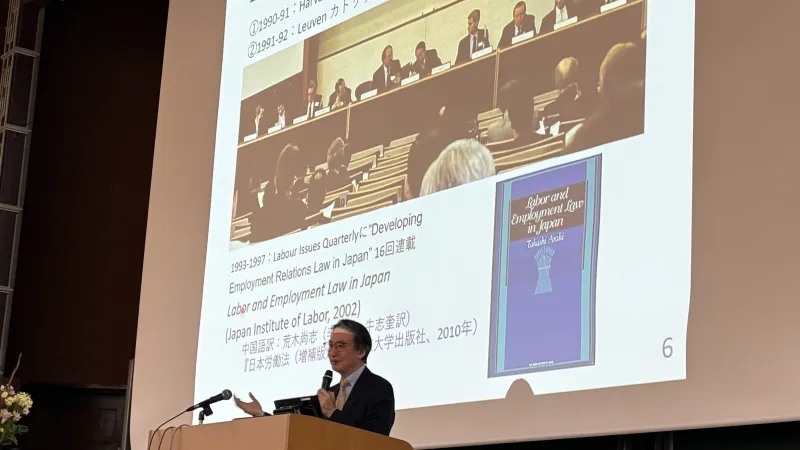
1. A National Honor and a Moment for Comparative Labor Law
In April 2026, Professor Emeritus Takashi Araki of the University of Tokyo received the Medal with Purple Ribbon, one of Japan’s highest honors awarded for distinguished achievements in academia, the arts, and sports.1 He is the first labor law scholar to receive this distinction in more than 40 years. The award recognizes Professor Araki’s outstanding contributions as well as his leadership in shaping Japanese labor law and policy through his comparative labor law research. Professor Araki’s career illustrates three enduring functions of comparative labor law in Japan: understanding Japanese law through foreign legal experience; informing domestic legislation and policy; and bringing Japanese legal experience into international scholarly debate. His award therefore provides an occasion not only to honor an individual scholar, but also to reconsider the significance of the scholarly tradition that his work represents.
Japan is not part of a regional integration project like the European Union, nor does it face the same practical need for legal harmonization. Therefore, one might expect comparative law to attract less attention in Japan. In this post, I will briefly examine the background of comparative law research in Japan and offer some reflections.
2. From Legal Reception to Policy Design: Why Japan Compares
Traditionally, it has been almost mandatory to conduct comparative law research in doctoral dissertations and similar scholarly work in the fields of substantive law in Japan, including labor law. Such research is expected not only to gain interpretive insights but also to derive legislative implications. As Professor Araki points out, there are two main reasons for the prevalence of comparative law research: historical factors and the necessity arising from the policy-making process.2
Historically, in the late 19th century, the introduction of Western legal systems became an urgent priority. It was necessary to revise the “unequal treaties” with Western powers, thereby abolishing consular jurisdiction. During this process, initially French law, then regarded as advanced, was used as a reference; later, German (Prussian) law, which was based on a monarchy, was consulted in the codification of laws. German and French law became decisive in shaping fundamental legal systems such as civil and criminal law. After World War II, under the influence of the General Headquarters, led mainly by the United States, Japan adopted the post-war Constitution and enacted core labor legislation, including the Labor Standards Act and the Labor Union Act. In particular, the latter introduced a system of unfair labor practices modeled after the Wagner Act, and thus collective labor law was heavily influenced by U.S. law. Japan’s current legal system has therefore been strongly influenced by German, French, and U.S. law. Against this backdrop, doctoral researchers in labor law often select one or two of these jurisdictions as points of comparison.
However, while historical context remains important, more than 80 years have passed since the end of World War II. Labor and employment practices in Japan differ substantially from those of the above-mentioned countries,3 and Japanese law has developed independently in its own distinctive way. The need to consult the original legal models might therefore appear to have diminished. Comparative legal research, nevertheless, remains important because it is necessary for the policy-making process.
In the typical legislative process for labor legislation, prior to deliberations in the Diet, proposals are discussed in a study group composed of academic experts organized by the Ministry of Health, Labor and Welfare, and then in the Labor Policy Council, a tripartite body composed of public-interest, labor, and management representatives.4 In study groups, labor experts such as labor law scholars discuss issues from a scholarly perspective, while the Labor Policy Council serves as a forum for balancing the interests of labor and management. Comparative legal insights are important at both stages. A recent example is the Study Group on Labor Standards Legislation, which issued its report in January 2025,5 discussing amendments to the Labor Standards Act and related laws. In its drafting process, developments in foreign laws and EU directives were considered when discussing topics such as the “right to disconnect,” the concept of worker, reforms to working hour regulations, and the worker representative system (although, as of now, these discussions have not yet led to legislative amendments). Furthermore, in discussions at the Labor Policy Council, labor and management representatives may at times “cherry-pick” foreign laws, ignoring the specific contexts in which those laws were enacted, to support their own arguments. In such cases, comparative legal insights grounded in an accurate understanding of the foreign legal system as a whole are important to ensure that the discussion is not shaped by misleading references to foreign law.
In fact, Professor Araki’s scholarship provides a concrete example. His comparative analysis of employment security and the legal rules governing changes to terms and conditions of employment helped shape the intellectual foundations of the Labor Contract Act enacted in 2007. He also served as a member both of the expert study group on labor contract legislation and of a subcommittee of the Labor Policy Council. His contribution thus extended from academic research to participation in both the expert and tripartite stages of the legislative process.
3. What Good Comparative Labor Law Requires
In Japan, research devoted exclusively to a foreign labor law system is sometimes undertaken as a necessary foundation for comparative research, since meaningful comparison presupposes an accurate understanding of the foreign law concerned. Comparative labor law research, in turn, is often conducted to derive insights from foreign law for the interpretation or legislative reform of Japanese labor law. This orientation reflects the broader mission of Japanese labor law scholarship: to improve the world of work.
Although the methodology of comparative labor law research has not been fully examined in a systematic way, there appears to be a shared understanding in Japan of what constitutes good and poor comparative research. Since the appropriate method depends on the research topic, a manual-style approach would be inappropriate. It is generally regarded as “poor” to uncritically mimic foreign law. By contrast, “good” comparative labor law research does not stop at a superficial comparison of rules and concepts directly related to the research topic. Rather, it also considers surrounding rules and concepts, analyzing how these elements are positioned and function within the foreign labor law system as a whole.6 Furthermore, depending on the research topic, it should incorporate analysis based on actual employment practices and labor market conditions. In other words, meaningful comparison requires a functional approach that examines how different legal systems address similar problems within their broader legal, institutional, and employment contexts.
Professor Araki has consistently emphasized the importance of such functional comparison and has applied this approach in his own scholarship.7 His comparative study, for example, analyzed dismissal protection and the legal rules governing changes to terms and conditions of employment not as separate issues, but as interrelated components of the broader institutional framework governing employment relations.
What has not been clearly articulated, however, is how such good comparative labor law research should be carried out in practice. Early career researchers often develop their methodology by reading papers or books on concrete topics in comparative labor law that are regarded as good comparative scholarship in Japanese academic circles. A systematic, meta-level analysis of existing comparative labor law scholarship may therefore merit consideration, both to identify recurring methodological approaches and to make the standards more explicit.
4. Beyond the West and Beyond One-Way Comparison
Given the historical reception of Western law, Japanese comparative law research has tended to focus on “learning” from the “West.” In addition to Germany, France, and the United States, jurisdictions such as the United Kingdom, Canada, Italy, the Netherlands, and Spain are also studied; nevertheless, Western legal systems remain the most frequently referenced. Belgium has also been relevant through academic exchanges, particularly with KU Leuven, where several Japanese labor law scholars have studied or taught. Despite the potential value of such research, particularly in light of Japan’s legal influence on some Asian jurisdictions, interest in the labor laws of Japan’s neighboring jurisdictions has remained relatively limited. Recently, however, there has been an increase in international student research from Asian jurisdictions that uses Korean, Taiwanese, and Chinese law as subjects of comparison, and Japanese researchers have also begun to select these jurisdictions as comparators. A related question is whether Japanese labor law scholarship has engaged more intensively with selected national legal systems than with international labor standards, such as ILO conventions.
Comparative labor law, however, need not be limited to what Japan can learn from foreign legal systems. Globalization, technological change, and demographic change increasingly expose countries to common challenges, including population aging and the regulation of artificial intelligence, while their responses may differ according to their legal traditions, institutions, cultures, and employment practices. Japan may therefore itself serve as a useful comparator. Japanese labor law has developed under the influence of both continental European and U.S. law, while operating in the context of distinctive employment practices. This combination may offer an interesting point of reference for examining how different legal systems respond to similar problems.
Good comparative research conducted in Japan often involves the functional comparison of multiple foreign legal systems. Such research may develop a theoretical framework and then apply it to Japanese law in order to examine a particular research question. Even when the question originates from Japanese law, the framework developed through this process may also prove useful for understanding the characteristics and challenges of other legal systems. Japanese comparative labor law may therefore contribute not only by presenting Japanese solutions, but also by offering analytical perspectives that can be applied beyond Japan.
For this to occur, however, Japanese law and Japanese comparative scholarship must be made accessible beyond the Japanese-speaking academic community. Their limited international dissemination in languages other than Japanese therefore remains a challenge.8Through his English-language scholarship, Professor Araki has both used foreign legal systems to analyze Japanese law and made Japanese labor law and its institutional context accessible to an international readership.
5. Honoring a Scholar, Reaffirming a Discipline
Historically, comparative law in Japan has drawn interpretive insights from foreign legal systems. As opportunities for labor law reform have increased, however, its role has expanded to legislative and policy debates. What is required in this context is not an uncritical reference to foreign law, but rather a functional comparison that takes into account how that foreign law operates within the relevant legal system, employment practices, and labor market.
Comparative labor law should also be a two-way endeavor. Japan will continue to learn from foreign legal systems, while Japanese legal experience and the analytical frameworks developed through comparative research may also contribute to international debate. Through his scholarship, Professor Araki has contributed to Japanese labor law and policy, emphasized and practiced functional comparison, and made Japanese labor law accessible to an international audience. His award therefore recognizes not only an exceptional scholarly career, but also the continuing importance of comparative labor law, both in Japan and internationally.
Selected Publications by Professor Takashi Araki
Takashi Araki, “Comparative law and contemporary labor issues viewed from comparative perspective,” in Marco Mocella & Elena Sychenko (eds.), The quest for labour rights and social justice: Work in a changing world, 2nd ed. (FrancoAngeli, 2026), pp. 355-370, available at: https://series.francoangeli.it/index.php/oa/catalog/book/1202.
Takashi Araki, “Japan’s Decentralized Industrial Relations, Internal Flexicurity, and Challenges Japan Faces,” in Adalberto Perulli & Tiziano Treu (eds.), Enterprise and Social Rights (Wolters Kluwer, 2017), pp. 173-195, also available at: https://islssl.org/wp-content/uploads/2015/10/Japan-TakashiAraki.pdf.
Takashi Araki, “The Widening Gap between Standard and Non-Standard Employees and the Role of Labor Law in Japan,” University of Tokyo Journal of Law and Politics, Vol. 8 (2011), pp. 3-19, available at: https://repository.dl.itc.u-tokyo.ac.jp/records/690.
Takashi Araki, “Corporate Governance Reforms, Labor Law Developments, and the Future of Japan’s Practice-Dependent Stakeholder Model,” Japan Labor Review, Vol. 2, No. 1 (2005), pp. 26-57, available at: https://www.jil.go.jp/english/JLR/documents/2005/JLR05_araki.pdf.
- 1The 26 recipients in spring 2026 also included six gold medalists from the Milano Cortina 2026 Olympic Winter Games, among them Riku Miura and Ryuichi Kihara, who won gold in the pairs figure skating event.
- 2For more details, see Takashi Araki, “Labor Law Scholarship in Japan”, Comparative Labor Law & Policy Journal, Vol. 23 (2002), pp. 735-738.
- 3For example, in Japan, labor unions are generally organized at the enterprise level, and collective bargaining typically takes place within the enterprise. This distinguishes Japanese industrial relations from those of Germany and France. Japan also differs from the United States in that dismissals are subject to legal constraints, as in Germany and France. At the same time, however, Japanese employers generally retain broader discretion to determine employees’ duties and to reassign them to different positions or workplaces, often as part of the trade-off for employment security.
- 4The Labor Policy Council is a statutory body that examines and deliberates on matters concerning labor policy and labor legislation.
- 5Available at: https://www.mhlw.go.jp/stf/newpage_48220.html [in Japanese].
- 6See also Yumiko Kuwamura, “The Contemporary Significance of Comparative Law in Labor Law Scholarship” [Rodohogaku ni okeru hikakuho no konnichitekiigi], The Japanese Journal of Labor Studies, No. 705 (April 2019), p. 49, available at: https://www.jil.go.jp/institute/zassi/backnumber/2019/04/pdf/046-050.pdf [in Japanese].
- 7See, e.g., Takashi Araki, “Comparative law and contemporary labor issues viewed from comparative perspective” in: M. Mocella and E. Sychenko (eds.), The quest for labour rights and social justice: Work in a changing world, 2nd ed. (FrancoAngeli 2026), p. 355 ff., available at: https://series.francoangeli.it/index.php/oa/catalog/book/1202. See also the Selected Publications by Professor Takashi Araki below.
- 8It may also be noted that, because Germany and France have traditionally been principal comparator jurisdictions, international academic exchanges by Japanese researchers have often taken place in German or French, which may partly explain why dissemination in English has remained comparatively limited.
Comments (0)
Your email address will not be published.
Become a contributor!
Interested in contributing? Submit your proposal for a blog post now and become a part of our legal community!
Contact Editorial Guidelines

You may also like



September 9, 2026