Social Dialogue as Economic Security: Why Transnational Company Agreements May Matter Again
August 6, 2026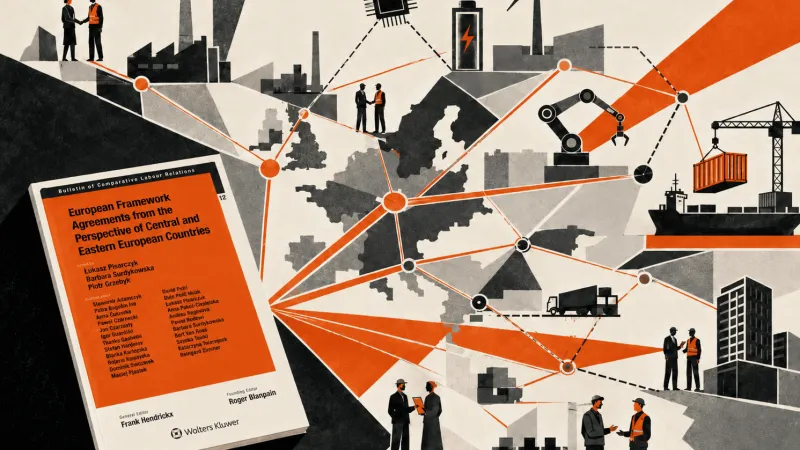
Transnational Company Agreements
Transnational company agreements (TCAs) were developed in a political economy that now looks increasingly distant. They emerged when cross-border corporate expansion, global supply chains and the internationalisation of production were generally treated as durable, largely irreversible features of economic integration. Multinational companies could organise investment, production and sourcing across jurisdictions, while labour law, trade union organisation and collective bargaining remained overwhelmingly national. TCAs were one of the few attempts to reduce that mismatch by establishing negotiated labour standards across a multinational group. In this post, TCAs are understood as an umbrella category encompassing both European framework agreements and global framework agreements concluded within multinational companies.
Their record is undeniably mixed. Some agreements created meaningful commitments concerning freedom of association, occupational health and safety, equality, restructuring, training, subcontracting or technological change. Others were poorly disseminated, remaining known at headquarters but barely visible in subsidiaries. TCAs were never fully incorporated into the legal architecture of European industrial relations. Their legal status is uncertain, their enforcement mechanisms vary considerably, and their relationship with national collective bargaining systems remains unresolved. It is therefore understandable that they have often been treated as an interesting but peripheral experiment.
Yet the conditions that originally made transnational labour coordination necessary have not disappeared. They have been transformed. Europe is now reorganising economic policy around resilience, strategic autonomy, decarbonisation, technological sovereignty and the security of critical supply chains. The European Commission’s Competitiveness Compass and Clean Industrial Deal bring strategic value chains, skills, quality jobs, economic security and resilience together within a more coordinated European industrial policy. The language is no longer simply that of market integration. It is increasingly the language of vulnerabilities, dependencies and the capacity to withstand geopolitical and economic shocks.
This shift gives the TCA debate new relevance. The question is no longer only whether agreements created during the previous phase of globalisation fulfilled the hopes once invested in them. It is whether negotiated cross-border labour governance can contribute to managing a more fragmented and geopolitically unstable economic order. TCAs will not become important merely because the geopolitical environment has changed. But the need for instruments capable of operating at the level of multinational production has become more difficult to ignore.
This post is derived from research contained in the recently published volume European Framework Agreements from the Perspective of Central and Eastern European Countries examines the legal uncertainty, uneven implementation and East–West asymmetries that have limited the development of TCAs. It does not offer a simple success story. Its value lies precisely in showing why the potential of cross-border bargaining has so often remained unrealised and why the perspective of Europe’s periphery must be included in any attempt to redesign it. The geopolitical shift does not remove these constraints. It makes overcoming them more urgent. If resilience is to describe more than the capacity of states and corporations to protect production, it must include the capacity of workers to anticipate, negotiate and influence transnational economic change.
Collective Bargaining in the Age of Resilience
The renewed interest in collective bargaining cannot be explained solely by a rediscovery of social dialogue or industrial democracy. It is also connected to a change in how governments and European institutions understand economic stability. Labour shortages, supply-chain disruption, the green transition, digital transformation and geopolitical rivalry have turned the continuity of production into a political concern. The ability to transform an industrial sector now depends not only on investment and technology, but also on the availability of skills, the retention of workers and the social acceptance of restructuring. The Commission’s current industrial agenda itself connects resilience and competitiveness with skills, an adaptable workforce and the creation of quality employment.
Collective bargaining consequently acquires an additional function. It remains a mechanism for distributing economic gains, correcting unequal bargaining power and enabling workers to influence their working conditions. But it may also form part of the institutional infrastructure through which change is anticipated, negotiated and made socially sustainable. Industrial transformation imposed without meaningful worker involvement may produce resistance, skills erosion, recruitment problems and political opposition. Negotiated transformation does not eliminate conflict, but it can create procedures for deciding how adjustment costs are distributed and what forms of protection accompany economic change.
This point is especially important because geopolitical restructuring does not restore a purely national economy. Reshoring, nearshoring and friend-shoring may shorten or redirect supply chains, but they do not abolish cross-border corporate organisation. A battery plant in Poland, a component producer in Slovakia, an engineering centre in Germany and a raw-material supplier outside the European Union may still form part of a single strategic production system. Decisions concerning investment, technology, sourcing and restructuring will continue to be taken at the level of the corporate group even when public policy becomes more protective and geographically selective.
There is therefore a risk of a new mismatch. Europe may develop common strategies for critical technologies, clean industry and resilient supply chains while worker representation remains fragmented among national jurisdictions and individual workplaces. Public authorities and multinational management may coordinate at the level of European industrial ecosystems, whereas labour is invited to react locally after the principal choices have already been made. In these circumstances, the social dimension of strategic autonomy cannot be secured solely through national legislation or national collective agreements.
What TCAs Can Contribute
TCAs cannot replace national collective bargaining, strong trade unions or enforceable collective agreements. They should not be counted as evidence that a functioning bargaining system exists where national institutions remain weak. Their possible contribution is different: they can connect domestic labour representation with the level at which multinational corporate decisions are prepared and implemented.
First, TCAs can provide procedures for advance information and consultation. Agreements may require management to disclose relevant changes, discuss transformation plans and establish joint monitoring bodies. Such procedures matter because restructuring is rarely a single event. It is usually a sequence of investment choices, technological changes and organisational decisions whose effects become visible at different times in different countries. Early transnational dialogue can give worker representatives an opportunity to compare information and identify whether locations are being pitted against one another.
Second, TCAs can establish a common floor. They are unlikely to harmonise wages or working time across countries with very different bargaining systems and economic conditions. They can, however, set minimum guarantees concerning trade union rights, non-discrimination, occupational safety and health, access to training, treatment of subcontracted workers or procedures during restructuring. In a multinational group, even a procedural floor can be important where national institutions vary sharply in strength.
Third, TCAs can support skills policies and a just transition. The introduction of artificial intelligence, automation and low-carbon technologies may create new jobs while making existing skills obsolete. A transnational agreement can link corporate transformation plans to training, employability, and internal mobility. This is particularly relevant where a company benefits from public support for industrial transformation. If states subsidise technological adaptation in the name of strategic resilience, workers have a legitimate interest in negotiated guarantees that public support for transformation will be accompanied by investment in their continued employability.
Fourth, TCAs can connect corporate due diligence with collective representation. Due diligence systems often operate through compliance departments, audits and reporting procedures. These may identify risks, but they do not necessarily strengthen workers’ capacity to act. A negotiated agreement can provide trade unions with access to relevant operations, as well as complaint channels, monitoring committees and escalation procedures. It can therefore help move corporate responsibility from unilateral risk management towards a form of social dialogue.
Recent Practice: A Change of Content, Not Yet a Renaissance
Recent developments do not demonstrate a quantitative renaissance of TCAs. The more defensible conclusion is that their subject matter is changing. The ILO’s review of agreements concluded or renewed in 2025 found that traditional themes—fundamental rights at work, occupational safety and health, and due diligence in supply chains—remain central. At the same time, it identified stronger attention to environmental sustainability, just transition, digital transformation and artificial intelligence. This is precisely the combination of issues generated by the new geopolitical and industrial context.
The renewed global framework agreement between IndustriALL Global Union and ENI, signed in January 2026, is the clearest recent illustration. Negotiated over two years with trade union participation from several countries and sectors, the agreement strengthens human rights due diligence throughout the supply chain, explicitly recognises social dialogue as a tool for supporting the energy transition and organisational restructuring, and links a just transition to training, inclusion and sustainable employment. The signatories described it as a living instrument capable of responding to decarbonisation, digitalisation, complex supply chains and geopolitical uncertainty.
The ENI agreement matters because it shows how the language of transnational agreements can move beyond a static catalogue of fundamental rights. The agreement treats transformation itself as a subject of dialogue. It does not prove that the resulting commitments will be implemented consistently across all operations, and IndustriALL itself emphasised that implementation remains decisive. Nevertheless, it provides a concrete example of a TCA being repositioned in relation to energy transition, corporate restructuring and geopolitical instability.
The EDF global framework agreement for 2025–2030 offers a more developed institutional model. Signed by EDF, IndustriALL Global Union, Public Services International and national trade union representatives, it covers due diligence, freedom of association, health and safety, equality, skills, employability, a just transition and the supply chain. It requires dissemination and discussion within controlled companies, translation in countries where the group has a significant presence, and incorporation of relevant commitments into the group’s supplier and subcontractor charter.
Importantly, the EDF agreement also provides an escalation structure. Disputes should first be addressed locally, then nationally, and subsequently through the group-level Global Dialogue Committee. The agreement allows for mediation and, as a last resort, referral to the competent court at EDF’s registered office. No procedure of this kind guarantees effective enforcement. But it shows that a TCA can be designed as an institutional process rather than a declaration that ends when the signing ceremony is over.
Two developments from 2026 demonstrate why such procedures matter. In April, KONE and TK Elevator announced a transaction valuing TK Elevator at EUR 29.4 billion and potentially creating the world’s largest elevator and escalator manufacturer, employing more than 100,000 workers. According to IndustriALL, unions and worker representatives learned of the deal through the financial press, without prior consultation. The federation considered this a serious breach of the 2021 global framework agreement and of European and global works council agreements. It announced that unions would withhold cooperation in relation to the transaction unless the agreements were honoured.
The case is significant even though its outcome remains open. It shows that TCAs matter most when ownership and production structures are actually transformed. A commitment to information and consultation has limited value if it does not operate before a transaction is publicly announced. At the same time, the existence of the agreement gives unions a common normative and organisational reference point from which to contest the process across countries. It converts what might otherwise appear as several national disputes into a challenge concerning the governance of the transaction as a whole.
The Mercedes-Benz case illustrates the opposite risk. In May 2026, IndustriALL withdrew from its agreement on social responsibility and human rights with Mercedes-Benz. The federation cited the company’s failure to remain neutral during union organising at its Alabama plant, its refusal to engage constructively over the alleged violations, and its unilateral update of the agreement in 2025 without resolving the dispute. Withdrawal could not retrospectively make the agreement effective. It did, however, withdraw the federation’s endorsement from a document that it believed the company had repeatedly violated.
These cases should not be presented as evidence that TCAs work automatically. They show something more modest and useful. Transnational agreements can create standards and procedures against which corporate conduct is assessed during transformation and conflict. Their effectiveness depends on whether unions are able and willing to invoke them, whether management treats them as operational commitments, and whether the agreement contains credible monitoring and escalation mechanisms.
It is also notable that the most visible recent instruments of this kind have often been global framework agreements concluded by global union federations rather than specifically European agreements concluded by European industry federations. This observation deserves attention but should not obscure the central point. Although the territorial scope and institutional routes may differ, these agreements affect multinational groups whose investment, restructuring and transition strategies are central to the European economy. They therefore provide evidence of how transnational bargaining instruments may evolve under new geopolitical conditions.
A Central and Eastern European Perspective
The potential relevance of TCAs is particularly visible in Central and Eastern Europe. Many economies in the region are deeply integrated into transnational production networks, especially in manufacturing, logistics and business services. Yet collective bargaining coverage and sectoral bargaining capacity often remain weak. The result is a structural paradox: the countries most exposed to corporate decisions taken outside their territory may possess the least developed institutional capacity to influence those decisions collectively.
This is not simply a defect of domestic labour law. It reflects the model through which much of the region was incorporated into European production. Foreign direct investment, cost competitiveness and flexible labour markets supported rapid integration, but strong multi-employer bargaining institutions did not develop at the same pace. Transnational production expanded more quickly than transnational labour governance.
TCAs cannot reverse this history. The research collected in European Framework Agreements from the Perspective of Central and Eastern European Countries shows that agreements concluded by Western-based multinational companies have often been poorly communicated and imperfectly implemented in CEE subsidiaries. Representatives from the region may participate formally without exercising comparable influence over negotiating agendas. Agreements may also remain legally external to domestic collective bargaining systems and may not be reflected in collective bargaining coverage statistics.
Nevertheless, this is precisely why their indirect functions deserve attention. A TCA can provide local unions with information, channels of contact at the level of the corporate group and a reference point for domestic negotiations. It may introduce subjects such as AI, restructuring procedures, psychosocial risks or supply-chain governance that are not yet firmly established in national bargaining agendas. Participation in transnational negotiation and monitoring can also help unions understand corporate structures and build relationships with representatives in other locations.
The contribution is therefore best described as catalytic. TCAs do not count as national collective bargaining coverage and should not become an excuse for failing to rebuild domestic bargaining institutions. But they may help generate some of the knowledge, organisational capacity and negotiating practices needed for that reconstruction, particularly inside multinational groups that play a central role in the region’s economies.
Beyond the Defensive Grammar of Social Dumping
The obstacles are not exclusively legal or organisational. They also concern how trade unions understand cross-border interdependence. This issue is addressed with unusual directness in Sławomir Adamczyk’s deliberately provocative chapter, The Issue of ‘Dark Matter’ or the Psychosis of ‘Social Dumping’ as an Explanation for EU Trade Unions’ Problems with the Idea of TCAs. Adamczyk does not deny that social dumping describes genuine tensions produced by unequal economic integration and weak social safeguards. His argument is that the diagnosis has too often become a substitute for strategy. Fear of lower standards can legitimise caution, institutional withdrawal and the defence of national “strongholds”, while discouraging experimentation with transnational solidarity. The result is a language of impossibility: everyone recognises that corporate power operates across borders, while proposed transnational responses are repeatedly postponed because mandates, procedures or trust are said to be insufficient.
This criticism is especially relevant under new geopolitical conditions. Economic interdependence is no longer presented as uncomplicated progress, but neither can it simply be reversed. Europe’s response is to govern dependencies more actively through industrial policy, supply-chain diversification and strategic investment. If labour remains confined to defensive national responses, workers may have little influence over how this reorganisation occurs. The alternative is not to abandon national institutions. It is to create additional capacity at the level where multinational decisions are made.
As Adamczyk argues, solidarity cannot be built on an assumption that workers and unions in different parts of Europe possess identical interests, resources or vulnerabilities. It requires accepting asymmetry and converting interdependence into a shared capacity to confront multinational corporate power. Otherwise, the “dark matter” of transnational bargaining will remain invisible while corporations continue to organise their strategies across national boundaries.
Conditions for Renewed Relevance
The geopolitical turn intensifies the need for transnational labour coordination; it does not guarantee that TCAs will meet that need. Their renewed relevance depends on several conditions.
The first is representative legitimacy. Agreements should be negotiated with clear mandates and meaningful participation by unions from the countries and operations affected. Consultation after the main priorities have been settled is insufficient. This is particularly important for subsidiaries in CEE and other peripheral locations, whose concerns may differ from those of headquarters-country unions.
The second is local translation. A corporate-level agreement must be disseminated, discussed and, where necessary, incorporated into national collective agreements, company agreements or other enforceable instruments. Translation is not only linguistic. It means identifying who is responsible for implementation, how workers can raise complaints and how the agreement interacts with domestic institutions.
The third is credible monitoring. Joint committees require access to information, agreed indicators and the capacity to examine implementation in particular locations. Monitoring should cover suppliers and subcontractors where the agreement includes the value chain. Monitoring should also lead to appropriate follow-up action, including remediation, escalation, mediation or adjudication where commitments are not respected. Recent agreements such as EDF and ENI illustrate the growing emphasis on ongoing review, implementation structures and accountability rather than reliance on general declarations alone.
The fourth is integration with transformation policy. TCAs should be linked to restructuring plans, skills strategies, investment decisions and due diligence systems rather than treated as separate CSR documents. Where companies receive public support for clean technologies or strategic production, policymakers could encourage or require robust arrangements for worker information, consultation and negotiation across the relevant corporate group.
Finally, the ambitions must remain realistic. TCAs will not create European wage uniformity or replace the institutions of sectoral bargaining. Their most plausible role is to create a negotiated transnational framework within which national and local bargaining can operate more effectively. They can establish common procedures and minimum guarantees while leaving distributive bargaining to the levels at which the legal and organisational foundations are strongest.
Conclusion
TCAs were created under the conditions of liberal globalisation, but they need not be confined to that historical moment. The new geopolitical economy is more fragmented, interventionist and security-oriented, yet it remains profoundly transnational. Corporate groups, industrial value chains and technological transitions continue to cross borders. The need to represent workers at that level therefore becomes greater, not smaller.
Recent practice suggests a change in the agenda of transnational agreements. The ENI and EDF agreements connect global social dialogue with energy transition, due diligence, skills and supply-chain governance. The KONE–TK Elevator case demonstrates the importance of agreements when corporate ownership is reorganised. The Mercedes-Benz case shows the limits of commitments that are not implemented and the importance of unions refusing to provide indefinite legitimacy to ineffective instruments.
None of this proves that TCAs are about to move from the margins to the centre of industrial relations. It does show that they address a governance gap that is becoming more visible. Europe cannot plausibly pursue economic security, resilient supply chains and strategic autonomy while treating the workers who sustain those systems as actors represented only within national boundaries.
Comments (0)
Your email address will not be published.
Become a contributor!
Interested in contributing? Submit your proposal for a blog post now and become a part of our legal community!
Contact Editorial Guidelines

You may also like


September 9, 2026
September 2, 2026