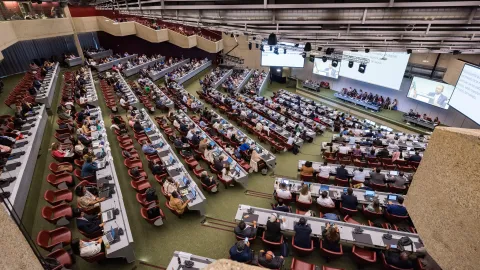
Evaluating the International Court of Justice’s Advisory Opinion on the Right to Strike
July 15, 2026
The Right to Strike under ILO Convention No. 87
I. Introduction and Background
On 21 May 2026, the International Court of Justice (ICJ) delivered the awaited Advisory Opinion on the long-standing disagreement among the constituents of the International Labour Organization (ILO) concerning the exact scope and meaning of certain provisions of the Freedom of Association and Protection of the Right to Organise Convention, 1948, Convention No. 87. The dispute developed around the consistent view taken by the supervisory bodies of the ILO, particularly the Committee of Experts on the Application of Conventions and Recommendations (CEACR), that “the right to strike is an intrinsic corollary to the right to freedom of association and that, as such, it is recognized and protected by Convention No. 87”. For over thirty years, employers’ groups have firmly challenged the Committee’s authority to interpret conventions. The litigation was on the very existence of the lawful right to strike at the ILO and its link to freedom of association and “trade union activities”. The sub-questions that followed were: who will interpret the Conventions, or indeed who has the authority to do so; and, perhaps more pointedly, the relevance that the ILO itself has.
II. The Advisory Opinion: Treaty Interpretation and Deconstructing the Counter-Arguments
The Court stated clearly that the right to strike is protected under ILO Convention No. 87. The first and most important matter was treaty interpretation under articles 31 and 32 of the Vienna Convention on the Law of Treaties (VCLT). Article 31(1) states that interpretation should be “in good faith in accordance with the ordinary meaning to be given to the terms … in their context and in the light of its object and purpose”. The VCLT obliges the interpretation to be in accordance with the ordinary meaning of the terms. As it was argued, strikes are among the “activities” and “programmes” of worker’s organisations for “furthering and defending the interests of workers”, as set out in Articles 3(1) and 10.1 Article 3 of the ILO Convention No. 87 states clearly that “workers’ and employers’ organisations shall have the right to…organise their administration and activities and to formulate their programmes”. The object and the purpose of the Constitution of the ILO and Convention No. 87 furthermore support that the right to strike is protected by Convention No. 87. The Preamble to the Constitution of the International Labour Organisation declares that “recognition of the principle of freedom of association” is a means of improving conditions of labour and of establishing peace. The Declaration of Philadelphia reaffirms that “freedom of expression and of association are essential to sustained progress”.Furthermore, Article 10 of Convention No. 87 states that the organisation’s aim is to further and defend the interests of workers and employers. Therefore, it is argued that the recognition of the right to strike is a natural consequence of the terms of Article 3(1), read alongside Article 10.2 Contrary to the arguments of the IOE and others, there is no ambiguity in these terms.
Conversely, the International Organisation of Employers (IOE) advanced a restrictive, counter-argument. The employers’ group’s main argument consisted of two related sub-arguments. IOE argued that the right to strike was never recognised in the Convention No. 87, and that the drafters never intended it to be recognised as such a right. The word “strike” is not expressly mentioned in the text of the treaty, nor is it indicated in the treaty's name. The IOE further argued that the right to strike cannot be derived by interpreting Article 3 of Convention No. 87, since Article 3(1) does not clearly answer whether those words cover a right to strike, and because it is general and broad.3 The IOE stated that Convention No. 87 only protects activities internal to workers’ (or employers’) organisations, excluding all activities external to their governance or regulation, or affecting non-members.4
However, according to the Court “the absence of an express treaty provision governing a certain issue does not necessarily mean that the issue is excluded from that treaty. Such an exclusion is only warranted when the text of all the provisions concerned, their context and the object and purpose of the treaty point to it. In the specific context of the ILO, the Permanent Court of International Justice rejected the argument that the mere absence of certain terms leads to the conclusion that particular activities fall outside the scope of ILO conventions.”5
According to the argument that No. 87 only protects workers’ organisations’ internal activities, the Court found that “This includes not only internal negotiation and adoption of constitutions and rules, and the election of representatives, but also broader powers enabling workers’ and employers’ organizations to decide on matters relating to their administration, as well as to activities to be performed and programmes to be formulated and implemented in both internal and external contexts. Article 10 defines the term “organisation” as “any organisation of workers or of employers for furthering and defending the interests of workers or of employers”. Reading these three provisions together, in good faith and in accordance with their ordinary meaning, suggests that, under Convention No. 87, workers and employers have the right to create and join organizations for the purpose of furthering and defending their respective interests, including to organize their activities and programmes to pursue that purpose”.
One of the most important paragraphs of the Advisory Opinion confirms this argument. It formulated how, in accordance with Article 31 VCLT, the ordinary meaning of Convention No. 87 denotes that “…strike action is one of the main activities engaged in and tools used by workers and their organizations to promote their interests and improve conditions of labour, thereby ensuring the effective exercise of the freedom of association protected under Convention No. 87. At the same time, freedom of association is instrumental in facilitating workers’ organizations to take collective action to further and defend the interests of their members, including through the exercise of the right to strike. Therefore, the protection of the right to strike is in line with the object and purpose of Convention No. 87”6. The Court reads the ordinary meaning of “activities” and “programmes” in Article 3 in conjunction with Article 2 (the right to form and join organizations) and Article 10 (the purpose of such organizations, namely furthering and defending workers’ and employers’ interests). Furthermore, the Court observes that strike action is capable of falling within the ordinary meaning of the term “activities” and is not “explicitly excluded” by the Convention’s two express limitations.7 In addition, the Court confirms that the protection of the right to strike is in line with the object and purpose of Convention No. 87.8
III. Supplementary Interpretation
The Court’s analysis under Article 31(3)(c) of the VCLT further anchored the right to strike within the broader fabric of international law by drawing supportive parallels from the International Covenant on Economic, Social and Cultural Rights (ICESCR), the International Covenant on Civil and Political Rights (ICCPR), and various regional human rights regimes.9Notably, Judge Sarah Cleveland provided a concurring declaration in which she expanded on this systemic integration, positing that:“given the breadth of recognition of the right to strike in numerous overlapping international and regional instruments, as well as in bilateral and trade agreements, the constitutional protection of the right to strike in at least 97 States and its legislative protection in more than 150 others, a compelling case can be made that protection of the right to strike is a principle of customary international law.”10
In terms of supplementary means of interpretation, the drafting history of Convention No. 87 was found to be “inconclusive” by the court. An analysis of the travaux préparatoires of Convention No. 87 demonstrates that they focuson whether public officials had the right to strike, suggesting that the debate was not over the existence of the right itself, but rather its scope and limitations.11
IV. Implications of the Advisory Opinion
The ICJ’s Advisory Opinion contains a strong formulation of the arguments which is likely to have significant influence on judicial proceedings and legislative drafting on the right to strike in national experience. The case also has an importance on interpretation of international treaties as described by the article 31 and 32 of the VCLT.
Beyond the question of the right’s existence, the Advisory Opinion effectively resolves the latent sub-questions regarding interpretative authority and the relevance of the ILO’s supervisory bodies. The Court explains: “The Court’s conclusion that the right to strike is protected by Convention No. 87 does not entail any determination on the precise content, scope or conditions for the exercise of that right”12. This approach appropriately reflects the boundaries of the Court’s advisory opinion. By deliberately refraining from specifying the “precise content, scope or conditions” of the right to strike, the Court signalled that such detailed determinations remain in the hands of CEACR. Most significantly, the Court’s decision ascribes “great weight” to the pronouncements of the CEACR and other supervisory bodies. The Court stated that: “Consequently, the Court considers that it may, mutatis mutandis, ascribe “great weight” to the pronouncements of ILO supervisory bodies, as a supplementary means of interpretation of Convention No. 87. The Court nevertheless deems it important to recall that it is ‘in no way obliged, in the exercise of its judicial functions, to model its own interpretation [on that of those bodies]’”13
Furthermore, the Court also emphasised that “…those bodies have progressively converged in recognizing the right to strike as protected under that Convention. The Court observes that these pronouncements, which constitute a relevant supplementary means of interpretation under Article 32 of the Vienna Convention on the Law of Treaties, confirm the finding reached by the Court on the basis of Article 31 of the same instrument.”14
The requested Advisory Opinion stemmed from events in 2012, when the employers’ group withdrew from the ILO supervisory machinery, claiming experts had “invented” a right to strike. In 2012, the employers’ group had expressed concerns on the issues of “political strikes and essential services”, and they objected to the influence of CEACR findings in other courts, implicitly the ECtHR. It is also another problem with the current debate. Arguing the existence of the right to strike, and arguing its scope and limitations, are different issues. It is clear, and well settled in the Advisory Opinion, that the employer groups had long accepted that the right to strike was derived from the Convention — even though they now argue the opposite. In addition, there is no evidence in the travaux préparatoires of Convention No. 87 that the drafters did not intend to create such a right. On the contrary the debate was more on the limitation and the scope of the right. Furthermore, the protection of the right to strike is a natural consequence of the object and purpose of Convention No. 87. Rejecting the employer groups’ argument that ILO supervisory bodies invented a new right, the ICJ ruled that the right to strike was, and will always remain, a fundamental human right and a labour right and derived from the Convention No. 87.
The next question may be worth exploring: what is the true foundation of the right to strike and what makes it different from the other instruments? The legal issues touch the very essence of the right to strike, particularly in comparison to other means of pursuing occupational interests. The right to strike is a prerequisite for trade unions to be effective in protecting workers’ interests. Therefore, the central question must be whether the alternative mechanisms or rights are genuinely as effective as the right to strike. The right to strike is related not only to effectiveness but also to the concept of solidarity. Solidarity allows workers to overcome the power imbalance inherent in employment contracts to achieve fair working conditions. The right to strike and the principle of solidarity are instrumental in enabling workers to participate in decisions that influence not only their conditions of employment but also the broader societal framework. It is difficult, if not impossible, to make their voices heard in the absence of a right to strike, given the unequal power dynamic in the employment relationship.15 According to Vogt et al., the right to strike is fundamental to the development and maintenance of democratic forms of government, and the right to strike is a democratic value.16 As Gamonal argues, a normative justification of the right to strike is based on the concept of dignity. According to the author, “when legislators regulate the right to strike, they should take note that establishing excessive limits beyond what is reasonable restricts the right to strike in such a way as to violate the dignity of the individual”.17 I argue that the true foundation of the right to strike lies in the principle of social justice. Viewed through this lens, the strike is more than a mere tool for industrial relations; it is a fundamental mechanism that enables worker participation in decision-making and ensures their voices are heard, influencing not only their conditions of employment but also societal well-being at large. Fundamentally, protecting the right to strike is a public interest mandate that serves social justice by addressing the inherent power imbalance between capital and labour. This crucial right was and still is instrumental in creating decent work, safeguarding human dignity, and reinforcing the mechanisms of democracy. Many rights, not limited to labour rights, have resulted from strikes.
Another question worth exploring is the ICJ conclusion that “its opinion did not entail any determination on the precise content, scope or conditions for the exercise of that right”.18 The IOE has responded to the Advisory Opinion as follows: “in light of the Advisory Opinion, Employers encourage all ILO tripartite constituents – Employers, Workers and Governments - to engage constructively and pragmatically, recognising the diversity of national legal systems and industrial relations traditions”. Despite the diversity of national legal systems, the CEACR emphasizes that member States are required to ensure that the right to strike is effectively protected.19 This right should, in principle, be guaranteed to all workers.20 It is true that the right to strike is not an absolute right; it can be subject to limitations, and in exceptional circumstances, it may even be entirely denied.21 Nonetheless, it needs to be stressed that any interference with the right to strike must be proportionate and justified by legitimate aims. While it was expected that the ICJ would not elaborate upon the scope or conditions, it is important to emphasise that the right to strike is a fundamental right and protected against undue interference and is subject only to lawful restrictions that pursue a legitimate aim which are necessary in a democratic society. Thus, the realization of the right to strike cannot be treated as discretionary for a national legal system to undermine the essence of the right.
Ambiguity at the ILO is not just a theoretical debate; it directly destabilizes national judicial interpretation across the globe. There are many countries where the right to strike is not explicitly recognized by a national Constitution or law, or where it does exist that is severely restricted by law. Furthermore, it also affects other supervisory bodies: the European Court of Human Rights (ECtHR) relied heavily on ILO interpretations to rule on strike restrictions in cases from Türkiye.The requested Advisory Opinion clarified who has the authority to interpret the Conventions. Consequently, ILO supervisory bodies will interpret the Conventions in accordance with the mandate vested in them by the ILO Constitution. There is a question put by Bogg as to what the Advisory Opinions’ effect will be on the European Court of Human Rights.[22] According to him “it is less clear that the advisory opinion will lead to a radical reappraisal of judgments in the ECtHR that have been criticised as restrictive, such as RMT v UK … and Humpert and others v Germany”. It is an important question and in my opinion the outlook does not seem bright. In the case of RMT and Humpert, the Court failed to apply the integrated approach which it had previously deployed in earlier decisions such as Demir and Baykara and Enerji Yapı-Yol Sen. Furthermore, the Court perpetuated the flawed distinction between essential and non-essential aspects, as well as between core and secondary aspects, of Article 11. This flawed division and subsequent argument led to the misapplication of the margin of appreciation doctrine. While the importance of the Advisory Opinion is not deniable, in my view it will not have a considerable impact on the ECtHR.
While ongoing debates surrounding the precise regulatory boundaries of collective action will inevitably persist, the Advisory Opinion, still, is a solid endorsement of the CEACR’s view that the right to strike is a human right and an intrinsic corollary to the freedom of association, and that, as such, it is recognized and protected by Convention No. 87. The Advisory Opinion is a notable victory for workers and their respective organisations.
[8] Additionally, employers’ group argued and asked to the Court to determine that the findings of ILO supervisory bodies on the scope and content of the right to strike by virtue of Convention No. 87 were illegitimate. However, the court stated that “In the present proceedings, the question put by the Governing Body is both circumscribed and specific in so far as it asks the Court to determine whether the right to strike is protected under Convention No. 87. Since there is no ambiguity in either the question or its terms, the Court considers that there is no need to reformulate the question referred to it” (para 58). See; Tonia Novitz, Recognition of the Legal Status of the Right to Strike by the International Court of Justice, University of Bristol Law School Blog https://legalresearch.blogs.bris.ac.uk/2026/05/recognition-of-the-legal-status-of-the-right-to-strike-by-the-international-court-of-justice/ (accessed 15.06.2026).
- 1Written Comments of ITUC, para. 3.12, p.20.
- 2See; ITUC, Written Statement para. 3.1, p.16. https://www.icj-cij.org/sites/default/files/case-related/191/191-20240913-wri-01-00-en.pdf. See, Merve Kutlu, “Right to Strike at the International Court of Justice, so the Workers Voice…”, Global Workplace Law and Policyhttps://legalblogs.wolterskluwer.com/global-workplace-law-and-policy/right-to-strike-at-the-international-court-of-justice-so-the-workers-voice/(accessed 10.06.2026).
- 3Written Statement of the IOE, para. 146.
- 4Written Statement of the IOE, para. 146-149.
- 5Advisory Opinion para. 68.
- 6Advisory Opinion para.73.
- 7See; Jeffrey Vogt, the ICJ Upholds the Right to Strike in Landmark Opinion, Blog, https://onlabor.org/the-icj-upholds-a-right-to-strike-under-convention-no-87-in-a-landmark-opinion/ (accessed 10.06.2026).
- 8Advisory Opinion para. 90.
- 9Vogt, Bellace, Compa, Ewing, Lord Hendy, Lörcher and Novitz strongly support with convincing arguments that the right to strike is recognised as customary international law.See J. Vogt, J. Bellace, L. Compa, K.D. Ewing, J. Hendy, K. Lörcher and T. Novitz, The Right to Strike in International Law, Bloomsbury Publishing , Chapter 11, at pp. 168-175. Also see; J. J. Brudney, “The Right to Strike as Customary International Law”,Yale Journal of International Law, vol. 46, no. 1, 2021 p. 30. The ITUC’s has further supported in its Written Statement that the right to strike has achieved the status of customary international law, as an inherent component of the universal human right of freedom of association.
- 10As indicated in para 111 of the Advisory Opinion: “The travaux préparatoires of Convention No. 87 indicate that, although the right to strike in general was briefly mentioned at the very beginning of the preparatory work, the discussions during the preparation of Convention No. 87 negotiations appear to have focused on the right to strike of public officials. Therefore, the intention of the drafters of Convention No. 87 with respect to the right to strike in general is unclear and the question was left open. In the view of the Court, the analysis of the travaux préparatoires leads to an inconclusive result.”[11]
- 11Advisory Opinion para. 140.
- 12Advisory Opinion para. 118.
- 13Advisory Opinion para. 119.
- 14T. Novitz, International and European Protection of the Right to Strike (Oxford University Press, Oxford, 2003),1–4; J. S. Vogt The Right to Strike and the International Labour Organisation (ILO), King’s Law Journal, 27:1, (2016), 112.; Also see; T. Novitz, K. Fitzpatrick, and J. Vogt, The Enduring Relevance of the Right to Strike: Arguments for Further Legal Protection and Regulatory Reform, Comparative Labor Law & Policy Journal, 45(2), (2025).
- 15J. Vogt, J. Bellace, L. Compa, K.D. Ewing, J. Hendy, K. Lörcher, T. Novitz, The Right to Strike in International Law, (Hart, 2020). See, Kiaia, M., UN Special Rapporteur on Freedom of Association and Assembly. (2017, March 9). UN rights expert: Fundamental right to strike must be preserved, https://www.ohchr.org/en/press-releases/2017/03/un-rights-expert-fundamental-right-strike-must-be-preserved?LangID=E&NewsID=21328 (accessed 20.06.2026) also see; A.B. Cornell, and R. Dukes, Strikes and the Struggle for Democracy, Comparative Labor Law & Policy Journal, 45(2), (2025).
- 16C.S. Gamonal Dignity and the Right to Strike, Comparative Labor Law & Policy Journal, 45(2), (2025), 275.
- 17Advisory Opinion Para. 140.
- 18ILO,<https://normlex.ilo.org/dyn/normlex/en/f?p=NORMLEXPUB:70002:0::NO::P70002_HIER_ELEMENT_ID,P70002_HIER_LEVEL:3945366,1> (accessed 03.06.2026).
- 19ILO, < https://www.ilo.org/publications/ilo-principles-concerning-right-strike-0> (accessed 03.06.2026).
- 20ILO, <https://webapps.ilo.org/wcmsp5/groups/public/---ed_norm/--relconf/documents/genericdocument/wcms_895774.pdf> (accessed 06.06.2026).
- 21Alan Bogg; The Right to Strike in the International Court of Justice, https://ohrh.law.ox.ac.uk/the-right-to-strike-in-the-international-court-of-justice/ (accessed 20.06.2026).
Comments (0)
Your email address will not be published.
Become a contributor!
Interested in contributing? Submit your proposal for a blog post now and become a part of our legal community!
Contact Editorial Guidelines

You may also like



September 9, 2026
September 2, 2026