ILO Convention 193 on Decent Work in the Platform Economy: At Long Last a Global Rights Floor for a Lawless Industry
August 12, 2026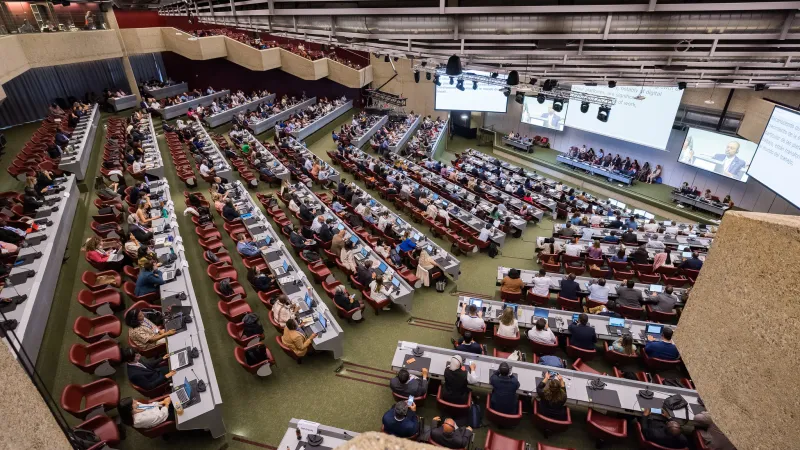
Much of the so-called “gig” economy was built on rank illegality, as its architects knew well at the time. Four years ago, in July 2022, The Guardian received over 124,000 internal Uber documents spanning 2013 to 2017 and distributed them through the International Consortium of Investigative Journalists. Among them was a message from Nairi Hourdajian, the company's then head of global communications, explaining that the company kept running into trouble because it was, in her words, "just fucking illegal."[1] Others at the company acknowledged that they were not legal in many countries, and described themselves as “pirates.” When regulators raided company offices, executives triggered a "kill switch", a procedure signed off by Uber's own lawyers, to sever access to the company's data systems and deny investigators access to evidence. The kill switch had been deployed at least a dozen times across France, the Netherlands, Belgium, India, Hungary and Romania. Mark MacGann, the senior Uber official who leaked the files, described the strategy as: break the law, demonstrate the service, then change the law.[2] This strategy worked in part because the company offered equity to media proprietors, lucrative commissions to academic economists in exchange for flattering research, and a receptive political class.
Of course, most of the cost of this corporate illegality was not borne by the corporations. What the digital platforms characterized as antiquated employment regulation, which they exempted themselves from, is, from the position of the person driving or delivering, the difference between a living wage and destitution. None of this is incidental to the business model -- it is the business model. It is built on misclassification of workers as independent contractors, which allows digital platforms to deny workers payment of the minimum wage, social security, workers’ compensation, protection from discrimination, the rights to organize and to bargain, and many others. Other tactics used by digital platforms to deny workers their rights included indemnity clauses penalizing workers who assert their rights, the insistence that these are technology rather than transport undertakings, engagement through subsidiaries designed to defeat legal claims for having named the wrong respondent, mandatory individual arbitration, and choice-of-law provisions routing disputes to distant courts.
Slowly at first and then with increasing regularity over the last half-decade, courts in a number of jurisdictions have declined to accept the digital platform contracts and the companies’ characterization of the relationship at face value. Instead, judges looked to how the work was actually being performed, invoking the principle of the primacy of facts to examine how the parties really behaved during the relationship. On that basis, courts in every region have sided with platform workers, ordering platform companies to pay workers back wages and reinstate those unlawfully suspended or de-platformed, to pay into public social protection schemes such as workers compensation, and, importantly, to recognize unions of platform workers, and to bargain collectively. Increasingly, legislatures have also stepped in, though platform company lobbying has succeeded in forestalling legislation in several countries.
On 12 June 2026, this arrangement was met with a binding international instrument. The International Labour Conference adopted the Decent Work in the Platform Economy Convention, No. 193 — the first treaty devoted to the platform economy — by 406 votes to 8 with 36 abstentions, and with only the United States and New Zealand among the governments voting against.[3] Unfortunately, the Conference Committee ran out of time before it could negotiate the supplementing Recommendation. As such, the Convention arrives without the interpretive scaffolding that normally accompanies a new standard. The Conference did however pass a resolution suggesting that the ILO Governing Body take “all necessary decisions”, including putting the negotiation of the Recommendation onto the agenda of a future conference.
With the Convention now on the books, it must of course be ratified by Member States and transposed into national law. In this phase, it will be crucial to develop a purposive interpretation of the Convention, read, as it should, to protect those it was intended to benefit.[5]
Nearly every national fight over platform worker rights has been a fight over the threshold question of classification. Convention No. 193 defines a “digital platform worker” as anyone engaged for platform-mediated work for remuneration, “regardless of their classification of status in employment.” Coverage attaches to the worker as a platform worker. Whether that person is also, in law, an employee becomes relevant only later as to the content of a handful of status-contingent guarantees. The instrument applies to every platform and every worker, in the formal and informal economy. While Article 2(2) permits a Member State, after tripartite consultation, to exclude limited categories of platform or of worker only where "special problems of a substantial nature arise", it is subject to a duty to extend the Convention progressively where practicable, and to give reasons in its Article 22 reports.
Article 9 is the heart of the instrument and requires States to ensure the “correct classification” of platform workers, “guided mainly by the facts relating to the performance of work” rather than by the labels in a platform’s standard-form contract. This is the primacy-of-facts principle, drawn from the ILO’s Employment Relationship Recommendation of 2006.[6] It has already been cited by numerous national courts to determine the correct classification. For example, when the United Kingdom Supreme Court held Uber’s drivers to be limb-b workers in Aslam, it did so by looking past the “partner” contract to the reality of control — over fares, routes, ratings and the acceptance of trips.[7] The word “mainly” in Article 9 is the treaty’s endorsement of this reasoning.
Article 9 does not impose a presumption of employment, as advocated by the workers group and vigorously opposed by the employers group. But, nothing prevents a Member State from adopting such a presumption. Further, the obligation to “ensure” correct classification, set against the well-documented, systematic character of misclassification, points in that direction. Some countries have already adopted a presumption, including Spain, which legislated such a presumption for delivery riders. A Member State confronting misclassification would likely struggle to show it had discharged its duty by any means weaker than a presumption, or something equally effective at shifting the practical burden off the worker’s shoulders.
Article 3 obliges each Member to respect, promote and realize the fundamental principles and rights at work in the platform economy (freedom of association and the effective recognition of the right to collective bargaining first among them, alongside the 2022 addition of a safe and healthy working environment) with no status qualifier whatever. On the face of the text, the self-employed platform worker is owed the right to freedom of association. That matters because the principal obstacle to platform workers organizing has been competition law, which treats agreements among nominally independent contractors as unlawful cartels. Article 3, read with Article 23, gives States a basis to carve out the solo self-employed, as the European Commission has already done by guideline.[9]
Articles 13 to 16 on algorithmic management are the Convention’s newest contribution to international labor law. Platforms must disclose their use of automated systems, not only to workers but to their representatives, giving algorithmic transparency a collective dimension and opening the operation of the algorithm to bargaining. They must also use those systems “responsibly,” which the Convention ties expressly to fundamental rights. As such an algorithm may not be turned to detecting and punishing union activity, to discriminatory allocation or pricing, or to work at intensities incompatible with a safe and healthy workplace. And where an automated decision significantly harms a worker, Article 15 confers a right to a documented explanation and to human involvement in the review of any decision that stops pay, suspends, deactivates or terminates.
Platforms have defended automated firing by pointing to a nominal human somewhere in the loop. The Amsterdam Court of Appeal refused to accept a review that was “not much more than a purely symbolic act”; where the human adds nothing, the decision remains, in substance, a solely automated one. Carried into Article 15, that reasoning means human involvement must be a genuine exercise of judgment by someone competent and authorized to change the result, not a rubber stamp. Read together with the data-protection guarantees of Article 16, which track the GDPR, these provisions give the worker a right to be told why, and a human who can decide. Article 17 adds a separate prohibition on suspension, deactivation or termination on discriminatory or otherwise unlawful grounds.
The issue of remuneration or payment is where the Convention is makes a difficult compromise. Article 10 guarantees to every platform worker, employee or not, that what is due be paid in full and subject only to lawful deductions, importing the protections of the Protection of Wages Convention. Article 11 supplies the informational counterpart, requiring platforms to give workers timely, accurate and easily understandable information on their remuneration and on any deductions made — the provision on which pay-transparency claims will be built. This is helpful in that it cuts against the unilateral clawbacks that pervade platform pay.
But the minimum-wage floor and the reimbursement of work expenses are guaranteed only to those in an employment relationship. For everyone else, the Convention obliges the State to “give consideration to whether” the floor should extend to them. However, read purposively it is a real obligation of conduct — a duty to assess in good faith, supervised by the Committee of Experts — and, set beside the Convention’s stated purpose. It points toward eventual extension rather than away from it. Moreover, if workers are properly classified as required in Article 9, then this exception is limited.
The convention also carries a preventive occupational-safety duty broad enough to reach the road-traffic risk borne by riders, the musculoskeletal toll of algorithmically driven work rhythms, and the psychological injury of content moderation. It insists that the primary duty of prevention rest with the party that actually controls the organization of the work, which is to say the platform. It also confirms the right to walk away from imminent danger without “undue consequences,” a phrase that must be read to catch not just deactivation but the quieter platform sanctions of a lowered rating or a throttled stream of offers.
It also extends the protection of the Violence and Harassment Convention to online and third-party abuse. And it reaches across borders, providing in Article 19 that terms and conditions shall "preferably" be governed by the law of the country where the work is performed, so that a platform cannot lightly relocate its legal risk to the jurisdiction its terms of service happen to name. However, that preference is subject to national law and to international and bilateral instruments, and "taking into account the contractual arrangements". The Convention also reaches past the platform to the intermediary, such as a fleet owner or the labor contractor, which Article 1(c) defines and which Article 24(3) requires Members to bring into an express allocation of responsibility.
Importantly, Article 23 also requires that platform workers be treated “no less favourably” than comparable workers with the same employment status. It runs through the whole instrument as a floor. Wherever a question arises about the level of a protection owed, the answer must be at least what a comparable non-platform worker already enjoys. It is, properly enforced, a standing prohibition on the creation of a sub-protected platform underclass.
None of it means anything without enforcement. Access to “effective” remedies must be real and not defeated by cost, complexity or a mandatory-arbitration clause. Labor inspection must actually be able to reach platforms — though Article 24(2) frames the implementation duty by reference to platforms and intermediaries operating, and workers working, in the Member’s own territory, leaving cross-border enforcement to be worked out.[13] And Article 12 requires access to social security on terms “no less favourable” than those enjoyed by other workers with the same classification of status.
Convention No. 193 is not the end of the argument. It leaves two decisive questions (whether to presume employment, and whether to guarantee a pay floor to the economically dependent self-employed) to be fought out country by country. But, importantly, for the first time, international law says clearly that decent work is owed to platform workers as such, whatever the platform has chosen to call them. Whether the Convention’s promise is realized now depends on the things it was always going to depend on purposive reading by courts and legislatures, the willingness of States to legislate presumptions and extend the floor, the rigor of ILO supervision, and the capacity of workers themselves to use the Convention’s transparency and freedom-of-association guarantees to build the collective power that no treaty can supply on their behalf.
Comments (0)
Your email address will not be published.
Become a contributor!
Interested in contributing? Submit your proposal for a blog post now and become a part of our legal community!
Contact Editorial Guidelines

You may also like


September 9, 2026
September 2, 2026