


Copyright and Scientific Research in Europe: Why Harmonisation of Research Exceptions Remains an Illusion
July 20, 2026
For more than two decades, European copyright policy has pursued the goal of harmonisation. Successive directives have sought to establish a common framework for copyright protection and limitations across the European Union, while more recent initiatives have aimed to strengthen the European Research Area and facilitate cross-border scientific collaboration. Yet, a recent study conducted by Centrum Cyfrowe and the Future Law Lab at Jagiellonian University, Barriers to Research: Insights into the Patchwork of Research Exceptions in European Copyright Laws and Practical Perspectives from European Researchers, suggests that, at least in the area of research exceptions, harmonisation remains largely aspirational.
Based on a comparative analysis of 28 European jurisdictions and qualitative research, the study reveals a fragmented legal landscape that generates uncertainty and barriers to cross-border research.
Looking beyond formal harmonisation
The report starts from a simple observation. While EU copyright law contains several exceptions and limitations designed to facilitate scientific research, their practical implementation remains largely dependent on national legislators. As a result, researchers operating across borders encounter different legal standards, different conditions for relying on exceptions, and different interpretations of what constitutes lawful research use.
To assess these divergences, the study combines comparative legal analysis with empirical research on researchers’ experiences, allowing it to compare the legal framework with everyday research practices. This dual methodology allows the report to compare the formal legal framework with the realities of contemporary research practices.
Image

Measuring openness: the development of the I-REx Index
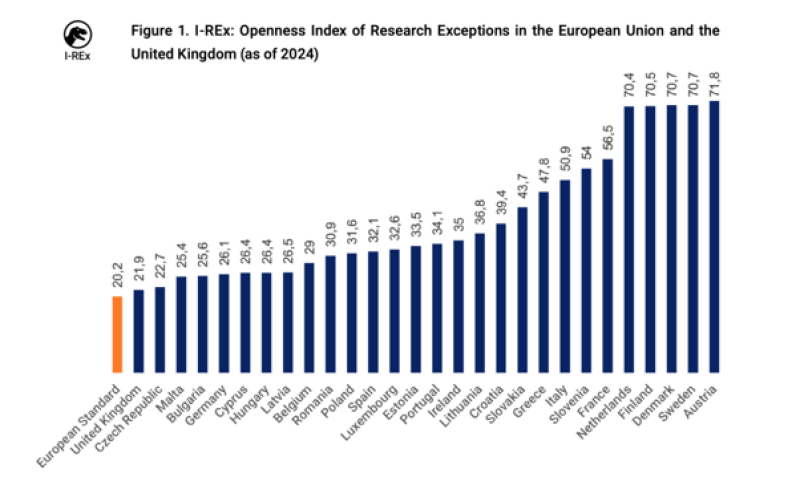
One of the report’s key contributions is the development of the Index of Research Exceptions (I-REx), a comparative analytical tool designed to assess the degree of openness of copyright systems towards scientific research. Rather than limiting the analysis to the formal existence of particular exceptions, the index evaluates their practical design and scope. It examines the extent to which researchers can effectively rely on copyright exceptions, taking into account the various legal conditions, restrictions, and safeguards attached to their use.
The underlying assumption is that the openness of a copyright framework can be measured by analysing the limitations imposed on research-related exceptions. The more conditions, procedural requirements, eligibility restrictions, or legal uncertainties associated with an exception, the less accessible and effective it becomes from the perspective of scientific research. Accordingly, higher I-REx scores indicate more restrictive legal frameworks, while lower scores reflect a greater degree of openness and flexibility in enabling research uses of protected subject matter.
The exceptions analysed
The study examined ten copyright exceptions considered particularly relevant for scientific research.
Four were classified as central research exceptions:
Scientific research exception;
Scientific research exception for copyright-protected databases;
Scientific research exception for sui generis database rights;
Scientific research exception relating to neighbouring rights.
Six supplementary exceptions were also included:
Reprographic reproduction;
Private copying;
Reproductions by libraries, educational establishments, museums and archives;
Quotation;
Dedicated terminal exception;
Text and Data Mining (TDM) for scientific research
The inclusion of supplementary exceptions reflects an important reality: researchers often rely on a combination of exceptions rather than on a dedicated research exception alone.
A parameter-based assessment model
Each exception was evaluated using eleven common parameters designed to capture the level of legal openness. These parameters included the scope of beneficiaries and protected subject matter, permitted uses, remuneration requirements, commercial-use restrictions, attribution and source-legality obligations, safeguards against contractual override and TPMs, the application of the three-step test, and the possibility of cross-border use. The methodology also accounted for: additional restrictions imposed by EU legislation itself or introduced during national implementation. Each parameter was assigned a score based on its relative restrictiveness. Because of their importance for scientific research, central research exceptions received a higher weighting than supplementary ones. The resulting comparative index measures the overall restrictiveness of a jurisdiction’s copyright framework for research purposes. Lower scores on the Index indicate more open and flexible copyright frameworks for research purposes.
The illusion of harmonisation
Perhaps the most striking finding is that all EU Member States have implemented the analysed research exceptions more restrictively than the minimum standard established by EU law. In other words, national implementation has systematically increased the number of restrictions placed on research uses. Importantly, these differences are not merely technical. They translate directly into different levels of legal certainty and different opportunities for researchers to access, analyse, and share knowledge.
Image
Testing the law against research practice
To complement the quantitative analysis, the report developed ten case studies based on real-world research activities described by researchers during interviews. These cases covered routine activities such as:
Sharing research materials with collaborators;
Reusing protected material in scientific projects;
Conducting collaborative research across borders.
Experts from 21 jurisdictions were asked to assess whether each activity would be considered lawful under their national legal framework. Rather than seeking definitive legal opinions, the objective was to identify broader patterns of legal certainty and divergence. The results revealed a remarkable lack of consensus. Responses indicating that activities were permitted or probably permitted were almost perfectly balanced by responses indicating that they were prohibited or probably prohibited. Even among copyright specialists, there was often no clear agreement on whether particular research activities fell within the scope of existing exceptions. This finding raises important questions about legal certainty. If experts struggle to determine whether routine research activities are lawful, it becomes difficult to expect researchers themselves to confidently navigate these legal frameworks.
What researchers experience in practice
The qualitative component of the study provides important insights into how copyright regulation shapes everyday research practices. Across countries and disciplines, researchers consistently described copyright as a source of uncertainty rather than support, and as poorly adapted to contemporary, digital, and cross-border research.
Several recurring themes emerged. First, many researchers relied on informal practices and professional networks to access and share research materials when legal pathways were unclear or burdensome. Researchers also reported receiving little formal training in copyright law and frequently relied on libraries for practical guidance. Copyright compliance was often seen as secondary to the practical demands of research.
Second, respondents expressed what the report describes as a “greater good” mindset. Many viewed the creation and dissemination of knowledge as a societal mission that should take precedence over restrictive or outdated copyright rules. As a result, some admitted engaging in practices that may not strictly comply with copyright law when necessary to advance research, facilitate collaboration, or ensure access to information.
Third, participants highlighted the growing importance of AI, Machine Learning, and TDM, while expressing concern that copyright law has not kept pace.
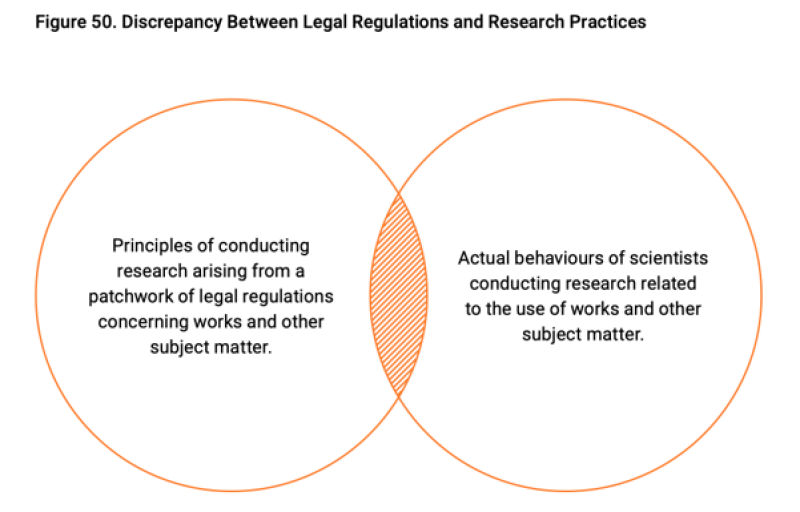
Taken together, these findings reveal a significant disconnect between copyright regulation and research practice. Rather than facilitating scientific inquiry, copyright law is often perceived as a source of friction that researchers must navigate, work around, or occasionally disregard in order to pursue their scientific mission.
Policy implications
The findings indicate that researchers are frequently pushed into a legal grey area between formal copyright rules and the practical realities of scientific research. Rather than providing clear and predictable conditions for research, the current framework often leaves researchers uncertain about the legality of routine research activities.
Image
To address this problem, the authors of this study propose reforms at two levels.
In the short term, they advocate the adoption of a European Standard+, under which Member States would implement research exceptions without introducing additional restrictions beyond those required by EU law. This model would also strengthen protection against contractual override and establish a principle of mutual recognition, ensuring that research uses lawful in one Member State are lawful throughout the EU.
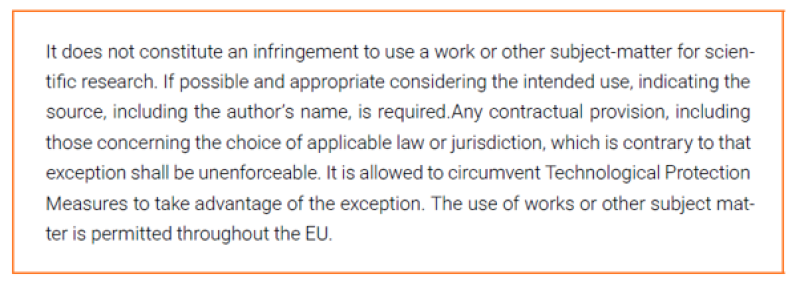
In the longer term, the report proposes an Enhanced Exception for Scientific Research: a mandatory and fully harmonised EU-wide research exception designed to support contemporary scientific practices. Such an exception would apply across borders, prevent contractual and technological restrictions from undermining researchers’ rights, and provide legal certainty for activities such as AI, Machine Learning, and TDM. Such an exception could be formulated as follows:
Image
Together, these proposals would create a coherent framework supporting the European Research Area and a meaningful right to research. The ongoing work on the European Research Area Act (ERA Act), together with the evaluation targeted initiative for a better copyright environment for European creativity and innovation, offers a timely opportunity to advance these reforms and ensure that copyright law better supports contemporary scientific research.
From copyright exceptions to a right to research
Beyond its immediate findings, the report contributes to the growing debate on the "Right to Research" in European and international law. As research increasingly depends on digital access, computational analysis, and international collaboration, copyright law has become a key factor shaping the production and circulation of knowledge. The report argues that if Europe wants to strengthen innovation and the European Research Area, it must move beyond a fragmented system of national exceptions towards a coherent framework that supports research. Such reform is also necessary to support the UN Sustainable Development Goals, which depend on effective knowledge creation, sharing, and scientific collaboration (The unsustainable patchwork of research exceptions in European copyright law: insights from the I-REx index).
Image: Edinburgh University Library, 1968 by N/A - University of Edinburgh, United Kingdom - CC BY, via Europeana.
Tags:
scientific research
Comments (0)
Your email address will not be published.



You may also like





August 27, 2026