Who Owns Outputs Generated with AI Twins?
August 27, 2026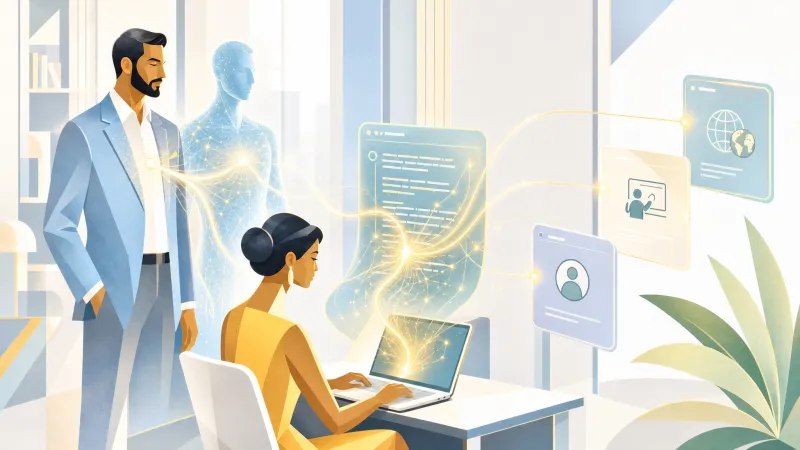
Who “owns” content generated with a person’s personal AI twin? In this post, we briefly explain the technology underlying personal AI twins and offer three possible answers to this question. We propose that the concepts of the author and authorship should be disaggregated. Distinguishing among different forms of human–AI collaboration, and thus among different forms of authorship, could facilitate a more nuanced understanding of how creators integrate AI tools into the creative process.
The arrival of generative AI and large language models (LLMs) has dramatically changed how we think about copyright law and its basic assumptions. For much of the past three years, public debates and most lawsuits against AI companies have focused on the use of copyrighted content and other publicly available datasets to train LLMs. However, another equally important question concerns the copyrightability and ownership of content generated using AI-powered tools.
Yet one topic has received insufficient attention: the copyrightability and ownership of content created using personal AI knowledge twins. An AI knowledge twin is a digital replica of an individual’s mind, powered by the individual’s data, such as publications, conference presentations, emails, audiovisual recordings, and diaries: essentially, anything that captures the individual’s intellectual life. This data is stored in a personal data vault and then made accessible via an LLM. The result is a digital replica of a person’s thoughts, capable of generating answers and creating a conversational experience that lets users interact with the individual’s knowledge base in an AI-mediated way.
AI-powered digital replicas of an individual’s mind will only proliferate. In fact, many individuals have recently begun creating their own knowledge twins and other versions of their digital minds. Examples include AI twins created by the innovator and entrepreneur Reid Hoffman, Yale ethics professor Luciano Floridi, and the authors of this comment.
Suppose, for example, that a user asks Paul AI to write a 1,000-word article on the disaggregation of copyright. Can this content be protected by copyright, and who should “own” the rights to AI-mediated output?
We can see three possible answers.
Answer 1: The Owner of the AI twin
The first approach attributes the initial title to the creator/owner of the AI twin. The reason for this is grounded in the so-called labor theory of copyright: the owner of the AI twin has invested time, effort, expertise, and creative labor into producing the underlying content and creating the AI twin of her intellectual life. To begin with, the AI twin would not even exist without such an intellectual corpus developed over many years. In other words, because the data powering the answers generated through the AI twin originally stems from the creator’s own knowledge base, the fruit of such intellectual investment (i.e., the answers generated by the AI twin) should belong to the AI twin owner. If copyright law is meant to recognize and reward the individual for her intellectual labor, it is only natural that the owner of the AI twin should have the initial title to whatever comes out of the “lips” of the AI twin.
This approach finds further support in personality theory. The AI twin could be deemed a structured extension of a person’s accumulated knowledge, judgment, and expressive identity. The owner of the AI twin should own the outputs because there is a close emotional bond between the underlying input data and the outputs that are generated by her AI twin.
Answer 2: The End-User of the AI twin
The second possible answer confers initial title on the user who interacts with the AI twin. The justification for this approach is grounded in the utilitarian theory of copyright: copyright is not only about rewarding past labor; it is also about creating incentives for future production. Without the user’s prompts, the new content would not exist: the user who chooses the prompt, defines the scope, frames the question, selects the context, and facilitates the creation of the content. In this regard, the user plays a necessary causal and creative role.
In this scenario, the AI twin is akin to an instrument in the hands of the user. Much like a painter with a brush, or a photographer with a camera, the user of an AI twin must skillfully interact with it to generate the content. The law should not turn a blind eye to this new form of content creation. The lack of legal certainty may curtail incentives to engage in the socially valuable creation of content. The utilitarian approach suggests that legal certainty is needed and forces us to face the question of whether, and under what conditions, the user of an AI twin could be recognized as the author and copyright owner of such content. (Critics may argue that a mere prompt is not enough to warrant copyright ownership, but this question is beyond the scope of this short comment).
Answer 3: Public Domain
A third possible answer is that this content should not be protected by copyright and that no one should own the output. The argument is that the content is “AI-generated” and lacks human authorship. This approach aligns with the current position of the United States Copyright Office (e.g., Entrance to Paradise decision where the Review Board held that ‘the Office will refuse to register a claim if it determines that a human being did not create the work’).
So, what might copyright lawyers learn from bioethics? In bioethics, medical concepts of death have changed enormously over the last thirty years in response to shifts in technology and scientific understandings. We might draw a useful analogy between the transformation of medical definitions of death and the transformation of authorship in copyright law. Today, we can deploy several different concepts of death, and these definitions coexist and are applied in different contexts.
This is the point where copyright law might learn something from bioethics. In medicine and bioethics, death is not treated as a single, simple event. We may speak of biological death (breakdown of the organism as a living body), neurological or cognitive death (irreversible loss of brain function), or social/personhood-based death (where the question is not only whether the body lives, but whether the person continues to exist in a meaningful relational, cognitive, or social sense).
Copyright law may benefit from a similar conceptual adjustment: we call this the disaggregation of authorship. Authorship should no longer be treated as a single, indivisible concept that either exists entirely or not at all. Instead, we may need to distinguish among several related but separate questions: Who supplied the underlying knowledge? Who initiated the output? Who exercised creative control over the process? Who takes the responsibility for the final version? Who should receive the economic benefit? Like bioethics, copyright law can learn to tolerate different concepts of authorship operating in parallel. Initial title, copyrightability, the degree of originality, as well as personality, labor, and utilitarian justifications may point in different directions depending on the specific nuances of human-AI collaboration.
Paths Forward
AI Twins represent a new social construct, and their emergence calls for a broader discussion about whether existing copyright rules should be adapted or whether a new social contract governing AI-generated outputs is needed. This demand is particularly important where market mechanisms, including the terms of use governing access to and use of an AI Twin, fail to produce fair or socially desirable outcomes. As this note has shown, different theories of intellectual property may support different approaches to the initial allocation of rights in AI Twin outputs or, in some circumstances, support leaving those outputs in the public domain. We hope that this note provides a modest step toward developing a more coherent framework for addressing these issues.
Tags:
ai twins
Comments (0)
Your email address will not be published.
You may also like
October 7, 2026

September 30, 2026