ICSID Arbitration Trends in Latin America: A Decade of Rising Claims and Peru’s Exposure
April 30, 2026
According to the most recent ICSID Caseload Statistics, 62 new cases were registered under the ICSID Convention (56) and the ICSID Additional Facility Rules (6) in 2025. This figure represents one of the highest caseloads ever recorded by ICSID in a single fiscal year. Following the trend since 2018, Latin American States contributed with about a third of all new cases registered in 2025.
I. The Increase in Claims Against Latin American States in the Past 10 years
The increase in the total number of ICSID arbitrations follows a general increase in the number of cases against States in South America, Central America, and the Caribbean (“Latin American States”) in the past 10 years, with a steady contribution of about a third of all ICSID cases registered annually since 2018. In 2015, out of a total of 52 cases, only 3 were registered against Latin American States, representing approximately 6%. Thereafter, the figures evolved as follows (based on ICSID caseload statistics for each year):
(i) 2016: 48 cases registered, 11 against Latin American States (23%);
(ii) 2017: 53 cases registered, 9 against Latin American States (17%);
(iii) 2018: 56 cases registered, 15 against Latin American States (27%);
(iv) 2019: 39 cases registered, 12 against Latin American States (31%);
(v) 2020: 58 cases registered, 16 against Latin American States (27%);
(vi) 2021: 66 cases registered, 21 against Latin American States (32%);
(vii) 2022: 41 cases registered, 11 against Latin American States (27%);
(viii) 2023: 57 cases registered, 22 against Latin American States (39%);
(ix) 2024: 55 cases registered, 18 against Latin American States (32%);
(x) 2025: 62 cases registered, 21 against Latin American States (33%).
Below is a chart illustrating this evolution:
Image
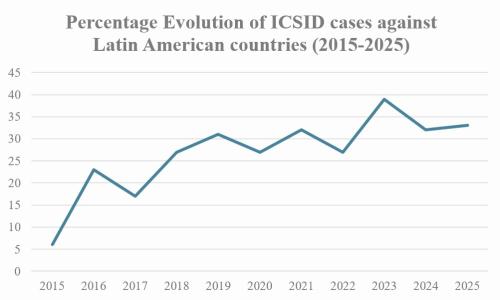
Prepared by the authors. Data systematized from the ICSID “Case Database”.
According to the ICSID Case Database, the Latin American States that have faced the highest number of ICSID claims historically are: (i) Argentina (60 cases); (ii) Venezuela (57 cases); and (iii) Peru (50 cases). It is no coincidence that these countries are precisely those that have experienced - and continue to experience - significant economic and political instability.
II. A Closer Look into the Numbers in 2025
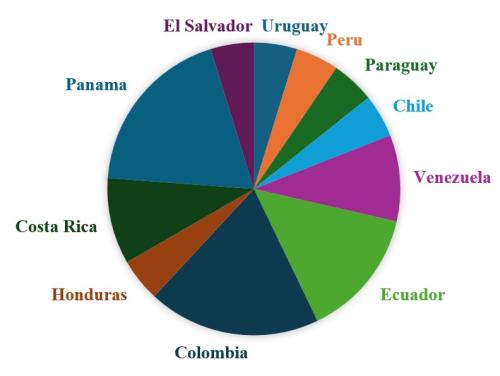
The total number of new cases against Latin American States reported by the most recent ICSID Caseload Statistics is illustrated below:
Image
Image
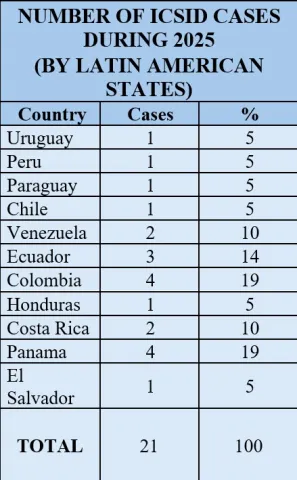
Prepared by the authors. Data systematized from the ICSID “Case Database”.
Based on the ICSID Case Database, the most litigious industries among the ICSID cases above were Oil, Gas, and Mining (7 cases), followed by Construction (4 cases). The remaining 10 cases were related to various other economic sectors. A summary of the industries involved in these new Latin American cases is provided below:
Image
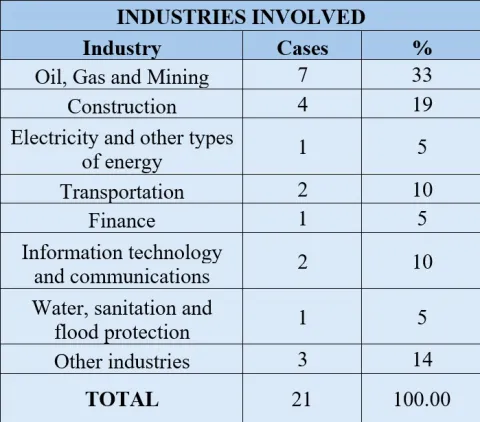
Prepared by the authors. Data systematized from the ICSID “Case Database” and information from the ICSID website.
III. The Peruvian Status in ICSID Proceedings
Despite being one of the most frequently sued countries before ICSID, Peru continues to rank as a significant recipient of foreign direct investment (“FDI”) among Latin America States.
According to the Foreign Direct Investment in Latin America and the Caribbean 2025, Peru led the annual FDI growth with a 56.7% increase from 2023 to 2024, amounting to USD 6.799 billion, far exceeding the regional average growth rate (7.1%). The growth of foreign investment in Peru from 2023 to 2024 represents a significant economic benefit reflected in its Gross Domestic Product (“GDP”).
Despite the recent growth in FDI, unpredictable and irregular changes in national policies, as well as wrongful State conduct, have given rise to international disputes that negatively impact the Peruvian GDP. This issue was addressed in detail in the Multiannual Macroeconomic Framework 2026–2029 issued by the Peruvian Ministry of Economy and Finance (“MEF”). The MEF estimated that, “in the worst-case scenario”, the amounts claimed by foreign investors and the associated arbitration costs (about USD 30 billion) represent up to 9.28% of Peru’s GDP as of 2024 (here).
According to the ICSID Case Database, Peru’s historical case record before ICSID amounts to 50 disputes, of which 23 remain pending (including cases with pending annulment proceedings). Following a series of favorable outcomes obtained until 2020, the State has been ordered to pay substantial sums in the past five years: out of 16 concluded proceedings, tribunals found Peru liable for breach of contracts or investment treaties in 8 cases; 5 cases were dismissed, and another 2 have been discontinued.
Below, we highlight 3 concluded arbitration proceedings of significant national relevance.
· Enagás and Enagás Internacional v. Republic of Peru
The dispute arose from the termination of a concession agreement for one of Peru’s most significant energy infrastructure initiatives. The project had been awarded to the consortium composed of Enagás and IITD (a subsidiary of Odebrecht). Enagás filed an arbitration against Peru arguing that measures adopted by the Peruvian State in the context of Odebrecht’s corruption investigations prevented Odebrecht from investing in the project and ultimately impaired the consortium’s ability to continue developing the project after significant investments had been made.
The majority of the Tribunal concluded that Peru’s actions, considered cumulatively, constituted a breach of the fair and equitable treatment standard and the prohibition against expropriation. Consequently, the Tribunal ordered Peru to pay a total of USD 302 million. The enforcement of the Award has been suspended because Peru challenged its validity.
This case underscores that investments allegedly tainted by corruption do not, per se, preclude investors’ access to investment arbitration. Rather, it is for the Tribunal to determine whether the investment is indeed tainted by corruption.
· Kuntur Wasi and Corporación América v. Republic of Peru
The arbitration stemmed from Peru’s unilateral termination of the concession agreement for the development and operation of the Chinchero Airport, a project conceived as strategic infrastructure for tourism development and air connectivity in southern Peru.
The Tribunal concluded that Peru’s conduct breached the concession agreement and the Peru-Argentina BIT, awarding the claimants USD 91.2 million, plus post-award interest. This decision reinforces the notion that deficient management of strategic concessions not only frustrates the development of relevant projects but also exposes the financial risks of Peru’s wrongful conduct in regard to large-scale projects.
· Lupaka Gold Corp. v. Republic of Peru
The dispute arose from Peru’s failure to provide effective protection against the occupation of the Invicta mine by the Rural Community of Parán. The Tribunal held that Peru’s prolonged inaction deprived the investor of control and possession of the asset, which constituted a breach of the State’s obligation to accord the investment fair and equitable treatment and full protection and security, ultimately leading to its expropriation. The Tribunal emphasized that merely promoting dialogue tables was insufficient in the case, and that effective measures must have been adopted to restore order. Accordingly, the Tribunal ordered Peru to pay USD 40.4 million in compensation, plus interest, and approximately USD 4.3 million in costs. The State’s failure to comply with the award in a timely manner has caused interests to accrue in the total amount of approximately USD 67 million.
This case illustrates how the State’s failure to address social conflicts in a timely manner can generate international liability and create a financial burden on the public treasury.
IV. Final Remarks
The international trend placing Latin America States at the center of ICSID-related disputes in the past 10 years clearly reveals the need for these States to adopt structural measures that provide investors with greater legal certainty and security.
With respect to Peru, taken together, the cases described above also reveal a troubling pattern. Beyond their specific factual circumstances, recent ICSID disputes reflect recurring shortcomings in State management of large-scale investment projects - whether through unsupported contractual terminations, lack of inter-institutional coordination, or inaction in the face of conflicts that ultimately deprive investors of the effective exercise of their rights.
In a context of FDI growth, the recurrence of adverse awards against Peru not only compromises significant public resources but also sends signals of legal uncertainty that may affect Peru’s perception as a reliable investment destination.
Strengthening State management of investment contracts, improving dispute prevention mechanisms, and professionalizing the State’s defense in international arbitration are not merely legal necessities but indispensable conditions to ensure that economic growth is not undermined by high-impact contingent fiscal liabilities.
Comments (0)
Your email address will not be published.