The 2026 USMCA Review: More Than a Trade Review – A Defining Moment for North American Investors
August 6, 2026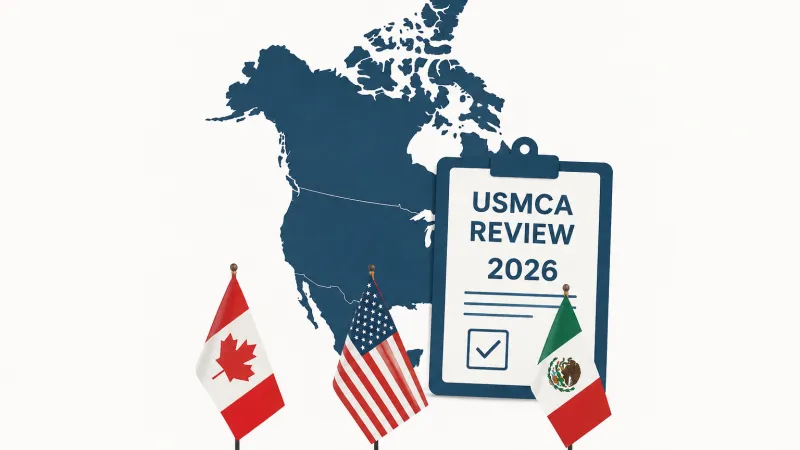
The United States–Mexico–Canada Agreement (“USMCA” or “Agreement”) entered into force on July 1, 2020, replacing the North American Free Trade Agreement (“NAFTA”) as the governing trade framework for North America – a transition previously examined on this Blog (see here and here). Although the USMCA is frequently described as a successor to the NAFTA, it differs from its predecessor in one particularly important respect: the inclusion of a built-in review and extension mechanism designed to force periodic political reconsideration of the Agreement.
That mechanism operated for the first time on July 1, 2026. While Article 34.7 of the USMCA formally refers to a “joint review,” the political and economic significance of the process has led many observers to view it as a de facto renegotiation of major aspects of the Agreement.
Although much of the public discussion has focused on the implications for trade policy, the review may prove equally significant for investors. As negotiations expand beyond traditional market-access issues into areas such as industrial policy, supply chains, regulatory compatibility, and sector-specific measures, businesses operating across North America should closely monitor developments that could affect both the value of their investments and the availability of treaty protections.
This post examines the 2026 joint review and what it means for investors. It begins with the legal framework under Article 34.7 and the negotiations culminating in the July 1, 2026 joint review, at which the United States declined to extend the Agreement for a new sixteen-year term. It then turns to the investment dimension – including the USMCA’s investor-State dispute settlement (“ISDS”) framework under Chapter 14 and the consequences of a potential withdrawal under Article 34.6 – before concluding with practical steps investors should consider to safeguard their investments.
I. The Legal Framework: Article 34.7 and the 2026 Joint Review
Article 34.7 of the USMCA requires the Free Trade Commission established by the Parties under the Agreement to convene on the sixth anniversary of the Agreement’s entry into force to conduct a “joint review” and determine whether to extend it for a new sixteen-year term. Failure to agree does not cause immediate termination; instead, annual reviews continue until the Agreement’s original expiration on July 1, 2036. In practice, the combination of the extension mechanism, the ability of Parties to submit recommendations, and the leverage created by the 2036 sunset date provides substantial room for what amounts to a renegotiation of significant provisions.
II. The Road to July 2026: Consultations and Preparatory Negotiations
The United States formally launched its review process in September 2025, when the United States Trade Representative (“USTR”) issued a Request for Public Comments and Notice of Public Hearing referencing Article 34.7. Mexico and Canada similarly initiated consultations during the same period.
The process entered a more substantive phase in early 2026. On March 5, 2026, USTR Jamieson Greer and Mexican Economy Secretary Marcelo Ebrard announced the launch of bilateral discussions, with negotiators instructed to focus on reducing dependence on extra-regional imports, strengthening rules of origin, and reinforcing North American supply chains. A subsequent meeting in Mexico City on April 20, 2026 identified economic security, critical minerals, and bilateral trade concerns as priority areas, with formal negotiations beginning the week of May 25, 2026.
III. The First and Second Negotiating Rounds and the July Joint Review
The first formal bilateral negotiating round took place in Mexico City on May 28–29, 2026, addressing automotive rules of origin, steel and aluminum, economic security, supply-chain resilience, and the U.S. goods trade deficit with Mexico. The second round, held in Washington, D.C. on June 15–17, 2026, advanced discussions on rules of origin and economic security, began conceptual discussions on agriculture, labor, and the environment, and agreed to establish a committee to review implementation of Chapter 12 on regulatory compatibility.
Taken together, these negotiations demonstrate that the review is already extending well beyond a technical assessment of the Agreement. Although most public attention has focused on the trade implications, the reshaping of the regulatory and commercial landscape across North America carries an equally important – if less visible – investment dimension.
On July 1, 2026, the United States declined to extend the USMCA for another sixteen-year term, stating that it would not renew the Agreement in its current form. Mexico and Canada each supported the extension. Although the USMCA remains fully in force, the U.S. decision triggered the annual review process under Article 34.7, discussed supra. As part of that process, additional bilateral negotiating rounds between the United States and Mexico are expected to follow in the coming months.
IV. Investment Protection and ISDS
Although USTR’s public statements do not identify Chapter 14 or ISDS as negotiation topics, the issues under discussion may nevertheless have significant implications for investors. Changes to rules of origin, local-content requirements, sector-specific regulation, or other trade disciplines may materially affect existing investments long before any amendment to Chapter 14 itself is considered.
Unlike NAFTA Chapter 11, which provided broad investor-State arbitration rights, the USMCA narrowed investor protection and access to arbitration. Under Article 14.2(4) of the USMCA, investors may submit claims only pursuant to three annexes: Annex 14-C preserved the NAFTA Chapter 11 arbitration for “legacy investment claims” during a three-year transition period that expired on July 1, 2023; Annex 14-D provides a narrower mechanism for current U.S.–Mexico disputes, excluding claims relating to the establishment or acquisition of investments and generally limiting claims to national treatment, most-favored-nation treatment, and direct expropriation; and Annex 14-E preserves broader protections only for qualifying “covered government contracts” in specified sectors, including oil and gas, power generation, telecommunications, transportation, and major infrastructure. Canada is not a participant in the USMCA ISDS framework.
Accordingly, even if Chapter 14 itself ultimately remains unchanged, the broader review process raises important questions regarding the future scope of investor protections and the continued availability of arbitration under the USMCA.
V. What Happens if a Party Withdraws?
Separate from the Article 34.7 review process mentioned above, Article 34.6 permits any Party to withdraw from the Agreement by providing written notice to the other Parties. Withdrawal becomes effective six months after notice is provided. Importantly, the Agreement remains in force between the remaining Parties.
Accordingly, if a Party were to withdraw, the Agreement would cease to apply to that Party following expiration of the six-month notice period, while continuing to govern trade relations between the remaining Parties of the Agreement unless modified by those Parties. Although withdrawal has often been viewed as a theoretical possibility, recent political statements suggest that it can no longer be dismissed as merely hypothetical. In June 2026, President Trump publicly stated that he would “rather have it terminated,” and that he was not inclined to renew the USMCA, while leaving open the possibility of negotiating a different arrangement. Those remarks plainly do not constitute formal notice under Article 34.6. Nevertheless, they underscore that withdrawal has become a realistic policy option rather than a purely academic possibility. The United States’ decision at the July 1 joint review not to extend the USMCA – while stopping well short of withdrawal – reinforces that the prospect of a more disruptive exit can no longer be treated as remote.
The implications for ISDS are considerably less clear. Unlike many bilateral investment treaties, the USMCA contains no general post-termination survival clause preserving Chapter 14 protections for pre-existing investments, nor any mechanism equivalent to Annex 14-C that would automatically preserve investor-State claims following a withdrawal under Article 34.6. In the absence of such provisions, whether investor-State consent survives a withdrawal for disputes not yet submitted to arbitration may become a significant–and potentially threshold–jurisdictional issue.
Investors should therefore not assume that new Chapter 14 claims would remain available once a withdrawal becomes effective. Claims already submitted prior to that date may stand on different footing, however, as treaty consent may already have been perfected before the withdrawing State ceased to be bound by the Agreement.
VI. Why Investors Should Act Now
For investors operating in North America, the principal risk associated with the 2026 review is unlikely to be a formal amendment to Chapter 14. The more immediate concern is that modifications to rules of origin, local-content requirements, customs enforcement, procurement frameworks, energy regulation, critical-mineral policies, or sector-specific regulatory measures may materially alter the economic assumptions upon which investments were originally made. As a result, the commercial consequences of the review may be felt well before any formal changes to the investment chapter are negotiated or take effect.
The 2026 review should not be viewed solely as a trade-policy exercise relevant to governments. For businesses with material exposure to steel and aluminum, energy, infrastructure, transportation, telecommunications, critical minerals, pharmaceuticals, medical devices, or government contracting, the review process carries direct implications for investment value, regulatory exposure, and dispute risk – and warrants the same legal and strategic attention as any significant shift in the underlying regulatory framework.
A proactive treaty-protection assessment is therefore increasingly important. Investors should evaluate whether their investments qualify for protection under Annex 14-D or Annex 14-E, whether qualifying government contracts exist, whether procedural requirements have been triggered, whether potential claims are approaching applicable limitations periods, and whether corporate structuring, contractual protections, stabilization provisions, or political-risk insurance may strengthen their position before a dispute crystallizes.
The possibility of withdrawal presents an even more significant consideration. If a Party invokes Article 34.6, the six-month notice period may become a critical window for evaluating available protections, preserving claims, and assessing whether access to Chapter 14 arbitration remains available. Because the USMCA does not contain a general survival clause preserving investor-State protections following withdrawal, investors should not wait until treaty uncertainty becomes an active dispute.
For many investors, the most important question is no longer whether the USMCA will be extended for another 16-year term, as the United States has already declined to do so. Rather, it is whether the now-activated annual review process itself may affect existing investments and whether the investor is positioned to preserve access to international dispute-resolution mechanisms.
In that respect, the 2026 review is not merely a trade-policy event. It is also a risk-management event, a treaty-planning event, and potentially a dispute-prevention event. Investors that assess those risks early will be better positioned to preserve rights, avoid procedural pitfalls, and protect long-term investments in an increasingly uncertain North American legal landscape.
This post does not express the views of the authors’ firms or their clients.
Comments (0)
Your email address will not be published.


You may also like

September 20, 2026
September 19, 2026

September 16, 2026