ICCA Handbook: Legislative Developments, First Half of 2026
September 19, 2026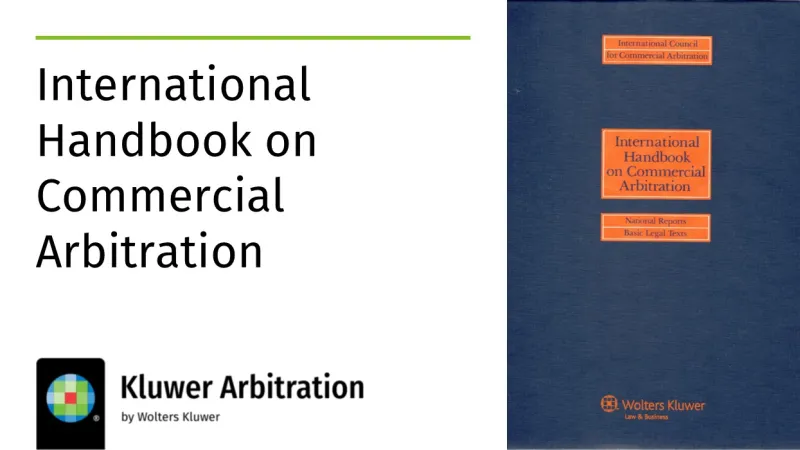
We are pleased to share the latest updates to the ICCA International Handbook on Commercial Arbitration, published in the first half of 2026. Reflecting our commitment to providing comprehensive, inclusive, and practical resources for arbitration practitioners globally, ICCA has published updates covering Reports for eight jurisdictions and new legislation for several more.
Report updated by Niamh Leinwather, Elisabeth Vanas-Metzler and Sophie Tesarik
In 18 OCg 3/22y (3 April 2024), the Austrian Supreme Court held that a partnership-resolution dispute was not objectively arbitrable because the arrangement did not guarantee all partners sufficient ex ante participation rights, without which the award would not bind all partners. In response, the Vienna Rules effective 1 January 2025 introduced Supplementary Rules for Corporate Disputes (Annex 7) and a new model clause for Articles of Association.
The revised Report also covers two Supreme Court decisions declaring mediation clauses ineffective for want of a sufficiently certain procedural framework, and notes that VIAC has amended its model mediation clauses and the Vienna Mediation Rules accordingly as of 1 January 2025.
Report updated by Jeffrey Elkinson
Recent decisions reinforce the willingness of courts to protect arbitration agreements through stays and anti-suit injunctions. The Report also addresses intentional and vexatious delay, which may justify restraining an arbitration pending an application to terminate the proceedings where delay threatens a fair hearing or causes serious prejudice. It further confirms the availability of freezing and asset-disclosure orders in support of enforcement and expands the discussion on arbitrator disclosure, privilege and concurrent expert evidence.
Report updated by Tatsuya Nakamura and Shinji Ogawa
The revised Report expands on Japan’s institutional and judicial infrastructure, highlighting the Business Court of the Tokyo District Court, the JCAA Advisory Board established in October 2024 and the 2024 TOMAC Rules. It also includes discussion of the JCAA procedures for joinder and consolidation; the enforceability of Tribunal-ordered interim measures; and the distinction between an enforcement decision under the Arbitration Act and subsequent execution under the Civil Enforcement Act.
Report updated by Giedrė Aukštuolienė and Simona Budreikaitė
The revised Report consolidates Lithuanian case law on the New York Convention. In 3K-3-41-823/2024 (29 February 2024), the Supreme Court addressed enforcement against a non-signatory. It held that the enforcing court must assess whether the reasoning for extending the arbitration agreement is not manifestly insufficient.
Other decisions have also narrowed the definition of “public policy” to mean “international public policy” for the purposes of setting aside an award. They have also confirmed that courts cannot review the merits of a case during enforcement proceedings, and that only “serious” departures from agreed procedures justify refusal.
The investment arbitration chapter reflects Lithuania’s withdrawal from the Energy Charter Treaty effective 8 August 2026, and the termination of BITs with Russia and Belarus.
Report updated by Tan Sri Dato’ Cecil Abraham, Aniz Ahmad Amirudin and Shabana Farhaana Amirudin
Malaysia’s Arbitration (Amendment) Act 2024 entered into force on 1 January 2026, introducing several changes to the Arbitration Act 2005. The new Section 9A provides that an arbitration agreement is governed by the law expressly chosen by the parties or, absent an express choice, the law of the seat. A choice of law for the underlying contract does not, by itself, constitute a choice for the arbitration agreement.
The updated Act now regulates third-party funding in arbitration, has ceased the application of maintenance and champerty in relation to these agreements, and has introduced disclosure and confidentiality requirements. The recent reform also broadened the definition of an arbitral tribunal to now expressly include emergency arbitrators.
The Report also highlights the governance reform of the AIAC Court of Arbitration. Since 2024 a supplementary agreement between Malaysia and the Asian African Legal Consultative Organization (“AALCO”) has also designated the President of the AIAC Court of Arbitration as the statutory appointing authority under Section 13.
Report updated by Sarah McKenzie and Vlad Movshovich
The new 2017 International Arbitration Act aligned South Africa with the UNCITRAL Model Law. This is seen in new case law reaffirming South Africa’s arbitration-friendly posture: Tee Que Trading Services v. Oracle Corporation South Africa and Industrial Development Corporation v. Kalagadi Manganese confirm that courts must refer parties to arbitration unless the agreement is null and void, inoperative or incapable of performance—including when the dispute overlaps with other claims. Kalagadi Manganese further confirms that public entities are bound by arbitration agreements under the International Arbitration Act.
In the context of enforcement requests, courts have refused to delay enforcement on account of separate proceedings; placed the burden of proof firmly on the resisting party; and confirmed that the three-month period for setting aside an international award is strict, subject only to a narrow exception for previously undiscovered fraud or corruption.
Report updated by Caroline Falconer
Two Swedish Supreme Court judgments of 26 May 2025 clarified the conditions for partial annulment. In Nyköpingshem Aktiebolag v. SEHED Byggmästargruppen AB, the Court declined to sever the challenged portion because doing so would have created res judicata obstacles to re-examining the affected claims. In Republic of Poland v. PD, the Court upheld an Energy Charter Treaty award in relation to a Swiss investor while maintaining annulment in relation to four EU investors, confirming that the EU-law public-policy objection did not extend to third-country investors. The Report also addresses the loss of the right to rely on a jurisdictional objection where a party participates in arbitration without raising it at the earliest opportunity.
Report updated by Dr Saowanee Asawaroj
The revisions note that, while Thai courts have no specific standard for assessing whether an arbitration agreement is null and void, inoperative or incapable of being performed, they have in practice conducted full examinations.
Thai courts have also confirmed that arbitral tribunals are not empowered by the Thai Arbitration Act to grant interim measures. Parties requiring interim relief must therefore apply to the competent court under Section 16. The Report also explains the kompetenz-kompetenz framework under Section 24, which requires jurisdictional objections to be raised no later than the statement of defence. The investment chapter has been updated to include Kingsgate v. Thailand.
England and Wales — Major Legislative Development
Legislation updated: Arbitration Act 1996 (as amended by the Arbitration Act 2025)
A consolidated version of Arbitration Act 2025 entered into force on 1 August 2025. The amended Act has been published in the Handbook and an updated National Report is forthcoming.
The most consequential change introduced by the 2025 Act is a statutory rule determining the law governing the arbitration agreement. The new Section 6A provides that the law expressly chosen for the arbitration agreement applies; absent such a choice, the law of the seat governs as default. A choice of law for the main contract does not by itself constitute a choice for the arbitration agreement, departing from the approach of the Supreme Court majority decision in Enka v. Chubb. Section 6A may apply even where the seat is outside England and Wales.
Further reforms include: a mandatory continuing duty of disclosure for prospective and appointed arbitrators (new Section 23A), which extends to matters they ought reasonably to know and cannot be excluded by agreement; a summary disposal power (new Section 39A) for claims or defences with no real prospect of success; statutory recognition of emergency arbitrators and their ability to issue peremptory orders enforceable by the court; and a revised Section 67 on procedure directing courts to prefer remission over setting aside and restricting the introduction of new grounds or evidence not raised before the tribunal.
Other Legislative and Institutional Developments
In Bulgaria, the Law on International Commercial Arbitration 1988 was extensively amended in 2025 and renamed the Law on Arbitration, with corresponding amendments to the Civil Procedure Code and the Law on Mediation. Mexico has published the civil arbitration provisions of the National Code of Civil and Family Proceedings (enacted June 2023 and being implemented progressively through 2027), available as a new Annex IV to the Handbook; the separate commercial arbitration regime under the Commercial Code remains unchanged. In the Netherlands, the consolidated arbitration legislation published in the Handbook has been updated to reflect amendments in force since 2022, most notably new Articles 1022b and 1074b, confirming that an arbitration agreement does not prevent a party from seeking preliminary evidentiary measures from a Dutch court, whether the seat is domestic or abroad. Switzerland has updated Part 3 of the Code of Civil Procedure on domestic arbitration, incorporating amendments in force from 1 January 2025. Cyprus has amended its 1987 international commercial arbitration legislation through Law 11(I)/2024 to align itself with the 2006 UNCITRAL Model Law. In Bahrain, the BCDR issued new Arbitration Rules effective 1 October 2022, introduced Sports Arbitration Rules and expanded the use of English in commercial proceedings. Pakistan’s Alternative Dispute Resolution (Amendment) Act 2026 introduces a mandatory referral obligation for specified categories of dispute.
Reforms to Watch
We are closely tracking legislative reform in several jurisdictions. France recently published Décret n. 2026-741 reflecting phase 1 of the ongoing arbitration reform. In Germany, the Cabinet adopted the Regierungsentwurf modernising the Tenth Book of the ZPO on 10 June 2026; the draft is now before the Bundestag and Bundesrat, with entry into force targeted for early 2027. Ireland’s Arbitration (Amendment) Bill 2025 was enacted on 17 June 2026 as the Arbitration (Amendment) Act 2026. Saudi Arabia published a draft Arbitration Law in September 2025 proposing comprehensive reforms including tribunal interim measures, joinder, consolidation and electronic awards. While the draft Arbitration Law remains pending before the Shura Council and Council of Ministers, the SCCA has published a country report with case law on 1 July 2026. We are also tracking proposed legislation in Finland, Kenya, Rwanda, Sri Lanka and Zambia, where new or amended arbitration or mediation legislation is under consideration.
Coming soon: Supplement 145
Our upcoming Supplement 145 will feature a revised National Report on Ghana by Doe Tsikata and Matilda Idun-Donkor. The Supplement will also introduce a brand-new National Report on Tunisia by Fatma Abdallah, making Tunisia the 87th jurisdiction covered by the Handbook. Legislative updates for China and Vietnam will also be included.
We are grateful to all our authors for their continued commitment to keeping the ICCA Handbook current. Their expertise and insights remain essential to its value as an authoritative and practical resource for arbitration practitioners worldwide.
Comments (0)
Your email address will not be published.

You may also like


September 16, 2026