The 2026 ICC Arbitration Rules: A Practical Guide for Counsel to the Most Significant Overhaul in a Decade
June 8, 2026
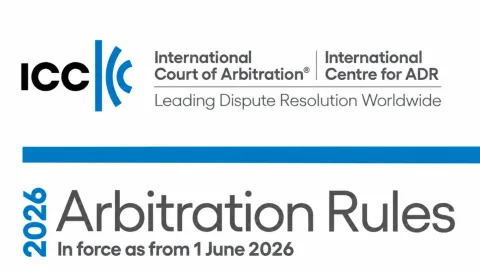
On 1 June 2026, the ICC's newly revised Arbitration Rules (the “Rules”) entered into force. They constitute a far-reaching overhaul of the ICC’s arbitration framework. The Terms of Reference are abolished. Ex parte emergency relief is now available. A new Highly Expedited Arbitration procedure promises final awards within three months. A formal early determination mechanism gives parties a tool to dispose of unmeritorious claims before they consume months or years of proceedings.
The Rules come into force only five years after the last revision in 2021 and introduce a substantial number of changes, reflecting the rapid evolution of international arbitration practice.
These revisions are far more than incremental refinements. They will reshape how parties draft arbitration clauses, structure cases and conduct proceedings from first filing to the final award. In this blogpost, we set out the key changes, explain what they mean in practice, and identify the steps parties should be taking going forward.
No More (Mandatory) Terms of Reference
The Terms of Reference — long a hallmark of ICC arbitration — are abolished as a mandatory step. The practical impact of this change is non-negligible.
It draws on a practical insight from the Expedited Procedure Provisions introduced in 2017, under which Terms of Reference were never required: their absence has not impaired the conduct of those proceedings in any material respect, confirming that the step can be dispensed with without detriment to the integrity of the arbitral process.
Under the new framework, the initial case management conference (new Article 24) fully replaces the Terms of Reference as the procedural cut-off for new claims and defences (new Article 25), unless the tribunal decides that Terms of Reference can be useful in a given case.
The practical consequence is that the window for refining or expanding claims closes significantly earlier. Parties who previously relied on the Terms of Reference stage to refine their case — identifying potential additional claims and polishing their relief sought — must now complete that work before the initial case management conference.
Early Determination: A New Tactical Tool
The new Article 30 gives parties a formal mechanism to seek the early dismissal of claims or defences that are manifestly without merit or manifestly outside the tribunal's jurisdiction. The mechanism is not entirely new: a substantially similar provision is contained in the 2020 ICC Note on the Conduct of the Arbitration under the ICC Rules (paras. 109 to 114). The most significant development is the elevation of early determination from soft guidance to a binding provision of the Rules, conferring greater authority and predictability on the mechanism. Beyond that elevation, the mechanism remains largely unchanged subject to two notable refinements, which merit attention.
First, the removal of the requirement that applications be made "as promptly as possible" broadens access to the mechanism: parties may now seek early determination at any stage of the proceedings, rather than being constrained to raise it at the earliest opportunity.
Second, the new rule confirms the tribunal's discretion to decide whether to allow the application for early determination to proceed — a useful clarification for cases in which bifurcation of jurisdiction, limitation of claims, liability or quantum may be more appropriate than an outright dismissal.
Early determination is a significant tactical addition. Counsel acting for respondents should assess early determination prospects from the moment they receive a Request for Arbitration: is there a jurisdictional defect or a manifestly unmeritorious claim that can be disposed of before the proceedings consume significant resources? Counsel acting for claimants should anticipate that respondents will deploy this tool — and ensure that their pleadings are sufficiently robust to withstand an early challenge on the papers.
Emergency Arbitration: Broader Scope and Ex Parte Relief
The Emergency Arbitrator Provisions (now in Appendix IV) have been expanded in one important respect. The Rules introduce a Preliminary Order mechanism (Article 7 of Appendix IV) that specifically permits ex parte relief – something that was de facto occasionally seen under the previous Rules.
A party may request a preliminary order directing the opposing party not to frustrate the purpose of the emergency application (e.g. asset dissipation, destruction of evidence), and this request may be made and decided without prior notice to the other side. The application and request are then notified to the opposing party once the emergency arbitrator has ruled.
Expedited Procedure: A Higher Threshold
The threshold for the automatic application of the Expedited Procedure rises from USD 3 million to USD 4 million for arbitration agreements concluded on or after 1 June 2026. The change is straightforward, but its implications for existing arbitration clauses are not. Parties remain free to opt into the expedited procedure regardless of the amount in dispute or opt out, if they consider that the Expedited Procedure may not be suitable. Therefore, parties should review their contracts, respectively arbitration agreements to assess whether the revised threshold alters exposure to the Expedited Procedure regime — and, where appropriate, consider whether an express opt-in or opt-out is warranted.
Highly Expedited Arbitration: Maximum Speed, Available by Opt-in Only
The revised Rules introduce an entirely new Highly Expedited Arbitration procedure (New Article 33 and Appendix VI), which is available where all parties agree. Unlike the Expedited Procedure — which applies by default below a monetary threshold and can be imposed over a party's objection — the Highly Expedited Arbitration is purely consensual.
The parameters are strict: a sole arbitrator decides the dispute, the Statement of Claim must accompany the Request for Arbitration, and the final award must be rendered within three months from the date of the initial case management conference. The tribunal has discretion to decide the dispute solely on the basis of the documents submitted by the parties, without a hearing and without examination of witnesses or experts. While parties may even agree to dispense with reasoning in the award, they should carefully check possible implications under the applicable lex arbitri. Joinder and consolidation are excluded.
For counsel drafting arbitration clauses, this is a powerful new option — particularly for lower-value commercial disputes or recurring contractual relationships where speed and finality are paramount. It replaces the ad hoc arrangements parties previously had to negotiate on a case-by-case basis and provides a predictable, institutionally supported framework. Counsel should consider now whether to include a Highly Expedited Arbitration election in their clients' standard dispute resolution clauses, rather than waiting for a dispute to arise.
Confidentiality: A Deliberate Asymmetry
The new Rules impose express confidentiality obligations on arbitrators (new Article 12 (8)), and tribunal secretaries (new Article 44 (2)), covering all matters relating to the arbitration. Notably, the revised Rules still do not impose a corresponding obligation on the parties.
This is a deliberate choice, suggesting that parties are better served by tailored confidentiality agreements than by a blanket rule that may not reflect the needs of a particular case. The practical consequence is straightforward: if your client requires confidentiality protection, especially when confidential or commercially sensitive information is potentially at stake, you may wish to ensure that a confidentiality clause will make it into the dispute resolution clause.
Disclosure Lists: A New Obligation for Parties
The new Article 12 (5) now requires parties to submit a list of individuals and entities whom they believe prospective arbitrators should consider for disclosure purposes, together with the reasons therefor.
This is a genuinely new procedural obligation — until now, the team in charge of the case at the ICC Secretariat compiled a list of relevant (related) entities on the basis of the Request for Arbitration and the Answer, which was included in the case information document sent to prospective arbitrators for the purposes of their conflict check. Under the revised Rules, the burden shifts to the parties themselves. By placing the identification of any related entities in the hands of those with actual knowledge of the relevant relationships, the new mechanism serves a dual function: it enables arbitrators to carry out a more targeted conflict check, but it also operates as a prophylactic measure, surfacing potential conflicts before they crystallise into challenges that may derail proceedings months into the case.
The authors wish to thank Dr Alexander Archner for his assistance in the preparation of this paper.
Comments (0)
Your email address will not be published.