Editor's Picks: Latest Additions to the ICCA Yearbook 2026
July 20, 2026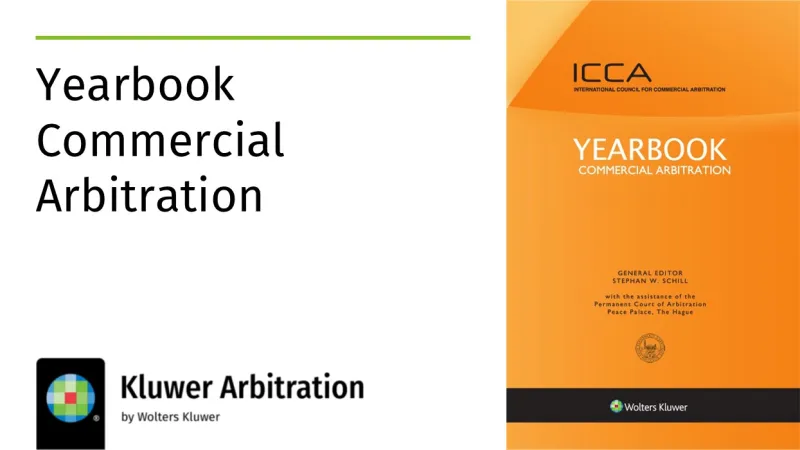
The latest updates to the 2026 Yearbook Commercial Arbitration are available on the Kluwer Arbitration database. These updates feature two regional focuses: one on Spanish-speaking jurisdictions, with decisions from Argentina, Colombia, Costa Rica, Ecuador, Peru, and Spain, and one on the Asia-Pacific, with decisions from China, Hong Kong, India, Pakistan, Singapore, and Vietnam.
Among the highlights of the Spanish-speaking jurisdictions selection is the decision in which the Corte Constitucional of Ecuador held, in the context of enforcement proceedings, that a domestic homologation requirement for foreign awards had to give way to Article III of the New York Convention, which prohibits imposing more onerous conditions on foreign awards than on domestic ones. The selection also addresses how the public policy exception to enforcement should be calibrated so as not to become a vehicle for an impermissible review of the merits of a foreign award. Two decisions by the Colombian Corte Suprema de Justicia (Zurgroup S.A. v. Importaciones y Exportaciones Fenix S.A.S. and Tricon Dry Chemicals LLC v. Agroindustrias El Molino de la Costa S.A.S.), a decision from the Costa Rican Corte Suprema de Justicia and a decision from the Peruvian Corte Superior de Justicia converge on a consistent answer: public policy means the fundamental principles of the domestic legal order, not a licence to revisit the tribunal’s findings of fact or law. The same conclusion was reached by the Spanish courts of Barcelona, Madrid, and Navarre in three decisions included in the update on Spanish jurisprudence prepared in cooperation with the Centro Internacional e Iberoamericano de Arbitraje de Madrid (CIIAM).
Turning to the Asia-Pacific selection, particularly noteworthy is a substantial update on Singaporean jurisprudence, prepared in cooperation with the Singapore International Commercial Court (SICC). The selection features 15 decisions rendered by the SICC in 2025 and includes the SICC’s decision in the well-known Hulley Enterprises Ltd et al. v. The Russian Federation dispute concerning enforcement of Dutch arbitral awards against the Russian Federation arising from the Yukos expropriation, where the SICC applied the doctrine of transnational issue estoppel to hold that the Russian Federation was precluded from relitigating its sovereign immunity objections, since those issues had already been finally decided against it by the Dutch courts at the seat. Also of interest is the Novo Nordisk A/S v. KBP Biosciences Pte Ltd et al. case, in which the SICC granted a worldwide Mareva injunction in support of a New York-seated arbitration, holding that a sufficient link between the arbitration and Singapore was enough to find jurisdiction, regardless of the place of arbitration. In DKB v. DKC, the SICC stayed enforcement of a Swiss award in light of a post-award settlement deed referring future disputes to arbitration, framing the question as one of contractual preclusion rather than grounds for refusal of enforcement. In Cooperativa Muratori and Cementisti – CMC di Ravenna v. Department of Water Supply & Sewerage Management, Kathmandu et al., the SICC granted an anti-suit injunction restraining proceedings in Nepal that sought to set aside a tribunal’s decision establishing Singapore as the seat of arbitration, holding that agreements on the seat impose a negative obligation not to challenge tribunal decisions outside the seat’s courts, and – addressing sovereign immunity raised proprio motu – that the second defendant’s links to the Government of Nepal did not extend immunity to a separate entity engaged in a commercial transaction.
Also featured in this selection are five decisions rendered by Vietnamese courts in enforcement proceedings of foreign awards. Of particular interest is the Ho Chi Minh City High-Level People’s Court decision in S C v. R Joint Stock Company, where the Court set aside a first-instance refusal and recognized a SIAC award, declining to revisit the merits and applying Article V of the 1958 New York Convention directly rather than the corresponding provisions of the Vietnamese Civil Procedure Code, whose wording diverges from the Convention’s.
Another substantial update covers Indian jurisprudence, with nine decisions spanning 2024 and 2025 across three areas. On enforcement, courts in Chhattisgarh, Calcutta, Delhi, and Bombay upheld foreign awards in five decisions, dismissing public policy objections (Bulk Trading S.A. v. Mahendra Sponge and Power Ltd., Mercator Ltd. v. Dredging Corporation of India Ltd., and Neilan International Co Limited v. Powerica Limited) as well as due process and pre-condition objections (International Air Transport Association Through Its Head IATA India Branch Mr Rodney Augustine D Cruz v. Spring Travels Pvt Ltd Through Its Managing Director Mr Mandeep Singh Anand), and finding that constructive res judicata barred the award debtor from raising an objection it could have raised in earlier proceedings in which the award’s enforceability had been discussed (Centrotrade Minerals & Metals Inc. v. Hindustan Copper Limited). In two decisions rendered by the Supreme Court in the context of petitions to appoint arbitrators, the Supreme Court clarified in Ajay Madhusudan Patel & Ors v. Jyotrindra S. Patel & Ors that at that stage its analysis was limited to a prima facie assessment of the existence of the arbitration agreement, and in Arif Azim Co. Ltd. v. Micromax Informatics FZE that its power to appoint arbitrators was limited to arbitrations seated in India. The selection also includes Gayatri Balasamy v. M/S ISG Novasoft Technologies Limited, in which the Supreme Court resolved a conflict in the case law and held, by majority, that courts have limited power to modify arbitral awards under Section 34 of the Arbitration Act 1996 in narrowly defined circumstances, with a dissent raising concerns about compatibility with the fundamental principles of arbitration and the enforceability of modified awards.
Rounding out the Asia-Pacific selection, in CCC v. AAC, the Court of First Instance of the High Court of the Hong Kong Special Administrative Region dismissed an application to set aside leave to enforce an award rendered under the Online Arbitration Rules of the Hong Kong Arbitration Society in a moneylending dispute, rejecting a public policy objection grounded in alleged signature forgery, finding that there was evidence that the respondent had received SMS notice of the arbitration, and holding that the expeditious conduct of the proceedings had not deprived him of a fair opportunity to present his case.
The full decisions, including English translations and indexing, are available by accessing the 2026 Yearbook on Kluwer Arbitration.
Comments (0)
Your email address will not be published.