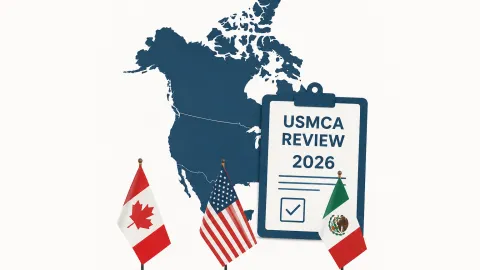
The United States–Mexico–Canada Agreement (“USMCA” or “Agreement”) entered into force on July 1, 2020, replacing the North American Free Trade Agreement (“NAFTA”) as the governing trade framework for…
Vivekananda Neelakantan is the Registrar of the Singapore International Arbitration Centre (“SIAC”). He brings a wealth of experience in international arbitration, having practised in India and…
International trade rarely moves through one contract. It moves through documentary chains: charterparties, bills of lading, sale contracts, guarantees, letters of indemnity, insurance policies,…
The public consultation for which AI uses should classify as “high-risk” under the EU AI Act is closed. On 23 July 2026, the window shut on the European Commission's targeted consultation on its…
The Editorial Board of Kluwer Arbitration Blog announces the opening of the following position with Kluwer Arbitration Blog: Assistant Editor for South Asia. Experience and knowledge in…
London International Disputes Week 2026 featured two thought-provoking discussions on the legal challenges facing the energy sector.The first, co-hosted by CMS and Twenty Essex, focused on Energy…
Welcome to the Kluwer Arbitration Blog, Dr. Al-Mandhari. We are grateful for this opportunity to learn more about the Oman Commercial Arbitration Centre (“OCAC”) and your experience with…
The Madras High Court in Rhutikumari vs. Zanmai Labs Pvt. Ltd. & Ors. marks a significant development in India’s treatment of cryptocurrency. The Madras High Court has held that tokens held on a…
Section 9 of India’s Arbitration and Conciliation Act, 1996 (“Act”) allows parties to seek interim relief(s) from the courts at three distinct stages, i.e. (i) prior to commencement of arbitral…
“It was the best of times, it was the worst of times, […] it was the epoch of belief, it was the epoch of incredulity” wrote Charles Dickens at the opening of A Tale of Two Cities (1859). Spanish…