


LIDW26: Main Conference of the 7th Edition of the LIDW
June 26, 2026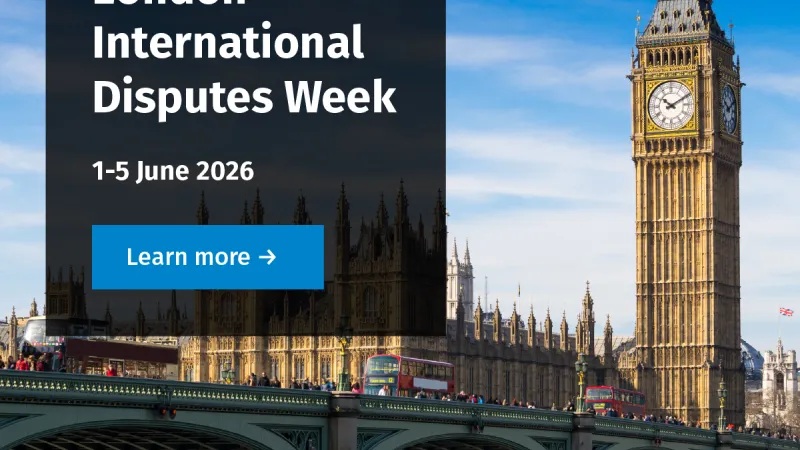
On 2 June 2026, the Queen Elizabeth II Centre opened its doors for the Main Conference of the 7th edition of the London International Disputes Week (“LIDW”). Under the theme Tradition, Trust and Transformation in International Dispute Resolution, the all-day event brought together the international disputes community to examine pressing questions across several sessions.
1. AI, Authenticity and the Future of Evidence: Disputes in a Volatile World
The morning keynote came from Sean West (The Unruly Corporation and Hence Technologies), who argued that the erosion of the rule of law, geopolitical instability and rapid technological change are generating new categories of risk for businesses and states. From politically motivated litigation and AI-driven disinformation to mass automated legal claims, these forces are reshaping commerce and challenge foundational concepts of contract law such as foreseeability and force majeure. West closed with a reminder that we are all responsible for the institutions we rely upon, and must ask what we are doing to sustain them.
The keynote was followed by a panel on AI, Authenticity and the Future of Evidence: Trust in a Synthetic World, chaired by Gregory Mostyn (Wexlink) and featuring Richard Blann (Lloyds Banking Group), Sophie Nappert (3VB) and Rt. Hon. The Lord Thomas of Cwmgiedd (President of the Qatar International Court).
Blann highlighted the burden mass AI-assisted litigation places on businesses, warning that without clearer disclosure and proportionality guidance, corporations risk being overwhelmed, and flagged employees unwittingly creating discoverable records through AI use. Nappert cautioned that arbitrators already face procedural challenges from AI-generated submissions and evidence, questioning whether documentary evidence can remain central given its abundance and difficulty to verify, and warned that confidentiality may grow more vulnerable where bad actors face less scrutiny. Lord Thomas called for procedural innovation and international judicial collaboration, urging courts and tribunals to act rather than wait on legislative reform; his advice to junior lawyers was to use AI without trusting it blindly, and remember that safeguarding the rule of law is their generation's defining mission. The panel agreed human judgment will grow more valuable, not less, in the AI era.
2. The Rise of Mass Claims: Balancing Investor Confidence with Access to Justice
The second session focused on the rise of mass claims, chaired by Simon Duncombe (Freshfields) and featuring Sophie Thomson (BT Group), Seema Kennedy OBE (Fair Civil Justice), Campbell Jackson (EY), Kimberly Phillips (Shell USA), Shazia Yamin (Mishcon de Reya) and Nicholas Gibson KC (Matrix Chambers).
Yamin argued that the rise of mass claims reflects the maturity of litigation funding and structural changes in modern harm: injuries such as data breaches, algorithmic discrimination and digital platform overcharges are diffuse and widespread, making collective mechanisms the only realistic avenue for redress. Kennedy was more sceptical, questioning whether the market around mass claims truly benefits claimants or primarily serves intermediaries.
Phillips noted that collective procedures are expanding across jurisdictions, spreading from the US to the UK and the Netherlands without uniformity, making litigation's reputational and financial risks harder to manage. Thomson echoed this, highlighting the significant legal costs, management time and commercial uncertainty generated by large-scale claims, particularly where proceedings run for years before merits can be tested.
Gibson challenged the notion that unmeritorious claims readily enter the system, arguing private enforcement does its job by preventing companies from retaining the gains of unlawful conduct. Yamin agreed, noting that funders and insurers perform rigorous due diligence before committing capital, pointing to pharmaceuticals as an industry that has long faced significant class action exposure yet continues to lead in R&D investment.
Jackson drew on Australia's experience to emphasise that any collective action regime's legitimacy depends on its ability to deliver compensation efficiently and accurately, with Australian courts playing a proactive role in establishing settlements and supervising distribution.
Looking ahead, panellists identified climate-related claims, AI-generated harms and algorithmic decision-making as likely frontiers, closing with a call for litigation funding reform and possible expansion of opt-out redress beyond competition law.
3. Law at the Frontiers
Moderated by Mark Evans (Law Society of England and Wales), the second panel of LIDW discussed the trends, challenges and opportunities of law and dispute resolution in frontier areas.
On deep sea water disputes, Toby Fisher (Matrix Chambers) highlighted that regulation here has largely been shaped by a need to avoid disputes over valuable minerals that can be harvested from the deep seabed. The current regime, codified in the United Nations Convention on the Law of the Sea (“UNCLOS”), reflects customary international law and establishes that these minerals belong to the common heritage of humankind. The US is not a UNCLOS member and has been challenging the common heritage principle's status as customary law; he flagged concerns over its Deep Seabed Hard Mineral Resources Act, warning that US deep sea mining could threaten not just Part 11 but the entire UNCLOS framework.
On the Antarctic and the Arctic, Alison Macdonald KC (Essex Court Chambers) compared both regimes: the Antarctic is governed by the Antarctic Treaty system, while the Arctic has no specific treaty, relying instead on UNCLOS. She cited climate change as a major factor driving disputes here, given geopolitical tensions over shipping routes and resources.
On space disputes, Rachael O’Grady (Mayer Brown) highlighted that proper regulation is required for the future, accounting for the privatisation of the sector and placing responsibility on governments to ensure licensed activities are appropriately robust. Regulation, she said, must allow continued benefit from space technology without stifling investment in innovation.
Terence McCulley (McLarty) closed by sharing closed by sharing concerns over how geopolitical tensions threaten the international legal order, warning that these regimes ultimately rely on States' willingness to uphold the systems they have built.
4. The Great Costs Debate and Pro Bono Address
Starting off the afternoon sessions, Aseel Zimmo moderated a debate between Paula Hodges KC and Carsten van de Sande (Hengeler Mueller). The debate revolved around the issue of how both arbitration and litigation can make dispute resolution more cost-effective for clients. The pair discussed methods for case management, balancing efficiency with due process, the role of institutions and procedural models that have proven to increase cost efficiency.
Carsten's contributions centred on the client: he urged practitioners to have honest cost conversations from the outset, explaining what can and cannot be controlled, and to build trust through transparency. Paula's suggestions followed a similar line while tailoring the process to the dispute, stressing the importance of clarifying clients' desired level of service and designing the process proportionately.
Before moving on, Sharif Shivji KC (4 Stone Buildings) and Yasmin Waljee OBE (Hogan Lovells) made passionate speeches advocating for greater involvement of commercial lawyers in pro bono. As Waljee put it, without the rule of law, the justice system we depend on will not survive.
5. The Intersection of Law and Politics - the Rule of Law under Pressure
Chairing the panel, Maeve Hanna (A&O Shearman) framed the discussion around two questions: why is the rule of law under pressure, and what does the shifting relationship between law and politics mean for lawyers and clients?
On the first question, David Gauke (Macfarlanes) attributed the rule of law's struggles to populism, fuelled by low growth, rapid social change and social media. Citing Tony Blair's description of Trump's appeal as someone who ploughs through brick walls, he noted that the rule of law does constrain arbitrary power; the legal profession had taken public support for granted and must now make its case from first principles with tangible examples. Dan Feldman (Covington & Burling) pointed to US law enforcement against political opponents, attacks on judges and the targeting of law firms as examples of eroded legal constraints once taken for granted.
On the second question, Fiona Hill CBE (Future Resilience Forum) argued that the tech revolution has fundamentally changed how government operates: where policy once ran through distinct verticals (foreign, economic and development), technology has folded them into one, with AI its most visible manifestation. She illustrated how political thinking can unlock outcomes law alone cannot, citing the Abu Qatada case (Othman v. United Kingdom), where years of litigation failed but diplomacy succeeded through Jordanian legislation providing the required guarantees. Feldman urged practitioners to treat geopolitical risk as legal risk, integrating sanctions, supply chain, contractual and reputational exposure into a single framework. Gauke cautioned that broadly drafted legislation on equality or the environment draws judges into political controversy they would rather avoid, calling potential withdrawal from the European Convention on Human Rights a significant mistake. The session closed with a shared challenge: examine your own area of law, identify what has changed, and modernise it.
6. The General Counsel Perspective
The afternoon continued with Hilton Mervis (McDermott) interviewing Clare Wardle, former General Counsel of Coca-Cola Europacific Partners, on what it means to be a modern General Counsel. Wardle argued that legal practice must stay connected to justice and common sense, with doing the right thing mattering more than the merely defensible. On external counsel, technical excellence is assumed; what differentiates firms is their people, values and commitment to diversity and pro bono. On AI, she welcomed its potential to widen access to justice but cautioned against outsourcing judgment, since asking the right business question remains distinctly human.
7. Access to Justice Internationally – Tradition and Transformation
The final panel, chaired by Kathleen Donnelly KC (Henderson Chambers), brought together Sir Geoffrey Vos (Master of the Rolls), Professor Emilia Onyema (SOAS), former Chief Justice of India Dr. D.Y. Chandrachud, and V.K. Rajah SC (Duxton Hill Chambers).
Sir Geoffrey Vos opened by noting that commercial litigation has become overwhelmed by data: the Woolf reforms, designed to simplify procedure, came too early, before the internet and AI changed everything. The next 25 years, he argued, will be far more transformative than the last, and justice cannot be achieved without digital justice, citing 60 million disputes resolved annually on eBay by AI at no cost as proof of what is possible.
Rajah described Singapore as a global arbitral hub, the result of a whole-of-country effort coinciding with rapid Asia-Pacific growth, suggesting that improving regional advocacy combined with AI will, over the next 25 years, shift high-value arbitration from traditional centres towards emerging ones.
Chandrachud highlighted India's advances in digitisation, live-streamed hearings, virtual courts and AI-assisted translation, including the Supreme Court's project to translate judgments into all 22 recognised Indian languages, with India deliberately choosing open-source platforms to avoid dependency on proprietary software. He described these as tools for enhancing transparency, accountability and accessibility while preserving fairness and the rule of law.
Onyema cautioned that counsel fees remain the primary driver of arbitration costs, and that AI tools requiring significant upfront investment risk deepening inequalities where infrastructure is limited; access to justice cannot rely on third party funding alone, but is a shared responsibility of the state and the profession. The discussion closed on a shared note: transparency about how AI is used by counsel, parties and tribunals is essential.
8. Conclusions and Final Remarks
The conference concluded with reflections from Sir Geoffrey Vos, who drew on fifty years in the law to leave the profession with a clear message: AI and technological change are irreversible, and the legal community must adapt or risk irrelevance. By embracing new technologies, simplifying processes, and staying focused on serving clients and society, international dispute resolution can continue to earn the trust on which it depends.
Comments (0)
Your email address will not be published.

You may also like

September 24, 2026


September 22, 2026


September 20, 2026
September 19, 2026