


The Politicised Tribunal? Arbitrator Challenges on Grounds of Political Opinion
August 10, 2026
The international arbitration landscape has been significantly reshaped in recent years. One of the traditional “selling points” of international arbitration for global parties has been the ability to select an arbitrator; however, geopolitical tensions have heightened scrutiny of arbitrators’ backgrounds, with issues of nationality and personal and professional views assuming greater significance. Following the emerging use of social media as a tool for identifying conflicts of interest, arbitrators now face a greater risk of facing challenges based on their political stance and online statements.
In November 2025, the SCC Arbitration Institute (“SCC”) published the SCC Practice Note: SCC Board decisions on challenges to arbitrators 2020–2024, which contains four challenges directly related to an arbitrator’s political stance, namely Cases 34-37. In this article, the authors include four additional unpublished cases which arose between January 2025 and June 2026, as set out below, to shed further light on the SCC’s evolving approach to arbitrator challenges concerning political statements and opinions:
Image
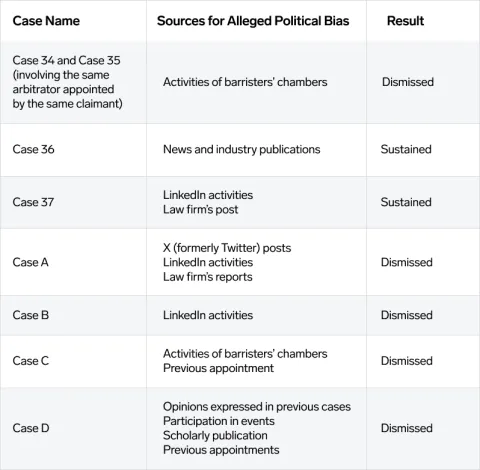
Table 1: Case Overview
Justifiable Doubts based on Political Opinion?
National arbitration laws typically contain provisions on arbitrator challenges, many of which are modelled on Articles 12 and 13 of the UNCITRAL Model Law. One principal ground for challenge under these laws is circumstances giving rise to justifiable doubts as to the arbitrator’s impartiality or independence. Many arbitration rules adopt the same wording, such as Article 19(1) of the SCC Arbitration Rules, Article 12(1) of the UNCITRAL Arbitration Rules, Article 10.1 of the LCIA Rules and Article 26.1(a) of the SIAC Rules.
Under General Standard 2(c) of the IBA Guidelines, “justifiable doubts” is assessed from the perspective of a reasonable and informed third party. However, the IBA Guidelines do not specifically address political opinions as a distinct ground. They do, however, offer some analogous guidance, which is reflected in the Orange and Green Lists. The Orange List identifies circumstances that may, depending on the particular facts, give rise to justifiable doubts and should therefore be disclosed, whereas the Green List covers situations that generally do not create an appearance of conflict and require no disclosure. Item 3.4.2 of the Orange List covers situations where an arbitrator has publicly advocated a position on the case itself, whether in a published paper, a speech, or through social media or online professional networking platforms. Previously expressed legal opinions are treated more permissively under Item 4.1.1 of the Green List, provided that the legal opinion is not focused on the case.
What did the Parties Rely Upon for the Challenge?
Image
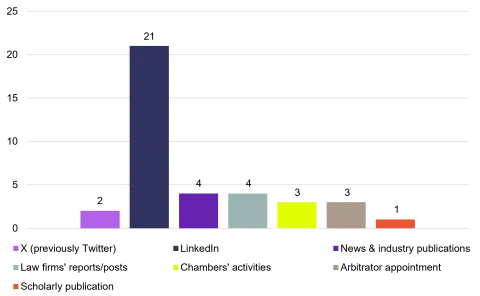
Chart 1: Number of Citations per Source in the 8 Cases
In relation to the 8 challenges received by the SCC based on political opinion from January 2020 to June 2026, all were either directly related to social media activities or came to light through social media. For example, in Case 36, the statements at issue were identified across a range of social media sources, spanning traditional news outlets and online legal commentary platforms. In addition, as shown in Table 1 above, LinkedIn has emerged as a particularly fertile hunting ground — parties have closely examined arbitrators’ posts, reposts, likes, and comments in search of indicators of alleged political bias. Beyond LinkedIn, parties have also relied on X posts as a basis for challenging arbitrators.
Interestingly, the sources relied upon in the 8 cases were not necessarily posts published by the arbitrators in their own name; some consisted of remarks attributed to them, while others comprised reposts, comments, or likes on social media. This suggests that parties conducted a thorough vetting of the arbitrator’s online presence, though as visible in the above case overview, such vetting does not guarantee success.
Insights: Analysis Behind the Challenges
As a matter of principle, the SCC Board has affirmed that arbitrators are entitled to hold their own political opinions. However, the manner in which a political opinion is expressed may nonetheless give rise to a ground for challenge. The SCC has engaged in a rigorous case-by-case analysis of each challenge, of which two were ultimately sustained. It is precisely this analytical discipline, applied consistently across eight decisions, that suggests three factors which commonly arise when assessing such challenges.
Attribution to the Arbitrator
The cases examined reveal that not all challenges were based on political stances which were expressed directly by the arbitrators themselves. Announcements and activities of the arbitrator’s law firm or chambers were also subjected to challenge. This raises an important question: does the political stance of a law firm or barristers’ chambers affect an arbitrator’s impartiality?
In Cases 34 and 35, the SCC Board invoked General Standard 6(a) of the IBA Guidelines, which makes clear that the activities of a chambers do not necessarily constitute a source of conflict for an arbitrator. A similar approach was applied in Case A, where the SCC Board held that mere membership in a law firm that has adopted an institutional position on the conflict, combined with the mere republishing of such institutional positions, does not in itself give rise to justifiable doubts as to an arbitrator’s impartiality.
Guidance may be taken from the IBA Guidelines, which require that the activities, organisational structure, and mode of practice of the arbitrator’s law firm be considered on a case-by-case basis and assessed in light of the specific facts at hand. In line with this, the SCC Board has examined the circumstances of each case individually, with due consideration to whether the arbitrator has engaged in any active personal advocacy. To date, none of the challenges concerning the actions of law firms alone have been successful. This reflects a high threshold for attributing a law firm’s political activities to an individual arbitrator.
The same applies with even greater force in the context of barristers’ chambers, as the Explanation to General Standard 6(a) of the IBA Guidelines expressly addresses barristers and provides that, as a general rule, barristers’ chambers should not be equated with law firms for the purposes of conflicts of interest. Accordingly, the connection between an arbitrator and their barristers’ chambers is generally regarded as more tenuous than that between an arbitrator and their law firm.
Active vs Passive Conduct
Where the allegedly problematic conduct consists of less explicit forms of engagement, such as the act of liking content on social media, it is necessary to consider whether such an act can express a discernible position at all.
This question was considered by the SCC Board in Case B, where it was noted that liking a post is of a more passive nature than leaving a comment, and may be used to convey general support for the author rather than agreement with or endorsement of the specific content of the post. Nonetheless, the nature of the post itself remains an important consideration. Having regard to the nature of the post in question, the SCC Board ultimately concluded that the arbitrator’s act of liking a post did not, in and of itself, give rise to justifiable doubts.
Nexus to the Present Case
Item 3.4.2 of the IBA Guidelines’ Orange List addresses situations where an arbitrator has “publicly advocated a position on the case”. This consideration is directly reflected in Case C, where the SCC Board dismissed a challenge arising from the arbitrator’s acceptance of an appointment in a separate arbitration which allegedly underscored the arbitrator’s adverse views against the respondent. The SCC Board noted that the prior appointment involved unrelated parties, arose under a different legal framework, and disclosed no legal or factual overlap with the present proceedings. Therefore, the SCC Board determined that there was no relevant nexus to the present case.
Case D further illustrates the application of the nexus requirement. Here, the challenge was based on numerous sources (as summarised above). The SCC Board dismissed the challenge, noting that most of the circumstances were not directly related to the factual circumstances of the present case.
However, a question arises: must the arbitrator have specifically referenced the current case or parties for a challenge to be successful? The SCC Board’s decisions indicate that this is not always required.
In Case 36, taking into account the specific facts of that case, it was sufficient that the respondent was subject to various sanctions, and that the arbitrator had made multiple statements critical of certain policies of the respondent’s home State. Similarly, in Case 37, it was sufficient that the arbitrator went beyond general commentary on governmental conduct, and conveyed support for an issue which was specifically disputed in that case — sanctions.
These cases establish that the relevance nexus does not necessarily require an arbitrator to have named the parties or explicitly addressed the specific facts of the case. Each case will ultimately turn on its own facts, taking into account the nature of the political statement in question and the overall context of the case. As always, the question of bias determination must be assessed through the lens of a reasonable third party. Only on that basis will such statements be considered by the SCC Board as meaningfully connected to an issue in dispute.
Conclusion
In line with prevailing international standards, the SCC Board consistently applies a high threshold for arbitrator challenges. This applies equally to challenges based on political statements. As examined above, the SCC Board’s decisions reflect a careful balance between protecting arbitrators’ freedom of political opinion and safeguarding the integrity of the arbitral process. The distinctions between institutional and personal advocacy, between passive engagement and active conduct, and between general commentary and case-specific predisposition are each critical to the SCC Board’s assessment.
Social media has broadened parties’ visibility into arbitrators’ personal views, increasing the frequency of such challenges. Nevertheless, the line between the expression of an opinion and the existence of genuine bias remains a difficult one to draw, and how this line is drawn matters beyond any individual case — it shapes the confidence that parties place in arbitration as a fair and impartial method of resolving disputes.
Comments (0)
Your email address will not be published.

You may also like

September 24, 2026


September 22, 2026

September 20, 2026
September 19, 2026