When Fame Is Not Enough: The ETRO vs ETRO Restaurant Case and the Limits of Trademark Protection in Kazakhstan
January 23, 2026
In two earlier posts on the Kluwer Trademark Blog, we explored how Kazakhstani courts approach the protection of famous and well-known marks. In When Fame Prevails: The GORILLA Energy Case and the Power of Well-Known Marks in Kazakhstan, it was shown that once a trademark is recognized as well-known in Kazakhstan, it benefits from enhanced and legally stable protection. In Well-Known Marks but Where? Territorial Scope in the Astana International Financial Centre vs. Mainland Kazakhstan, attention shifted to the territorial and institutional boundaries of such protection.
The recent decision of the Specialized Interdistrict Administrative Court of Astana in ETRO S.p.A. v. Ministry of Justice of the Republic of Kazakhstan provides an important counterpoint. Unlike the Gorilla Energy dispute, the court held that global fame alone is insufficient to secure brand protection in Kazakhstan where a trademark has not been legally recognized by the administrative body (the Commission on Recognition of Well-Known Trademarks under the Ministry of Justice) as well-known and the parties operate in distinct economic sectors.
Background of the Dispute
The claimant, ETRO S.p.A., an Italian luxury fashion house, owns multiple international registrations for the mark “ETRO,” covering clothing, accessories, perfumes, textiles, home goods, etc. These registrations were extended to Kazakhstan under the Madrid System.
Image
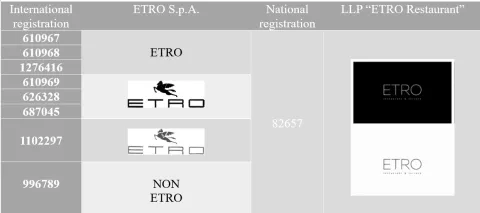
In July 2022, a Kazakhstani company, LLP “ETRO Restaurant,” applied to register a combined trademark with the dominant verbal element “ETRO” for services in Classes 41 and 43. Following a full substantive examination conducted on 24 February 2023, the National Institute of Intellectual Property allowed full registration for all services in Class 41 and partial registration for selected services in Class 43, including café and restaurant services. The trademark certificate was subsequently issued in March 2023, with priority dating back to 22 July 2022.
After the Appeals Board of the Ministry of Justice rejected ETRO S.p.A.’s opposition, the company challenged the decision before the administrative court.
Subject Matter of the Dispute: Two Core Arguments
The dispute centered on two legal arguments:
First, ETRO S.p.A. argued that the Appeals Board improperly limited its analysis to the homogeneity of goods and services, ignoring the worldwide fame of the ETRO brand. According to the claimant, such fame should justify broader protection, even in unrelated sectors.
The court rejected this position. It emphasized that, under Kazakhstani law, extended protection across dissimilar goods and services is available only to trademarks recognized as well-known in the Republic of Kazakhstan. Global reputation, however significant, does not replace this legal status. As ETRO had not been recognized as well-known domestically, the assessment was correctly confined to goods and services similarity. Given the lack of homogeneity between luxury fashion products and restaurant services, the court found no likelihood of consumer confusion.
Second, the claimant relied on the argument that “ETRO” is the surname of the fashion house’s founder, Gerolamo Etro, and that its use by a third party violated personal non-property rights. The court dismissed this claim, noting that objections based on unauthorized use of a personal name must be raised by the individual concerned or their heirs. Since the case was brought by a legal entity and this argument had not been properly raised during the administrative stage, it could not succeed.
Conclusion
The ETRO case clearly illustrates the limits of trademark protection based solely on global fame in Kazakhstan. In this context, the absence of recognition as a well-known trademark meant that the assessment remained confined to a traditional likelihood-of-confusion analysis based on the similarity of goods and services.
For international brand owners, the case emphasizes the value of obtaining well-known status in Kazakhstan and the need for procedural precision when invoking personal name arguments.
Together with the earlier Gorilla Energy case, the ETRO decision confirms that Kazakhstani trademark law follows a structured and formal approach: reputation matters, but only within the legal mechanisms expressly provided by law.
Author’s Note:
The contributor participated in the proceedings on behalf of the National Institute of Intellectual Property (Qazpatent). The views expressed herein do not represent the position of any party or institution involved.
Comments (0)
Your email address will not be published.
Become a contributor!
Interested in contributing? Submit your proposal for a blog post now and become a part of our legal community!
Contact Editorial Guidelines



You may also like

March 5, 2026


February 10, 2026
February 9, 2026
February 6, 2026