From Enforcement to Invalidity: The Uzbek-Kazakh PREMIER Trademark Dispute
August 10, 2026
A recent Kazakhstan dispute over the PREMIER brand saw trademark enforcement turn against the registered owner, whose attempt to stop imports was followed by the invalidation of two of his registrations.
The case ultimately turned on the parties’ commercial relationship, abuse of rights and the agent-or-representative rule under Article 6septies of the Paris Convention.
From customs detention to an unsuccessful infringement action
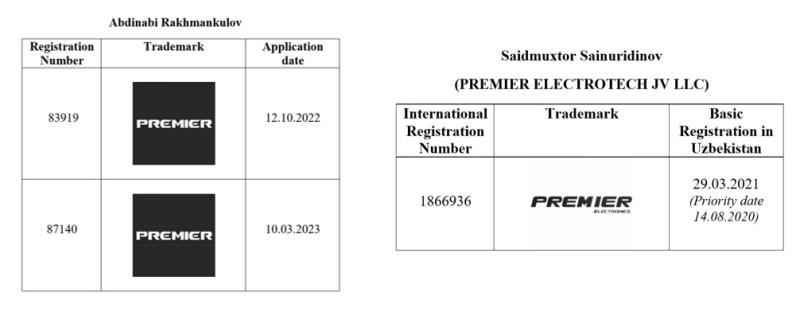
Abdinabi Rakhmankulov owned several Kazakh PREMIER registrations, including Nos. 83919 and 87140. PREMIER was also entered in Kazakhstan’s Customs IP Register, which informs and enables customs authorities to suspend goods suspected of infringing recorded IP rights. Customs subsequently suspended the release of 262 washing machines declared by Technoks Astana LLP. Rakhmankulov sued the importer, seeking a sales prohibition and KZT 1,100,960 (around $2000) in compensation.
On 18 September 2025, the Astana Specialized Interdistrict Economic Court dismissed the claim. The shipping documents showed that Technoks Astana LLP had imported washing machines bearing the MIU mark from Uzbek manufacturer PREMIER ELECTROTECH JV LLC. “PREMIER ELECTROTECH” appeared as the manufacturer’s name rather than as the trademark identifying the goods. The court therefore found no evidence that the defendant had used or sold goods bearing Rakhmankulov’s PREMIER mark.
More importantly the court examined the broader commercial background.
In March 2023, PREMIER ELECTROTECH JV LLC and Rebus Kazakhstan LLP entered into a contract for the supply of household appliances. In September 2024, Vista Electronics Group, a dealer of the manufacturer, concluded another sales agreement with Rebus Kazakhstan LLP. Rebus Kazakhstan LLP had been founded by Rakhmankulov’s brother, and in July 2025 Rakhmankulov granted Rebus Kazakhstan LLP an exclusive license to his PREMIER trademark. The court further noted that Rakhmankulov did not manufacture his own PREMIER goods and was involved in the sale of Uzbek PREMIER products in Kazakhstan.
These circumstances became central to the assessment of the claimant’s conduct. Relying on Article 8 of the Civil Code, the court emphasized that civil rights must be exercised in good faith, reasonably and fairly, that entrepreneurs must observe business ethics, that abuse of rights is prohibited and that no one may derive an advantage from bad-faith conduct.
The court concluded that Rakhmankulov had copied and registered the manufacturer’s PREMIER mark with the purpose of restricting supplies by other distributors and securing for himself the position of sole seller. It therefore characterized his conduct as an abuse of rights and refused judicial protection. Rakhmankulov appealed, but the Astana City Court upheld the first-instance judgment.
From abuse of rights to the agent-or-representative rule
Saidmuxtor Sainuridinov, the owner of an Uzbek PREMIER Electronics registration with priority from August 2020 and a participant in PREMIER ELECTROTECH JV LLC, subsequently challenged Kazakh registrations Nos. 83919 and 87140.
The oppositions relied on Article 23(2) of the Kazakhstan Trademark Law and Article 6septies of the Paris Convention. Rakhmankulov argued that there was no evidence that he had acted as Sainuridinov’s agent or representative and that the applicant was instead relying on supply and dealership relationships between other entities. He also maintained that the Uzbek and international registrations did not establish such a relationship.
Image
Appeal Council and conclusion
The Appeal Council nevertheless invalidated both registrations on 19 February 2026. It relied heavily on the facts established by the civil courts and held that, when the applications were filed, stable commercial relationships already existed between affiliated persons involving supply, dealership and sale of the Uzbek manufacturer’s products. It concluded that Rakhmankulov knew of the PREMIER brand and registered it without the true owner’s consent.
The Council also found the competing marks confusingly similar and the relevant household-appliance goods and services homogeneous, invalidating registrations Nos. 83919 and 87140.
The case also illustrates the importance Kazakh courts attach to the principles of good faith, reasonableness and fairness when trademark rights are enforced. A formally registered right may be denied protection where its exercise amounts to an abuse of rights. This approach is particularly relevant in trademark squatting cases, as discussed in earlier posts (here and here). The PREMIER dispute further shows that such judicial findings may subsequently influence the Appeal Council when assessing the validity of the registration, including under the agent-or-representative rule of Article 6septies.
Comments (0)
Your email address will not be published.
Become a contributor!
Interested in contributing? Submit your proposal for a blog post now and become a part of our legal community!
Contact Editorial Guidelines
Image

Books
Reputed Trade Marks and Their Protection
€205.00
You may also like

October 9, 2026

October 1, 2026


September 22, 2026