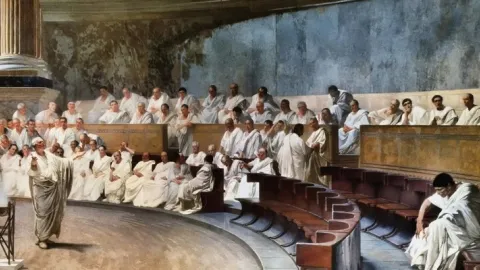
Munich's FRAND Guidelines: A Compass Drawn Too Finely
October 1, 2026
A compass worth having
The 7th Civil Chamber of the Landgericht München I has done something no European court had done before. On 13 August 2026 it published guidelines, sixty-seven pages long, setting out how it will handle FRAND disputes, and consolidating four judgments it delivered between January and April of this year.1The chamber had issued procedural notes on the FRAND defence in 2020, and the Tokyo District Court published guidance of its own in January, but nothing on this scale exists elsewhere.2The document explains the order in which the chamber examines the parties' conduct, the evidence it expects, the methods it uses to test an offer and the figures it treats as plausible when it cross-checks a result. It also introduces a FRAND FIRST hearing, available on request, which confines the early debate to licensing questions within twenty-five pages of submissions.3
The initiative is worth taking seriously, and the chamber deserves credit for it. For more than a decade after Huawei v. ZTE, the way German courts assessed FRAND offers had to be pieced together from judgments, confidential annexes and what counsel remembered of hearings; the sequence practitioners came to call the FRAND dance was rarely written down in one place.4A court that states its method gives the parties a compass. They know which way the court will look, they can anticipate what will count, and they can settle before a hearing rather than after it. Legal certainty in SEP disputes is a European good, and there is not much of it about. Implementers need to know what conduct will protect them; holders need to know what an offer must contain to be enforceable; both need to know how a court will get from the undertaking to a number. Guidelines are a legitimate way of providing that, and in principle a welcome one.
The difficulty lies in the scale. A compass gives a direction. The Munich guidelines draw the route, with thresholds, percentages, reference prices and, in places, monthly royalties for named consumer services. The more precisely a court fixes the path in advance, the less room it leaves for the facts of the case and for the obligations the parties actually undertook. Past a certain point, precision starts to undo the certainty it was meant to create.
Competition among courts, seen from outside
Observers outside Germany sometimes find it odd that a national chamber should publish its own FRAND method at the moment when the Unified Patent Court is building a practice of its own, with local divisions sitting in the same cities and hearing the same disputes.5Seen from Paris, Milan or The Hague, it can look like a national court competing with a European one.
That reading misses how German patent justice has always worked. Munich, Mannheim and Düsseldorf have competed with one another for decades, on speed, on predictability, on the handling of evidence and on the treatment of SEPs, and parties have chosen among them accordingly. The arrival of the UPC added a participant to a market that already existed. The guidelines are best read in that light: a chamber explaining itself so as to remain attractive to the parties who choose where to sue.
This kind of competition has real virtues. It has pushed German courts to decide quickly, to specialise and to publish more of their reasoning than many other European courts do. It has produced procedural devices that others have borrowed. But competition among forums rewards the claimant who chooses the forum, and it can pull a court towards positions that make it more attractive to that claimant without making the law more coherent. The same chamber gave a recent illustration outside the FRAND field. In September 2025, relying on the Court of Justice's judgment in BSH v. Electrolux, it granted a preliminary injunction covering twenty-two European countries. It treated the validity of the foreign parts of the patent as sufficiently secure on the strength of the German validity decision, and it presumed that the other Contracting States would reach the same conclusion on equivalence as German law, leaving the defendant to prove otherwise.6Whatever one thinks of the outcome, a court that treats twenty-two legal systems as presumptively identical to its own is making a choice about attractiveness as much as about law.
German courts should keep competing: a European patent system with several strong forums is healthier than one with a single dominant court. What has changed is that guidelines published by one chamber of one court now shape negotiations across Europe, including in disputes that will end up before the UPC or before courts in other Member States. That reach calls for a method anchored in what European law and the parties' undertakings require, rather than in what makes one courtroom predictable for the parties who file there.
The sequence: where the money comes first
The core of the guidelines is a two-stage test of willingness, already visible in the January and February judgments.7The chamber first asks whether the implementer shows outer willingness, understood as the absence of obvious hold-out. That test is formalised. The implementer must pay the undisputed part of the royalty, which will usually match its own last offer, and must pay it outright rather than into a deposit. Where its offer falls below 60 percent of the holder's demand and the gap exceeds USD 10 million, it must also provide security equal to one year of royalties under the holder's offer. Where it has started a rate-setting or interim-licence proceeding abroad, its financial position in Munich must at least match what the foreign court has proposed.8Only then does the chamber examine the holder's offer as it stands at the close of the oral hearing. If that offer falls within the FRAND range, refusal shows a lack of inner willingness and the injunction follows.9
The advantage is plain: an implementer knows what it must do to be taken seriously. The difficulty is the order. In Huawei v. ZTE, the holder alerts the implementer, the implementer expresses willingness, the holder makes a specific written offer, and the implementer then owes a diligent response, a counter-offer and, where its use continues, appropriate security.10The offer comes before the security. The Federal Court of Justice has since held, in FRAND-Einwand III, that the implementer's duty to provide security does not wait for a judicial finding that the holder's offer was FRAND: once the counter-offer is rejected, security is due.11The guidelines go a step beyond that. The undisputed amount must be paid, not secured; a threshold of 60 percent and USD 10 million decides when a further year of royalties must be put up; and all of this precedes any examination of what either party offered. Those thresholds are not drawn from the Court of Justice, from the Federal Court or from the ETSI undertaking. They are settings chosen to sort cases, and their precision is the problem. A case can now be decided at the threshold, on a payment made late or a percentage missed, before the court has looked at the offers themselves.
Where precision turns against itself
The same tension runs through the substantive parts of the guidelines. The chamber gives priority to comparable licences, limits their age to five years, treats multi-standard and cross-licences as unsuitable in principle, derives a median from the agreements produced and draws a range of 50 percent on either side of it. An increase over a directly comparable agreement is capped at 15 percent and cannot be chained.12The top-down cross-check relies on standardised product prices rather than actual selling prices: USD 170 for a phone, USD 150 to 200 for a tablet, USD 500 to 550 for a laptop, USD 130 to 150 for a router, with an aggregate royalty burden of 8 percent for 5G and around 18 percent once Wi-Fi and streaming are added.13For streaming services, where the chamber itself notes that no licensing practice exists, it offers indicative monthly figures for named services and tiers.14Portfolios held by Chinese companies are presumed inflated by state filing incentives and discounted by 15 percent.15
Each parameter can be defended on its own. The difficulty appears when they are read together. The corridor is very wide, which should reassure implementers, but it is computed from agreements the holder selects, and a median is only as representative as the set from which it is drawn. The chamber refuses to appoint experts on the ground that the FRAND rate is a question of law, while the guidelines are built almost entirely from economic parameters.16The streaming figures are declared non-binding; a number published by the court that will hear the case nevertheless anchors offers and counter-offers before any evidence has been produced. The Chinese discount is presented as a correction in the name of fair valuation, but a presumption tied to the nationality of the patentee sits uneasily with the non-discrimination limb of the very undertaking the court enforces, and it will be invoked in every forum where Chinese licensors litigate. Finally, the guidelines reject a safe harbour for implementers who offer binding arbitration, on the ground that holders cannot be expected to accept further delay.17An offer to have a neutral determine what the undertaking requires is, on any reading, strong evidence of willingness to be bound by it.
None of these tensions would matter much in a single judgment, where a court can adjust a parameter to the record before it. They matter in guidelines, because guidelines are written for cases that do not yet exist. Once the figures are published, a party that wants to argue that USD 170 misstates its products, or that the comparable set is unrepresentative, is no longer arguing against a finding. It is arguing against the court's own stated position.
What the parties actually undertook
The deeper question is where the numbers come from. They are not drawn from the four judgments the guidelines consolidate, which decided specific disputes on specific records, nor from a court-appointed expert, nor from any consultation. They express the chamber's own assessment, stated in advance. That is the natural product of an approach which reasons throughout in the vocabulary of abuse: whether enforcement by a dominant holder is abusive, and whether the implementer is holding out. Within that frame, a corridor, a threshold or a reference price is a proxy for good or bad conduct, and precision looks like rigour.
There is another way of approaching the same dispute, which starts from the commitment the holder made. A patentee that declares a patent essential and undertakes to license it on FRAND terms has promised something to every implementer of the standard. The first question in a dispute is what that promise required in this relationship, at this time, given what each side offered and how each behaved in the negotiation. Comparables, top-down figures and portfolio shares are evidence of what the promise required; they are not rules that define it in advance. Conduct matters, but as part of the question whether each party honoured its side of the bargain, not as a gate to be passed before the bargain is examined.18On that approach, an implementer's offer to arbitrate counts in its favour, a holder's selection of comparables is open to scrutiny as a matter of course, and a presumption based on the patentee's nationality has no obvious place.
This approach says nothing about the level of royalties. Its effect is on the reasoning, which follows the parties' undertakings rather than the court's parameters, and it travels well: it is available to a Munich chamber, a UPC local division and a Paris court alike, because it rests on the same undertaking and the same judgment of the Court of Justice. The UPC's first FRAND decisions, in Panasonic v. Oppo and Huawei v. Netgear, already assess an offer in the light of how both sides negotiated, and the Federal Court has read them in the same sense.19
What litigants can take from the guidelines
The method deserves credit. A court that explains in advance how it will decide is doing litigants a service, and other European courts could usefully follow the example. The FRAND FIRST hearing, in particular, is a sensible device that deserves wider adoption.
The Unified Patent Court is the obvious candidate. Its local divisions have begun to decide FRAND disputes, and guidance on the order of examination, the evidence expected and the treatment of offers, whether it comes from the Court of Appeal or from a practice note, would give parties across the participating Member States a shared point of reference. National courts that hear SEP disputes elsewhere in the Union could do the same, ideally in dialogue with the UPC rather than alongside it. The Patent Mediation and Arbitration Centre has already moved in that direction: its rules provide for guidelines on FRAND disputes which the parties may elect to apply.20Guidance from several European fora, built on the same judgment of the Court of Justice and the same undertaking, would converge more readily than a series of local tariffs.
It is less clear that the guidelines, in their present form, are of much use to the parties who will actually appear before the chamber. A holder with an established programme already knew that Munich would be receptive; the guidelines confirm it and tell it how to prepare its file. An implementer learns mainly that the decisive step will be financial and will come early, and that the arguments it most wants to make, on the representativeness of the comparables, the reference price or the nationality discount, run against positions the court has already published. Neither side can treat the figures as settled, because they bind only the chamber that wrote them: the parallel 21st Civil Chamber has been informed of them but has not adopted them, and neither the Oberlandesgericht nor the Federal Court of Justice has ruled on them.21Parties do not choose their chamber in Munich. A method that applies in one courtroom and not in the next offers a limited kind of predictability.
A few adjustments would make the guidelines more useful without abandoning the idea. They could concentrate on procedure and evidence, where predictability helps everyone, and treat figures as rebuttable indications whose sources and methodology are disclosed. They could follow the Huawei v. ZTE sequence more closely, examining the offer before requiring security beyond the undisputed amount. They could make disclosure of the holder's full licensing programme the default rather than an application to be made. They could recognise an offer of binding arbitration as a strong indication of willingness. They could drop the nationality presumption in favour of evidence on the portfolio actually asserted. And they could be developed in dialogue with the 21st Chamber, the appellate courts and the UPC, so that a European standard emerges rather than a local one.
The Munich chamber has shown that a European court can explain its FRAND method in writing. The next step is to make that explanation a compass rather than a map: a statement of the direction in which a court will reason, drawn from what the parties undertook, which leaves the route to be found in each case.
- 1Landgericht München I, 7th Civil Chamber (Presiding Judge Dr. Oliver Schön, Judges Katalin Tözsér and Dr. Florian Schweyer), FRAND Guidelines, 13 August 2026, consolidating the judgments of 8 January 2026, 7 O 5007/25 (ASUS I), 22 January 2026, 7 O 4102/25 (ASUS II), 5 February 2026, 7 O 7655/25 (Renault), and 30 April 2026, 7 O 64/25 (ZTE v. Samsung).
- 2Landgericht München I, Hinweise zur Handhabung des kartellrechtlichen Zwangslizenzeinwandes nach Huawei v. ZTE innerhalb des Münchener Verfahrens in Patentstreitsachen, February 2020, which dealt mainly with the conduct of the FRAND defence within the Munich procedure. Tokyo District Court, Intellectual Property Divisions (29th, 40th, 46th and 47th Civil Divisions), Guidelines for Proceedings in Patent Infringement Lawsuits involving Standard Essential Patents, January 2026, https://www.courts.go.jp/tokyo/saiban/minzi_section29_40_46_47/SEP_tokkyoken_shingai/index_2.html (in Japanese); the Tokyo guidelines organise the proceedings around a settlement recommendation made at the first hearing.
- 3FRAND Guidelines (n. 1), section on the FRAND FIRST hearing.
- 4Case C-170/13, Huawei Technologies Co. Ltd v. ZTE Corp., EU:C:2015:477, 16 July 2015, paras 60 to 71.
- 5UPC, Local Division Mannheim, 22 November 2024, UPC_CFI_210/2023, Panasonic v. Oppo; UPC, Local Division Munich, 18 December 2024, UPC_CFI_9/2023, Huawei v. Netgear.
- 6Landgericht München I, 7th Civil Chamber, 25 September 2025, 7 O 9383/25, Regeneron and Bayer v. Formycon (the parallel injunction for Germany bears the reference 7 O 9382/25), applying Case C-339/22, BSH Hausgeräte GmbH v. Electrolux AB, Grand Chamber, 25 February 2025, ECLI:EU:C:2025:108. On what a cross-border claim must carry once jurisdiction is established, see M. Dhenne, "Pleading the Long Arm: What a UPC Statement of Claim Must Carry Beyond Jurisdiction", Kluwer Patent Blog, 29 September 2026.
- 7Landgericht München I, 8 January 2026, 7 O 5007/25 (ASUS I), summarised in the court's press release No. 3 of 9 February 2026, https://www.justiz.bayern.de/gerichte-und-behoerden/landgericht/muenchen-1/presse/2026/3.php; Landgericht München I, 5 February 2026, 7 O 7655/25 (Renault).
- 8Press release No. 3 of 9 February 2026 (n. 7), points (1) to (3), which state the three requirements without figures; the 60 percent and USD 10 million thresholds appear in the FRAND Guidelines (n. 1), section on outer willingness.
- 9FRAND Guidelines (n. 1), sections on inner willingness and on the offer to be examined, which is the holder's operative offer at the close of the oral hearing; superseded offers are not reviewed.
- 10Huawei v. ZTE (n. 4), paras 60 to 67 and operative part, point 1.
- 11Bundesgerichtshof, 27 January 2026, KZR 10/25, VoiceAge EVS v. HMD Global (FRAND-Einwand III), ECLI:DE:BGH:2026:270126UKZR10.25.0, paras 44 to 46 (willingness must persist throughout the negotiation) and paras 85 to 87 (security is owed once the counter-offer is rejected, without a prior finding that the holder's offer was FRAND), https://www.bundesgerichtshof.de/SharedDocs/Entscheidungen/DE/UebrigeSenate/KartS/2025/KZR__10-25.pdf.
- 12FRAND Guidelines (n. 1), section on comparable licence agreements.
- 13FRAND Guidelines (n. 1), section on the top-down analysis.
- 14FRAND Guidelines (n. 1), section on streaming as a service.
- 15FRAND Guidelines (n. 1), section on Chinese patent portfolios, where the chamber recomputes its own result in ZTE v. Samsung, 30 April 2026, 7 O 64/25, with the discount applied.
- 16FRAND Guidelines (n. 1), section on expert evidence.
- 17FRAND Guidelines (n. 1), section on the safe harbour considered and rejected, with reference to the Patent Mediation and Arbitration Centre. On arbitration as the parties' own route to a FRAND determination, see M. Dhenne, "Come Together? Acer v Nokia and the Contractual Turn of FRAND Arbitration", Kluwer Patent Blog, 13 May 2026.
- 18ETSI Rules of Procedure, Annex 6, ETSI Intellectual Property Rights Policy, clause 6.1; Huawei v. ZTE (n. 4), para. 53. See further M. Dhenne, "FRAND Is Not a Number: The Prior Question About Standard-Essential Patents", Kluwer Patent Blog, 28 May 2026; M. Dhenne, A Contractual Theory of FRAND: From Private Normativity to Legal Obligation in Technical Standardization (Wolters Kluwer, 2026).
- 19Panasonic v. Oppo (n. 5), paras 201 to 203 and 212 to 213; Huawei v. Netgear (n. 5), paras 299 et seq. and 307 to 312; both read in that sense by the Bundesgerichtshof in FRAND-Einwand III (n. 11), paras 70 to 72.
- 20PMAC Rules of Arbitration, Administrative Committee Decision D-AC/07/04112025_rev.2 of 24 April 2026, art. 48; PMAC, SEPs/FRAND Disputes, https://www.pmac-upc.org/en/services/sepsfrand-disputes. See M. Dhenne, "Designing Patent ADR: The PMAC Rules Through the Lens of FRAND", Kluwer Patent Blog, 24 June 2026.
- 21FRAND Guidelines (n. 1), introductory section: the chamber records that the 21st Civil Chamber has been informed of the guidelines and that joint guidance was not feasible at this level of detail.
Comments (0)
Your email address will not be published.
Become a contributor!
Interested in contributing? Submit your proposal for a blog post now and become a part of our legal community!
Contact Editorial Guidelines



You may also like




September 22, 2026