A Contribution To A Debate That Europe Never Had
June 8, 2026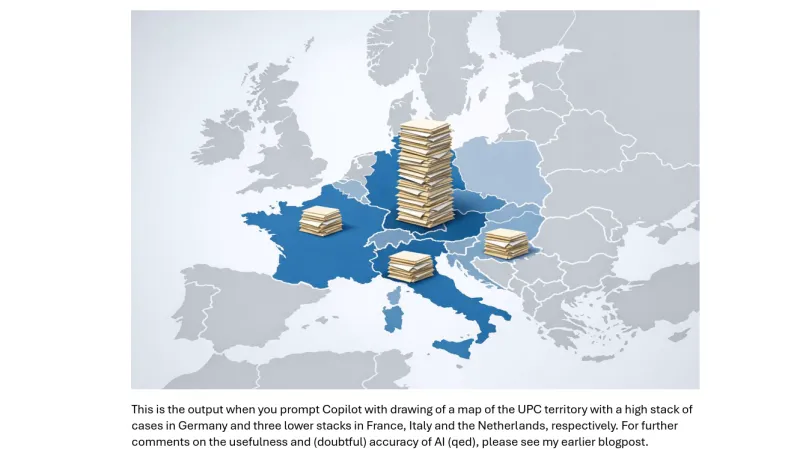
JuVe reported in March 2026 that “Europe” would debate the redistribution of UPC cases. First I thought “whow”, then "what??", and then it turned on me that this headline is probably a slight exaggeration. The European Union, which is only a part of Europe, has more than 450 million inhabitants. I would be genuinely surprised if more than a few ppm of them were even aware of such a debate, let alone actually participate in it. And I would respectfully submit that “Europe” has many more important issues to debate than the redistribution of UPC cases.
So what is behind this headline? As JuVe reports it, it is this:
The background to the statement is a discussion among UPC member states on the topic at the February meeting of the Administrative Committee. Following this, the Advisory Committee called on the four organisations with observer status at the UPC — BusinessEurope, EPI, EPLIT and EPLAW — to identify reasons for the lack of balance between the UPC divisions and to propose measures that could ensure a more balanced distribution of cases.
While I have no such observer status and only write here in a private capacity, I have nonetheless been observing the UPC for many years and so I thought I might as well provide a contribution to this debate.
First and foremost, a general observation: When plaintiffs have a certain choice on the court where to bring their lawsuit, it seems to be almost a law of nature that the distribution will never be even or even near even. We have observed such imbalances both in the USA for many years, and we have had them in Germany since the second world war and still have them today. While there are 11 German infringement courts where plaintiffs can theoretically bring most of their cases, only four of them are used in practice: Düsseldorf, Mannheim, Munich and Hamburg. Yes, lawsuits are occasionally also brought in Braunschweig, Dresden, or Magdeburg etc., but these are rare exceptions. There has always been a considerable inertia in this focussation on a small number of courts, probably because many plaintiffs and their representatives think that their patent cases deserve being dealt with by a specialized, experienced and efficient panel.
Just as a digression, and mainly for the non-German readers of this blog, you may perhaps wonder why Düsseldorf has been the leading patent infringement court (in terms of case numbers) for decades. The story I was told when inquiring about the reason thereof was this: Before the 2nd World War, the German “IP City” clearly was Berlin, where the Reichspatentamt had its seat and the Kammergericht dealt with most patent infringement cases. But the Patent Office was destroyed during the war, its location had been in the Russian sector anyway, and West Berlin was cut off from the rest of Western Germany for a while, so there was no way to continue in this city. This brought an informal “club” of Berlin patent judges and attorneys-at-law to consider their options in post war Western Germany. What I was told is that they decided together to move to Düsseldorf owing to its central geographical location, particularly its established role as an economic decision-making center (“the Ruhr region’s administrative hub”), and the fact that many of its administrative buildings remained intact. These were, conveniently, also the deciding factors why Düsseldorf was designated as the capital of the new state of North-Rhine Westphalia. Thus, in the end, it was simply a critical mass of experienced judges and attorneys that created this new IP hub in Germany together. Over the next years and decades, the judges and local attorneys educated each other and found ways to deal with patent infringement actions very efficiently and with a high quality. Together with Germany's broad industrial base and high patent affinity, this made Germany, and in particular Düsseldorf, to the most popular battleground for infringement litigation in Europe.
In view of the above, I strongly suspect that there will always be a relatively uneven case distribution before the Local and Regional Divisions of the UPC, at least so long as infringement plaintiffs can more or less freely choose which local or regional division to seize. However, this right is firmly enshrined in Art. 33 UPCA. In order to be able to deal with very uneven case numbers owing to this setup, Article 18 of the Statute provides the court with a certain flexibility: new local or regional divisions may be established by the Administrative Committee at the request of a UPC member state. Conversely, if a member state hosting a certain local or regional division requests that this division be discontinued, the Administrative Committee must even decide to discontinue this division and set a date as of when no new cases may be brought before the division and the division ceases to exist (UPC Statute, Art. 18(3)). Any cases still pending after this date are automatically transferred to the Central Division (Art. 18(4)).
Personally, I do not think that an amendment of Article 33 UPCA is on the table at this moment, nor would it appear wise to me to change this important pillar of the system, which – all in all – works well for the parties and is also consistent with EU legislation, e.g. Art. 4 and 7 of the Brussels I Regulation (EU 1215/2012).
So what could “measures that could ensure a more balanced distribution of cases” but that do not violate the principles of Art. 33 UPCA possibly be? This brings us to the factors that may play a role for parties and/or their representatives for choosing a certain division, or for preferring division A over division B. In my own experience, the following factors are particularly important:
- Experience/Quality of the Division
- Costs
- Speed
- Local proximity to the representatives of the case
- Procedural Conduct
Let us consider each of these factors in turn and whether any of them can be leveraged to achieve a more balanced case distribution.
Experience
At least in my view, there is not a great deal of difference between the individual local divisions, which in most cases consist of four judges, two locals and two of different nationalities. While certain legally qualified judges are (currently) involved in more UPC cases than others, the panels are nearly always composed of a mix of more and less experienced judges. If there is any gap in experience between individual judges, I would approach this long-term by more judicial exchange, temporary work placements, secondments or the like.
Costs
Costs awarded by local divisions of the CFI are (and should be!) the same. I see no room for any “equilibration measures” in this regard.
Speed
I have not looked too much into the statistics regarding speed of individual local divisions, but my impression overall is that it does not differ significantly between the individual LDs and RDs. To some extent, this was to be expected because the Rules of Procedure provide a certain structure at least during the first 6 months of the proceedings. After that, individual LDs and RDs would have the flexibility to speed up the interim proceedings and summon the parties to the main hearing sooner or later (within reasonable limits, of course). Interestingly, it seems to me that this option has not been used much (if at all) by Local or Regional Divisions with lower case numbers. Conversely, two German Local Divisions with a very high caseload started missing the one year target and, hence, saw no other way out than to set up a second panel in order to keep their schedules within the spirit of the Rules of Procedure, as expressed in recital no. 7:
In accordance with these principles, proceedings shall be conducted in a way which will normally allow the final oral hearing on the issues of infringement and validity at first instance to take place within one year whilst recognising that complex actions may require more time and procedural steps and simple actions less time and fewer procedural steps.
Having done so, the LD Munich and Düsseldorf are now back on track with delivering a decision within about 14 months and holding the final oral hearing within about 1 year. As a representative in UPC proceedings, I must say that I find 1 year very fast and completely satisfactory. I would even plead for extending the extremely short terms of 2 months according to R. 29 (a) or even 1 month for written submissions according to R. 29 (e) RoP. One more month or at least two more weeks might secure a fairer playing field: Only large patent law firms are otherwise able to absorb such time pressure without neglecting their other obligations. In view of the fact that not much seems to happen during the interim procedure, such a modest extension would probably not even lead to a prolongation of the proceedings as a whole.
All in all, however, there are limits to which the speed of the proceedings can be used to equilibrate the case load between individual LDs and RDs, as long as all divisions more or less keep within the timeframe of about one year provided in the RoP, as they should.
Local proximity
Likewise, to the extent that local proximity plays a role when parties or their representatives choose a particular local division, not much can be done about it. Experience rather suggests that attorney firms tend to gather “where the music plays”, i.e. in a venue where particularly many or particularly good (quality-wise) decisions are being made.
Procedural Conduct
While we have a uniform set of Rules of Procedure, these Rules still allow the individual judges and divisions considerable latitude in their conduct of the proceedings. A point where I (and many other colleagues) have observed particular differences between local divisions from a German-speaking background and local divisions of e.g. a French or Scandinavian background is to what extent the court actually talks to and discusses with the parties. By tradition, there seems to be a trend of e.g. French or Swedish judges not to disclose anything of the Court’s preliminary thinking to the parties. Perhaps these judges fear that rendering or voicing a preliminary opinion may damage the Court’s appearance of being neutral.
If this were the case, I can perhaps relieve these judges from this concern. Preliminary opinions are (meanwhile) almost mandatory in EPO proceedings1, and I know of no single case where after the issuance of a preliminary (and, of course, non-binding) opinion a party has even tried to argue that the Opposition Division or the Board of Appeal would be biased against them because they issued a negative preliminary opinion. Quite to the contrary, such preliminary opinions are generally understood as an incentive to put even more effort into one’s own case, explain the own position better and/or to point to obvious misunderstandings or inaccuracies in the decision maker’s preliminary opinion, if any. In doing so, the preliminary opinion enhances, at least in my view, the quality of the discussion between the parties and the deciding body and thus contributes to a higher quality of the decisions.
Moreover, from a representative’s view, I find a court or a Board at least difficult if they limit their contribution to the discussion to a “you speak – you speak – let’s have a break” type of discussion, and you have absolutely no idea whether what you just pleaded falls on completely deaf ears or is at least understood and in the best case considered relevant for the decision-making process. A preliminary (and non-binding) opinion would greatly help representatives to focus their pleadings on those points that the division wants to be addressed and are (hopefully) helpful for it to come to a fair and just decision. It also helps a representative's party to guard against a surprise decision to their detriment, which is always the most uncomfortable outcome of a proceeding. Finally, if a well-reasoned preliminary opinion on the merits were issued sufficiently in advance of oral proceedings, it might even catalyze a settlement in some cases and thus reduce the court’s case load.
Thus, if I had to make one suggestion that might help both in improving the quality of the discussions and decisions and to equilibrate the case load – at least to some extent -, it would be to make a preliminary opinion of the CFI mandatory.
Obviously, a preliminary opinion can be expressed in different ways.
- In German nullity proceedings, where preliminary opinions were introduced only relatively recently (in 2021), the “Vorbescheid” is issued in writing by the entire 5-member panel, normally within 6 months after service of the nullity action (§ 83 PatG).
- Conversely, there was and still is no written preliminary opinion in the second instance and before the infringement courts. In lieu of that, the Presiding Judge in these proceedings gives a (sort of) preliminary opinion at the beginning of the main hearing.
- The EPO in turn decided to go for a preliminary opinion that is issued just by the Rapporteur of the proceedings and is issued in writing at the latest a couple of weeks before the hearing (and ideally at least 2-3 months before the hearing).
- In Italy, a patent infringement lawsuit includes a mini-trial between the patent attorneys of each side, which ends with the issuance of an opinion by the court-appointed expert. This opinion is no preliminary opinion by the court in a strict sense, but has a similar effect. The court may deviate from it, but tends to follow it in most cases.
- Finally, there is also the opinion of the Advocate General in proceedings before the CJEU, but – very unfortunately – this is provided only after the main hearing and does not contribute to the discussion between the parties.
If I had to choose between these alternatives, I would clearly prefer the EPO approach. Only a preliminary opinion that comes in time will really help the parties to thoroughly prepare and focus on the essential points in the forthcoming oral proceedings. An opinion that is just voiced orally at the beginning of the proceedings is better than nothing but can at times be difficult to even comprehend (completely). In some cases, such an oral preliminary opinion may require the complete reorganization of your pleading; in other cases, it may not even be possible to appropriately react to new aspects just introduced by the court. In any case, pleading after you have just heard the court’s preliminary view for the first time can be very demanding, particularly if it is negative.
Conversely, the German approach in nullity proceedings, where the “Vorbescheid” is issued after deliberation by the whole panel, seems to me to be an unnecessary waste of precious judicial resources and time. The same applies to the Italian approach, mutatis mutandis. As the EPO experience more than sufficiently shows, a preliminary opinion delivered just by the Rapporteur perfectly serves the double purpose of (i) alerting the parties to the points that will probably be considered essential by the deciding body and (ii) maintaining the appearance of provisional status - it is always possible that the other members of the Board may come to a different opinion.
Summary
Where does this take us? First and foremost, I would argue that an uneven distribution of cases across UPC divisions is not a malfunction but a predictable consequence of a system that gives infringement plaintiffs meaningful choice of forum. From experience we know that patent litigation naturally concentrates in venues that are perceived as experienced, reliable, and procedurally attractive. I do not consider this market-driven dynamic as necessarily disadvantageous for the UPC system but would rather argue that it may help to maintain and even improve a high level of quality. At the same time, I would also venture the prediction that there will always be some dynamic in the distribution of cases. For example, while the German local divisions handled about 80% of all first instance cases in the first 1.5 UPC years 2023 and 2024, it seems that this percentage has now gone down to 68% in 2026 and it is reasonable to assume that this trend will continue to some extent, as there are certainly equally good local divisions of the CFI in other countries. Conversely, it is of course unrealistic to expect that a local division in a [small] country with not much patent litigation activity for decades past would be seized in a similar number of cases as for example the LD Düsseldorf or the LD The Hague. As long as the setting of local and regional divisions remains the same as today, there will probably always be some imbalance.
Having said that, if there is one area where meaningful improvement is possible, both in terms of quality and equilibration/harmonization between divisions, it is procedural conduct. Mandatory timely, non-binding preliminary opinions can in my view both improve the quality of the judicial dialogue and remove a slight competitive advantage in attractiveness that the German-speaking Local Divisions may have had in the past. Rather than undertaking the Herculean task to rewrite the jurisdictional framework of the UPC, I would therefore propose to level the playing field by more judicial exchange (and training of new judges!) and by harmonizing the procedure to the maximum extent possible such that all users of the UPC system get the same excellent service by all first instance divisions of the UPC.
- 1Article 15(1) RPBA 2020 stipulates that, in preparation for oral proceedings, the Board shall issue a communication drawing attention to matters that seem to be of particular significance for the decision, or indicating other matters that may help concentrate on essentials during the oral proceedings. While this does not require the Board to issue a “preliminary opinion” strictu sensu, this is now the established practice before the Boards of Appeal. I am very happy about that and I have not heard any colleague complaining about this practice – quite the contrary.
Comments (0)
Your email address will not be published.
Become a contributor!
Interested in contributing? Submit your proposal for a blog post now and become a part of our legal community!
Contact Editorial Guidelines