A Continental Treat: Picking Up the Bill at the UPC
October 19, 2026
Remember the caps? In March 2021 this blog asked what it is with the Dutch and money, and reported that the Dutch patent courts had put indication tariffs on recoverable legal costs. Simple case, normal case, complex case, very complex case. No more full bills, no more haggling to the cent. The proof, it was said at the time, would be in the pudding.
Five years on, a second court has served its own pudding, and this one arrived with the tariffs already printed on the menu. Article 69(1) UPCA lays down the general rule that reasonable and proportionate legal costs of the successful party are borne by the unsuccessful party, unless equity requires otherwise, up to a ceiling. Rule 152.2 RoP hands that ceiling to the Administrative Committee, which adopted its scale on 24 April 2023. Ten bands, from EUR 38,000 for a value of the proceeding up to EUR 250,000, to EUR 2 million for anything above EUR 50 million.
The Administrative Committee described the ceiling in its recitals as a safety net, "an absolute cap on recoverable representation costs applicable in every case". A safety net, on that description, is there to catch the exceptional case. The decided cases say otherwise. The net is being hit, and sometimes hit hard.
Thirty-two cost decisions
A caution before the numbers. The registry's action-type label does not reliably identify cost proceedings, so the count here is by what the operative part actually does. On that basis the Court of First Instance has issued thirty-two decisions fixing recoverable costs on an application for a cost decision under Rule 151 RoP. The earliest is the Munich Local Division's decision of 11 October 2024. One came in 2024, nineteen in 2025, twelve so far in 2026, the most recent on 6 August 2026. Beyond them, Rule 152 RoP is cited in 112 published decisions, 100 of which engage the language of the ceiling.
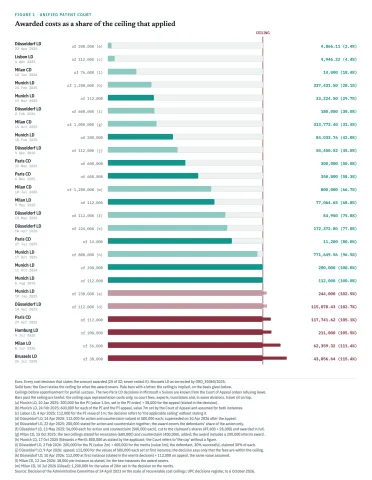
Only the separate cost proceedings of Rules 150 to 157 RoP are counted, that is, decisions fixing the costs on an application under Rule 151 RoP. Seven of the thirty-two redact the amount. Two, both in Microsoft v Suinno before the Paris Central Division, are not published themselves; the Court of Appeal orders refusing leave to appeal state their amounts and ceilings. Decisions rejecting an application are not counted. Nor are costs fixed outside those proceedings, such as sums the parties agree and the Court writes into the decision on the merits, as the Local Division The Hague did for example in Orbisk on 13 August 2025 (UPC_CFI_327/2024). Interim awards on provisional measures and settlements confirmed by the Court are also left out for that reason. Figure 1 shows every cost decision that states the amount. Where the decision does not state the ceiling for what the award covers, the ceiling is implied from the value of the proceedings, and the notes to the figure give the basis. A continuously updated overview of all costs decisions can be found here.
The ceiling bites
The first cost decision, issued by the Munich Local Division's on 11 October 2024 sat the case value at EUR 2 million, giving a ceiling of EUR 200,000, and the applicants limited their request to that sum. The judge-rapporteur nevertheless assessed what was reasonable, benchmarking the team of representatives against the composition of the panel, and arrived at EUR 202,041 after refusing EUR 4,450 of interpretation costs for want of a request under Rule 109 RoP. The Court awarded EUR 200,000. The application, it noted, did not exceed the limit. The Court's own arithmetic already had.
This decision is not an outlier of the early days. In Edwards v Meril the Munich Local Division in October 2025 ordered EUR 771,649.56 against a ceiling the applicant put at EUR 800,000, ninety-six per cent of it. Most of the sum was agreed between the parties; the only dispute was travel, which the judge-rapporteur declined to scrutinise. In the Munich decision of 6 August 2026 the successful party asked for EUR 168,200 against the EUR 112,000 ceiling attaching to a value of EUR 1 million. The judge-rapporteur held that a request to raise the ceiling must be made expressly, and before the decision on provisional measures, and that even with every contested item struck out the remainder still exceeded the cap. He ordered EUR 112,000. Precisely the cap.
The gap between costs incurred and costs recoverable is widest in the Brussels Local Division. In its decision of 25 July 2025 the applicants' representation costs were EUR 451,236.75. The applicable ceiling, the value being at the bottom of the scale, was EUR 38,000. The applicants told the Court that such a cap stood in stark contrast to, and out of all proportion with, their actual costs. They were not wrong. They were simply on the wrong side of Rule 152.2 RoP. Their request to raise the ceiling came too late, Article 2(4) of the Administrative Committee decision requiring it before the interim procedure closes.
The Court also folded the representatives' travel and the translations into the EUR 38,000 rather than adding them on top. And to the argument that in Dutch practice a timesheet is proof enough, the answer was that this is UPC practice, with the burden of proof under Article 54 UPCA, a strictness the Munich judge-rapporteur in Edwards v Meril has since expressly declined to share. The order came to EUR 41,656.64 in all, corrected on 19 August 2025 to EUR 43,856.64 for an expert fee the Court had allowed but left out of the total. Some eight per cent of the representation costs incurred was recovered.
Awards do also land well below the ceiling, though not always because of it. The Lisbon Local Division awarded EUR 4,946.22 where the applicants had claimed representation costs at the full EUR 112,000. The ceiling never came into play: the unsuccessful applicant for provisional measures had since brought an action on the merits, so the Court deferred the representation and expert costs to that action to avoid assessing them twice, and awarded only the representatives' substantiated travel. The Düsseldorf figure of EUR 4,866.11 in Figure 1 is low for a different reason again: the defendants, entitled to costs for the infringement action only, had calculated their fees under the German Lawyers' Remuneration Act (RVG), the statutory fee scale for German court proceedings, under which fees follow the value in dispute rather than the hours worked. The Court accepted that basis. The top of the scale, meanwhile, is crowded: EUR 337,431.50 in Munich, EUR 313,773.40 in the Milan Central Division, and EUR 800,000 in the same division's Gilead decision of 10 July 2026, a sum the losing party did not contest.
Image
Why some awards exceed the ceiling
Several orders sit above the cap on their face, and lawfully so. Article 1(2) of the Administrative Committee decision confines the ceiling to representation costs. Court fees and experts' costs (Rule 153 RoP) sit on top, and so, in Paris and Düsseldorf, does travel; Brussels, as noted above, counts the representatives' travel within the ceiling. So the Paris Central Division ordered EUR 117,741.62 against a EUR 112,000 ceiling: the applicant had incurred EUR 203,818.02 in representation costs, limited its claim for representation costs to the ceiling, and recovered its representatives' travel in full and its party's for two of the four in-house attendees it had sent to the hearing. The Hamburg Local Division ordered EUR 211,000 against a EUR 200,000 ceiling, the excess being court fees, after the applicant had argued for a EUR 400,000 ceiling and lost. The Milan Local Division's EUR 62,359.32 against EUR 56,000 is the same arithmetic, though there the representation costs, claimed at EUR 45,359.88, were allowed at EUR 45,000 for an action that had ended in a decision by default; experts, translation and court fees made up the rest.
The value of the proceeding is the whole ballgame
Because the ceiling is a step function of value, the decisive moment comes long before the cost schedule, when the value is fixed under Rule 104(i) and (j) RoP and Rule 370.6 RoP.
The Munich Local Division decision of 10 February 2025 records that the respondent had originally considered EUR 6 million appropriate. The Court set EUR 1.2 million, and with it a EUR 200,000 ceiling rather than a EUR 600,000 one. The award of EUR 84,033.76 then came from the schedule, not the cap: some twenty hours out of roughly 240 were struck, among them 3.1 of the 3.6 hours billed for a one-sentence request for a technically qualified judge. The same division's decision of 19 March 2025 shows the other half of the arithmetic: an infringement action and a counterclaim for revocation valued at EUR 500,000 each are added, giving a EUR 112,000 ceiling, against which the defendant, billing at EUR 285 an hour, recovered EUR 33,224.50, court fees included.
The Paris Central Division, dealing with the costs of a preliminary objection alone, took the EUR 56,000 band, allowed a quarter of it for that stage, applied an 80 per cent apportionment and arrived at EUR 11,200, refusing on the way a EUR 6,720 expert opinion on Article 33(4) UPCA, the representatives being expected to handle a legal question themselves.
And in Düsseldorf in July 2025, where the infringement action and the counterclaim had each been valued at EUR 15 million, the consolidated EUR 30 million band gave EUR 1.2 million, raised to EUR 1.5 million under Article 2(1)(b) of the Administrative Committee decision. The unsuccessful party argued in the cost proceedings that the uplift required a formal request never made. The Court declined to reopen it: a ceiling set in the decision on the merits and left unchallenged is the basis for the cost decision. Munich's headnote of 6 August 2026 says the same from the other side. The instruction to practitioners is unambiguous. The ceiling is litigated in the main action or not at all.
Image

Written by very few hands
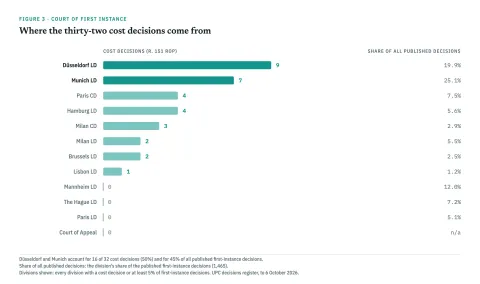
Of the thirty-two cost decisions, nine come from the Düsseldorf Local Division and seven from Munich. Two divisions, half of the output, in line with their share of about forty-five per cent of all published first-instance decisions. Hamburg and Paris Central have four each, Milan Central three, Brussels and Milan Local two each, Lisbon one. Most divisions have never issued one.
Mannheim and The Hague, with twelve and seven per cent of the first-instance decisions, have none. Many cases end before separate cost proceedings begin. At least thirty-nine first-instance decisions closing proceedings on withdrawal or settlement record that no cost decision is needed or that each party bears its own costs, fifteen of them in Mannheim and twelve in Düsseldorf. The Hague, for its part, has written costs agreed by the parties into the decision on the merits in at least four cases.
The Court of Appeal has issued none at all. Following its own order in Hanshow v VusionGroup it has repeatedly held that an application for a cost decision belongs before the Court of First Instance even where the costs were incurred on appeal, most recently in April 2026. Luxembourg leads every division on citations of Rule 152 RoP, with 34, yet has left the quantum of final cost decisions to the first instance.
What the Court of Appeal does control is access. A cost decision of the judge-rapporteur is appealable only with leave under Rule 157 RoP with Rule 221 RoP, within fifteen days, and the standard is whether the assessment departs from the principles of Article 69(1) UPCA. That gate is not shut. Leave was denied in August 2025, December 2025 and June 2026, but granted in August 2026 in the Gilead matter, where the EUR 800,000 award is now under appeal with suspensive effect refused. That appeal concerns whether an appeal on the merits suspends the cost decision, not the amount. Appellate guidance on this matter has simply not arrived yet.
Image
In sum
The scale of ceilings is not the distant safety net its drafters described. It is a live constraint that has fixed awards at exactly EUR 200,000 and exactly EUR 112,000, held a EUR 771,649.56 award to within four per cent of its limit, and limited a party that had spent EUR 451,236.75 on representation to EUR 38,000 of it. Where it does not bind, it is because the costs never reached it, because the value was set high, because a division trimmed the bill for a simple case, or because court fees and travel sit outside it.
Which is why the Administrative Committee's own words deserve attention. Recital (5) of its decision calls for an early review of the scale in the light of how judges apply the cost recovery rules, and Article 3 set the first review for within two years of the Agreement entering into force.
On whether the ceilings are too low, the decisions actually give an interesting insight, because many of them record what the successful party says it spent. A contested first-instance action on the merits mostly costs between about EUR 100,000 and EUR 200,000 in representation, from some EUR 112,000 in Düsseldorf to EUR 203,818.02 before the Paris Central Division, and it does not become much cheaper because the patent is worth less, as the EUR 451,236.75 spent on a case valued at EUR 250,000 in Brussels suggests. The ceiling, by contrast, falls with the value. Above EUR 1 million it is EUR 200,000 and covers that range. Above EUR 500,000 it is EUR 112,000 and covers the lower end. At EUR 500,000 or less a party that wins outright recovers at most EUR 56,000 of its representation costs and carries the rest itself. On these figures, a contested UPC action pays its way on costs only from a value of about EUR 1 million. That points a review to the lower bands rather than to the valuation, which follows the claimant's interest under Rule 370.6 RoP and cannot simply be raised to fit the bill.
At the UPC, picking up the bill still hurts. It just hurts, differently depending on whether your case is decided in Brussels, or for example in Paris, Düsseldorf or Munich, where travel expenses may be added and exceed the cost ceiling.
Comments (0)
Your email address will not be published.
Become a contributor!
Interested in contributing? Submit your proposal for a blog post now and become a part of our legal community!
Contact Editorial Guidelines