AI and Employment: A new book on Governance, Rights and Organisational Change in the context of the Technological Transformation
October 26, 2026
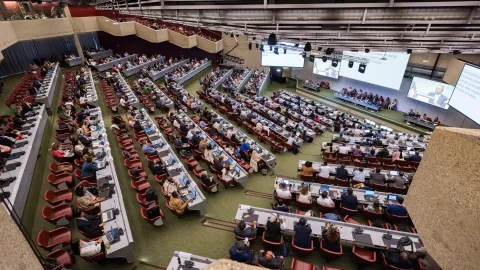
On 19 and 20 March 2025, the Marco Biagi Foundation devoted its annual international conference in commemoration of Marco Biagi to Employment in the Era of AI and Digital Platforms: Understanding and Regulating Transitions. A selection of the contributions presented at the conference has now become AI and Employment: Governance, Rights, and Organisational Change, edited by Federica Palmirotta, Ilaria Purificato and Iacopo Senatori.
The volume’s defining feature is its interdisciplinary approach, consistent with the methodological tradition of the Marco Biagi Foundation. It examines two interconnected dimensions of technological transformation. The first is internal to the organisation: the impact of AI on the management of employment relations, including the delegation of organisational and decision-making functions to automated systems. The second concerns the external labour market: the implications for employment, the reconfiguration of tasks and the changing demand for skills, as workers face both the risk of obsolescence and the need for continuous professional renewal.
Law, organisational studies and economics provide complementary perspectives on these developments.
The rationale for this approach is both analytical and practical. Understanding how AI affects work requires attention to the interaction between legal rules, organisational structures and economic dynamics. These connections help explain why technologies adopted in pursuit of efficiency may also intensify inequalities, redistribute authority or create new vulnerabilities. They are equally important when devising responses: regulatory safeguards must engage with organisational realities, while managerial choices must account for their consequences for workers’ rights and interests.
Avoiding both apocalyptic predictions and indiscriminating enthusiasm, the volume offers a critical and constructive exploration of AI in employment relations. One of the take-aways is that AI, if properly governed, can support fairer and better-informed decisions and contribute to safer workplaces. Yet no algorithm can replace the human capacities for judgment, responsibility, and solidarity on which labour law rests.
This argument develops across three main domains: management and human resources, collective bargaining, and protection against violence, harassment and other harms.
A thread connecting these domains is the promise, and the limitations, of delegating human functions to AI. Within management, as Massimo Bianchi’s contribution highlights, the aspiration to achieve increasingly rational and comprehensive control must be tested against concrete organisational problems. Technological sophistication does not necessarily produce better decisions. It can also introduce complexity, encourage excessive reliance on automated systems and distance managers from the activities for which they remain responsible. Interdisciplinary inquiry itself must resist becoming an eclectic accumulation of theories disconnected from organisational experience.
The transition from Taylorism to digital Taylorism, explored by Mattia Gasparro, illustrates these tensions. Workforce analytics and algorithmic management reshape the relationship between owners, managers and employees, affecting performance assessment, scheduling, training and discipline. Efficiency gains may coexist with heavier workloads, stress, diminished human contact and difficulties in understanding or contesting decisions. The question is therefore how managerial innovation can be reconciled with accountability, sustainable leadership, and social dialogue.
These concerns extend throughout the human resources cycle. Recruitment and selection, examined by Marius Olivier, provide a particularly revealing test: systems presented as neutral may reproduce bias embedded in training data and organisational practices, while intrusive data processing can affect privacy and dignity before an employment relationship even begins.
Similar problems arise in evaluation, remuneration and dismissal, as Kinga Moras-Olaś and Justyna Czerniak-Swędzioł show in their analysis of AI across human resources management. Alongside potential benefits, including personalised training, these contributions identify a continuing need for contextual judgment, meaningful information, human intervention, and effective remedies. The relational dimension of human resources management remains central to these safeguards.
Collective bargaining brings the limits of delegation into sharper focus. As Sławomir Adamczyk and Barbara Surdykowska argue, AI can assist representatives by analysing data and modelling negotiating scenarios, but it may also become an invisible influence on strategies and expectations. Supporting negotiations is different from assuming the authority to consent on workers’ behalf. The acceptance of an agreement involves responsibility, recognition and solidarity that cannot be reduced to an optimised outcome. Preserving this human dimension is essential to the democratic legitimacy of collective representation.
The same concern with the conditions of legitimate use informs Ceren Kasım’s examination of AI as a tool for preventing and addressing violence and harassment. Predictive analysis, reporting platforms and other applications may assist early detection and protection. Their contribution depends, however, on integration into comprehensive prevention strategies that address the structural dimensions of harm. Without transparency, participation and appropriate limits, protective technologies risk reproducing surveillance, discrimination or further forms of institutional harm.
Together, these analyses open a broader agenda for discussion. How does managerial power change when people analytics makes supervision more pervasive while decision-making becomes less intelligible? Under what conditions can AI advance inclusion, including through reasonable accommodation, without reinforcing discriminatory classifications? What information and opportunities for contestation do workers need when decisions depend on opaque systems? And how can collective protections enable workers’ representatives to participate meaningfully in the design, introduction and continuing governance of workplace AI?
European legislation provides an important testing field in which to investigate these questions. The AI Act (Regulation (EU) No. 2024/1689) and the Platform Work Directive (Directive (EU) No. 2024/2831) combine, within their respective scopes, preventive safeguards with requirements concerning transparency and human oversight; they also recognise roles for workers and their representatives. They offer material for studying how risk regulation interacts with labour protection and organisational decision-making. Their implementation and subsequent evolution should be accompanied by a critical assessment: whether these safeguards work in practice, where gaps remain and how experience can inform the regulatory improvement while preserving the acquis. Contributions such as those collected in this volume support that process.
However, assessing the European approach requires caution about portraying it as the world’s most advanced regulatory model or assuming that it can readily serve as a blueprint for policymakers elsewhere. While AI governance presents a global challenge, national approaches reflect divergent priorities, institutional arrangements and understandings of the relationship between innovation, protection and public authority. These differences are compounded by inequalities in technological capabilities and geopolitical power. Any prospect of effective global coordination therefore depends on negotiation and accommodation among competing interests and regulatory visions.
Recent interventions make those differences visible. In his provocative essay “We Must Pace the Frontier”, published in September 2026, the Anthropic CEO Dario Amodei calls for slowing the advance of frontier AI capabilities so that safety measures can keep pace. His proposal connects independent evaluation with coordination among companies and governments, while explicitly confronting geopolitical competition. It illustrates how calls for stronger safeguards can emerge from within the industry developing the technology.
The contrasting public statements of the US and Chinese presidents further expose the contested terms of this debate. Addressing the United Nations on 22 September 2026, Donald Trump rejected what he called a “globalist scheme of control” for AI. Two days later, according to the Chinese official account of his talks with Trump, Xi Jinping insisted that AI must be kept under human control and advocated dialogue on risks, benefits and the prevention of misuse. These statements suggest that the purposes, institutions, and distribution of authority involved in AI governance remain deeply contested, precisely as AI becomes a major arena of strategic global competition.
For employment scholarship, this global dimension reinforces the need for interdisciplinary and comparative inquiry. The challenge is to understand how different governance choices translate into organisational practices, employment opportunities and effective protections. By connecting those levels of analysis, the volume aims to contribute to an ongoing discussion about how technological change can be directed towards fairer employment relations, and how workers can participate in shaping that direction.
Comments (0)
Your email address will not be published.
Become a contributor!
Interested in contributing? Submit your proposal for a blog post now and become a part of our legal community!
Contact Editorial Guidelines
You may also like



September 9, 2026
September 2, 2026