


Main Developments in Competition Law and Policy 2025 – Spain
May 13, 2026
Below we cover the main competition law developments in Spain in 2025, concerning (i) Institutions and legislation; (ii) Antitrust; (iii) Mergers; and (iv) State aid.
Institutions and Legislation
The CNMC calls for additional resources to fulfil its mandate in the DSA and EMFA enforcement
On 2 July 2025, the Spanish Competition Authority (“CNMC”) published a report on the draft of a new Law aimed at improving democratic governance in digital services and the regulation of the media. The proposed draft is currently in the parliamentary phase (see Law proposal here). The draft aims to transpose the DSA –an EU Regulation aimed at making online platforms safer and more transparent– and the EMFA –an EU regulation designed to protect media freedom, independence and pluralism–. It modifies three Spanish laws: (i) the Law for Information Society Services and e-Commerce, (ii) the General Audiovisual Communication Law, and (iii) the CNMC founding Law.
The draft designates the CNMC as the Digital Services Coordinator under the DSA, and as the Media Supervisory Authority under the EMFA framework, significantly expanding the CNMC’s regulatory, supervisory and enforcement powers. While the CNMC welcomes its new designations, it issues a warning regarding the insufficient allocation of organizational and human resources needed to execute these functions. The CNMC stresses that, without these resources, the effective enforcement of EU obligations may be compromised. Moreover, the CNMC calls for the full and explicit incorporation of the EMFA into Spanish law, in particular those provisions that confer new powers to an independent authority.
The CNMC and the CGPJ Sign a Renewed collaboration Agreement to Further Enhance their Cooperation in the Application of Competition Law
On 21 October 2025, the CNMC and the governing body of the Spanish judiciary (“CGPJ”) signed a four-year collaboration agreement (available here), which replaces and updates the previous 2012 agreement under which the parties had been operating. The agreement establishes comprehensive mechanisms for information sharing between the institutions, promoting the use of new technologies. The CNMC will make all its resolutions available to the courts and provide the CGPJ on a quarterly basis its resolutions of greatest relevance. In turn, the CGPJ will make available to the CNMC the judgements issued by the National High Court and the Supreme Court in judicial proceedings reviewing CNMC resolutions, as well as civil judgements relating to the application of Competition Law. The agreement also provides for biannual seminars to bring together the judiciary and competition authorities, addressing the different technical issues of current relevance arising from the application of Competition Law, and promotes temporary placements at each other’s institutions.
Antitrust
The CJEU stablishes that the limitation period for follow-on actions based on CNMC decision’s starts to run once the decision becomes final.
In its judgment of September 4, 2025, Nissan Iberia, the Court of Justice established that the limitation period for follow-on actions based on CNMC decisions begins to run only once the decision becomes final (Nissan Iberia SA C-21/24). The case involved an action lodged in 2023 by a private individual against Nissan claiming compensation for the damages caused by Nissan’s anticompetitive conduct. In 2015, the CNMC fined Nissan for having participating in an unlawful exchange of commercially sensitive information. In 2021, the Spanish Supreme Court confirmed the fine and the decision became final. The action raised questions regarding the starting point of the limitation period for follow-on actions based on the decisions of a national competition authority. In its 2024 judgment, Heureka, the Court of Justice established that the limitation period for follow-on actions based on a Commission decision begins to run when the summary of the Commission’s decision is published in the EU Official Journal, without the decision having to be final.
With this background, Nissan argued that the limitation period began to run in 2015, once the CNMC published a press release announcing the decision in its website. According to Nissan, the 1 year limitation period for damages cases established in Spain before the transposition of the Damages Directive would have expired. On the other hand, the claimant argued that the limitation period only began to run once the CNMC’s decision had become final in 2021. The referring court accordingly decided to stay the proceedings and submitted a preliminary reference to the Court of Justice.
In its judgment, the Court of Justice distinguished Commission decisions and the decisions of the national competition authorities. The Court noted that, unlike Commission decisions which bind national courts since their inception, the decisions of the CNMC were only binding once they become final. Given this circumstance, the Court considered that an injured person could not effectively rely on the findings of the CNMC, as they could not “rely on [the] decision before that court in order to substantiate his or her action against the possible perpetrator of the infringement.” Accordingly, the Court found that an injured party could only be in a position to bring an action on the basis of a CNMC decision once it had become final.
Finally, the Court clarified that for the limitation period to begin to run it is not only necessary for the decision to become final. It is also necessary that the judicial decision rendering the decision final is published in a freely accessible manner to the general public.
Spanish National High Court annuls CNMC fine against tobacco manufacturers and their distributor for alleged software-facilitated tobacco
In November 3, 2025, a Spanish High Court (“Audiencia Nacional”), overturned the CNMC’s decision of April 10, 2019 imposing a fine of around EUR 15 million on three major tobacco manufacturers (Philip Morris Spain, Altadis and JT International) along with their Spanish wholesale distributor, Logista (SAN 4663/2025) (Tabacos S/DC/0607/17). The fine related to the alleged exchange of sensitive sales information over nearly a decade from 2008 to 2017, which the CNMC had classified as a single and continuous breach of Article 101 TFEU and the its national equivalent (Article 1 of la Ley 15/2007 de Defensa de la Competencia). The CNMC had determined that, since 1999, Logista had provided manufacturers with free, daily access to detailed “sell-in” volume data, which relates to its sales to downstream retailers broken down by brand and geographic area, through its platform. This arrangement enabled each tobacco manufacturer to access Logista’s non-public wholesale volumes, which exceeded the aggregated data Logista was obliged to submit to the Tobacco Market Regulator.
Despite recognising that information exchanges may constitute a restriction by object, the CNMC conducted an effects-based analysis and concluded that the practice produced collusive effects by the main tobacco manufacturers, including the stabilization of the market shares despite the sharp decline in demand, the parallelism in prices, and the reduction of market uncertainty by knowing the effects of different commercial strategies.
Both the producers and Logista challenged the decision before the High Court, which found that the CNMC had failed to establish several key elements of its substantive analysis. First, the exchanged information lacked strategic value, as it was irrelevant to the main competitive parameters in the Spanish tobacco market (i.e., pricing, innovation, and promotional activities). Second, the CNMC did not conduct a proper counterfactual analysis: another tobacco manufacturer, BAT, lost access to competitors’ sell-in data in 2013 and that did not alter its market share or conduct; the same data was available for roll-your-own tobacco, yet the CNMC found no restrictive effects in that market; and although the practice existed since 1999, harm was identified only after 2008, despite shifting market shares and increased promotional investment, indicating ongoing competitive pressure. Third, the CNMC did not demonstrate a causal link between the conduct and its purported effects, nor explain how access to information would enable manufacturers to anticipate competitors’ decisions.
Spanish High Court annuls CNMC’s fine on publishers and their industry association for an alleged coordination on policies and commercial conditions
In October 8, 2025, the long-running Spanish textbook cartel case has come to a definitive end after Spain’s Supreme Court rejected a cassation appeal against a ruling of the National High Court of May of the same year, which annulled the fines totaling c. EUR 33.88 million imposed by the CNMC on 34 publishers and their industry association (“ANELE”) (SAN 2285/2025) (ANELE S/DC/0594/16). The CNMC sanctioned an alleged Article 101 TFEU (and its national equivalent) infringement involving coordination of publishers’ policies and sales conditions for school textbooks through an ANELE Code of Conduct and price-fixing of digital textbooks, but then amended the fine 20 days after issuing the decision. The sanctions were overturned because the CNMC had unlawfully amended substantive elements of the fine calculation—notably the duration of the infringement and market shares—after the decision was adopted. The Supreme Court held that the appeal raised no issue of cassational interest, as the limits on correcting material errors were already settled case law, thereby confirming the annulment in full and ordering costs against the CNMC. The expiry of the proceeding, following the out-of-time modification of the sanction, voided the administrative fines, but the courts did not rule on the collusive conduct or the material existence of the cartel, and hence this ruling does not preclude potential civil damages actions by affected consumers.
The CNMC expands App Store probe.
The CNMC has expanded the sanctioning proceedings initiated against Apple in 2024 regarding the operation of its App Store. The authority is investigating whether Apple imposed unfair commercial conditions on app developers and whether it established a pricing schedule that developers were required to follow in order to distribute their applications through the App Store. According to the CNMC, such conduct could amount both to an abuse of a dominant position and to a restrictive practice among undertakings (Apple App Store S/0005/24).
In particular, the CNMC is examining whether Apple’s alleged pricing schedule restricted developers’ ability to set prices independently, thereby potentially infringing Article 1 of the Spanish Competition Act and Article 101 TFEU, in addition to Article 2 of the Spanish Competition Act and Article 102 TFEU. The authority stressed that the expansion of the proceedings is based on new evidence and does not prejudge the outcome of the investigation. The statutory maximum period of 24 months from the initiation of the case in July 2024 remains applicable for the investigation and its resolution.
The CNMC fines Naturgy abusing its dominant position market for electric distribution
On 19 December 2025, the CNMC fined Naturgy EUR 5.08 million for abusing its dominant position (UFD Contadores S/0006/23). Naturgy abused its dominant position in the upstream market for distribution of electricity by imposing undue burdens to downstream competitors in the market for the installation of certain electricity measuring equipment. Particularly, Naturgy applied an erroneous interpretation of the sectorial regulation to make the installation of electric measuring equipment cumbersome for downstream competitors. These actions resulted in the restriction or delay of the installation of measurement systems provided by competitor measurement service providers.
The CNMC fines ICON for restricting competition in its distribution network.
On 3 December 2025, the CNMC fined ICON EUR 1.2 million for fixing resale prices in its distribution network for professional hairdressing products (ICON S/0015/23). Particularly, ICON established a series of contractual clauses requiring wholesale distributors to respect the prices established by ICON. In the retail sector in online sales, ICON required retailers to sell at the price set by the company and prohibited them from selling in online platforms such as Amazon. To monitor compliance with its demands, ICON tracked its retailers prices and required retailers to immediately align with ICON’s price strategy if any deviation was found.
CNMC issues first direct contracting prohibition in abuse of dominance case against Eólica del Alfoz
In August 5, 2025, the CNMC fined Eólica del Alfoz EUR 958,593 and banned the company from participating in public sector contracts for six months for abusing its dominant position by favoring access of a renewable installation within its own corporate group over a competitor in breach of Article 2 Ley 15/2007 de Defensa de la Competencia (Eólica del Alfoz S/0011/23). As the Single Point of Contact (“Interlocutor Único de Nudo”) for a transmission network node, Eólica del Alfoz was the sole entity authorized to request grid access on behalf of renewable energy installations, and hence has broad discretion in handling access requests. This marks the first time the CNMC has directly determined both the duration and scope of a public procurement ban in a competition law decision, following the publication of its Communication 1/2023 on criteria for determining contracting prohibitions. Previously, the CNMC would only declare the prohibition and refer the matter to the State Public Procurement Advisory Board for the Minister of Finance to determine its parameters. The parent company, Beta Participaciones Ibérica, S.L., has been held jointly and severally liable for payment of the fine.
CNMC Launches Antitrust probes into several sectors.
During 2025, the CNMC announced the launch of a series of investigations across a wide range of sectors, including vehicle recycling, private healthcare, moving services, school bus transportation, airport service providers, pharmaceuticals, construction services, health insurers, the lottery sector, land machinery, and collective rights management. These probes reflect the authority’s increased enforcement activity and focus on detecting potential anticompetitive conduct in both traditional and highly regulated markets.
While the investigations are still at an early or intermediate stage, resolutions can be expected in the coming months, which may result in fines, behavioral remedies, or other enforcement measures, depending on the findings.
Mergers
Spanish Merger Statistics (2025)
The CNMC reviewed a total of 120 concentrations in 2025, spread monthly as follows:
Image
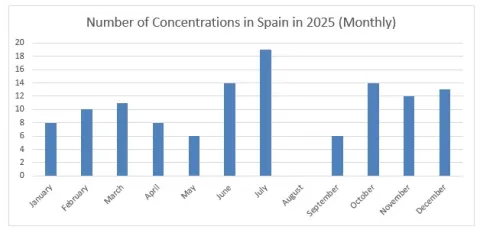
2025 was a historic year in terms of transactional activity (see full list here). There has been a considerable increment over 2024 (80 concentrations, a 50% increase), surpassing the previous record of 108 concentrations that the CNMC reviewed in 2021 (see D. Pérez de Lamo, X. Bascompte and P. González Casín, “Main Developments in Competition Law and Policy 2024 – Spain”).
The CNMC authorized most concentrations in phase I without commitments (114); a minority of concentrations in phase I (1) or in phase II with commitments (4); closed one notification before concluding the administrative procedure; and prohibited one concentration. The concentration authorized in phase I with commitments was GPNL International Holding / Urban Sports (C/1564/25). The four concentrations authorized in phase II with commitments were Hospital Polusa / Clínica Gaias Lugo (C/1563/25), Salzillo / Lázaro Soto (C/1579/25), Bondalti Chemicals / Ercros (C/1480/24) and BBVA / Banco Sabadell (C/1470/24). The abandoned transaction was Idealista / Portal47 (C/1550/25). The prohibited concentration was Curium / IRAB (C/1501/24).
The CNMC Prohibits Curium’s Takeover of IRAB in its First Ever Merger Prohibition
On 6 October 2025, the CNMC blocked the acquisition by Curium Pharma Holding Spain (“Curium”) of the Institut de Radiofarmàcia Aplicada de Barcelona (“IRAB”). The ruling (Curium/IRAB C/1501/24), unprecedented in the authority’s history, marks the first time the CNMC, since its creation in 2013, prohibits a merger outright, although its predecessor, the Competition Defence Tribunal, had blocked two transactions under the prior regime.
Curium and IRAB are active in the manufacture and commercialization of radiopharmaceuticals and related products used in positron emission tomography (“PET”), either for their own use or for third parties through contract manufacturing organisation (“CMO”) services. Curium owns two cyclotrons (production plants) and commercially operates five public cyclotrons across Spain, while IRAB operates a single cyclotron in Barcelona. These radiopharmaceutical products, used in medical imaging and therapy, have an extremely short shelf life, which limits distribution from the cyclotron (manufacturing facility) to a maximum radius of c.400–500 km by road. In northeastern Spain, only Curium and IRAB manufacture certain PET pharmaceuticals, while operators without their own infrastructure rely on CMO services to access these products.
In Phase I, the CNMC identified several competition risks: (i) substantial horizontal overlaps at national and regional level; (ii) a strengthening of market concentration, with the number of cyclotron operators falling from three to two nationally and from two to one in northeastern Spain; (iii) risks to innovation, given that PET radiopharmaceutical R&D requires independent cyclotron capacity to ensure uninterrupted supply to hospitals during clinical trials, with IRAB serving as an international reference center; (iv) potential portfolio effects; and (v) risks arising from Curium’s CMO activities competing with IRAB’s products.
Following its Phase II investigation, the CNMC concluded that the transaction would create significant competition concerns: (i) likely price increases and reduced product variety in the supply of certain PET radiopharmaceuticals in northeastern Spain; (ii) higher barriers to entry and expansion, and potential foreclosure in PET radiopharmaceutical supply markets due to the disappearance of IRAB as the only independent CMO operator; and (iii) a risk of coordinated effects in the affected markets. These risks were exacerbated by Curium’s prior involvement in a market-sharing and bid-rigging cartel with another competitor, highlighting the potential for post-merger coordination.
Curium offered a series of behavioral commitments to mitigate the CNMC’s concerns. These included (i) refraining from manufacturing or commercializing products from IRAB’s Barcelona facilities until alternatives were available in northeastern Spain; (ii) continuing to manufacture IRAB’s products under existing conditions for a transitional period; (iii) expanding IRAB’s manufacturing capacity; (iv) offering new CMO contracts on standard market terms; and (v) increasing IRAB’s cyclotron capacity. However, the CNMC found these commitments insufficient, as their limited duration and behavioral nature could not address the structural risks identified. In particular, the commitments were incapable of remedying the structural competition concerns identified. In particular, they failed to prevent the effective closure of the CMO manufacturing market for future radiopharmaceuticals, and they did not mitigate the risk of coordinated effects between the two remaining cyclotron operators in north-eastern Spain. According to the CNMC’s press release (available here), the authority concluded that there was no viable condition that the CNMC could impose on Curium to remedy the structural risks arising from the transaction. As a result, the CNMC prohibited the concentration.
The BBVA / Sabadell saga draws to a close
Following the CNMC’s Phase II review, the procedure advanced through Spain’s merger control framework (BBVA / Banco Sabadell C/1470/24). On 30 April 2025, the CNMC concluded the Phase II investigation and authorised the acquisition of sole control of Banco Sabadell by BBVA subject to a package of commitments designed to remedy the competition concerns identified in retail banking, payment services and related markets; the CNMC found that these commitments were “appropriate, sufficient and proportionate” to address the competitive risks posed by the transaction. However, this authorization was not final under Spanish law and had to be communicated to the Minister of Economy for consideration of whether to elevate the matter to the Council of Ministers on public interest grounds other than competition, under Article 60 of the Spanish Competition Act.
On 24 June 2025, the Spanish Government’s Council of Ministers, following an unprecedented public consultation, authorised the economic concentration, imposing an additional condition over and above the remedies accepted by the CNMC requiring BBVA and Banco Sabadell to retain separate legal entities, shareholders’ equity and operational autonomy for at least three years. This condition was presented as necessary to protect broader public interest considerations, including employment, regional financing decisions and SME credit policies, and effectively delayed full legal and operational integration until at least 2028. BBVA communicated that it would move forward with the takeover bid despite this condition and did not withdraw from the offer even though it considered the additional requirement to be legally contestable and initiated a contentious‑administrative appeal before the Spanish Supreme Court challenging the Council’s decision.
Meanwhile, BBVA pursued its voluntary tender offer for Banco Sabadell shares, improving terms in September 2025 with a 10 percent higher consideration and enhanced tax treatment, with the tender period running until 10 October 2025. Sabadell’s board rejected the bid, citing undervaluation, overstated synergies, and regulatory constraints. Following the offer’s failure, BBVA acknowledged the outcome and effectively closed the takeover chapter, with Sabadell reaffirmed its independence.
The failed bid and the Spanish Government’s intervention have also drawn scrutiny at EU level, with the European Commission having initiated an infringement procedure against Spain on the grounds that certain national merger intervention powers may conflict with EU rules on freedom of establishment, free movement of capital and the scope of national versus EU banking supervision—although as of late 2025 these proceedings are ongoing and have not resulted in definitive sanctions or rulings.
The provision allowing the Spanish Government to intervene in merger control proceedings was originally conceived as a tool to facilitate mergers deemed challenging from a competition law perspective, for example by easing conditions imposed by the CNMC, and had been used only once since its introduction. Its use for the opposite purpose, to reinforce or harden CNMC-imposed conditions, has been widely criticized. I will not, for now, face scrutiny by the courts, as BBVA withdrew its appeal following Sabadell’s board rejection of the bid.
The CNMC Authorizes for the First Time a Concentration Transaction Subject to a Compliance Commitment
On 1 October 2025, the CNMC authorized, for the first time, a concentration consisting in the creation of a joint venture (“JV”) subject to a commitment to adopt an internal competition law compliance protocol to prevent the risks of information exchange between competitors (Formigons CAT JV C/1586/25). The transaction concerned the acquisition of joint control by four Catalan companies active in the ready-mixed concrete manufacturing sector over a JV centralizing the joint management and operation of fifteen production plants.
Although the combined market shares did not exceed 30%, and in all areas where overlaps occurred there were between two and five competitors capable of exerting competitive pressure on the JV, the CNMC considered that the transaction raised competition concerns. In particular, the CNMC noted that the creation of a JV among four competing companies within the same geographic area, in a product market that had previously been subject to sanctions for collusive conduct, could facilitate the exchange of sensitive information between competitors, creating risks of coordinated effects.
In order to address these risks, the parties offered commitments consisting of (i) the adoption of an internal competition law compliance protocol for the corporate management of the JV and (ii) the amendment of the shareholders’ agreement to reflect the content of the protocol in that corporate instrument. These commitments ensured the autonomy of the JV and prevented the circulation to the shareholders of commercially sensitive information (current or future) relating to markets in which they compete or may potentially compete.
The CNMC Fines HM Hospital Group for Failure to Notify a Merger
In December 2024, the parent company of the private hospital group HM (“PME”) implemented a concentration by acquiring sole control of Hospital General de la Santísima Trinidad (“Hospital ST”) through its subsidiary Hospital de Salamanca (“HM Salamanca”) without notifying the CNMC. This change-of-control transaction was notifiable because Hospital ST held a 60–70% share (by number of beds) in the market for the provision of private inpatient healthcare services to private patients in the province of Salamanca, thus exceeding the 30% market-share notification threshold set out in Spanish merger control rules. The transaction was notified ad cautelam by HM Salamanca on 5 February 2025 and was cleared in Phase I, without remedies, on 25 June 2025.
However, on 23 May 2025 the CNMC opened sanctioning proceedings against PME and HM Salamanca for breach of the notification obligation (HM Hospital Santísima Trinidad SNC/DC/090/25) and issued a proposed fine of EUR 83,000 for PME and EUR 23,700 for HM Salamanca. On 22 July 2025, HM Salamanca and PME (i) formally acknowledged liability for the infringement, (ii) committed to pay the proposed fines before the adoption of a sanctioning decision, and (iii) waived their right to bring any administrative action or appeal. As a result of this acknowledgement and acceptance of liability, the CNMC applied a 40% reduction to the fines, resulting in final amounts of EUR 49,800 for PME and EUR 14,220 for HM Salamanca.
State Aid
EC Approves €700 Million Spanish Scheme to Support Cleantech Manufacturing Capacity
On 6 November 2025, the EC approved a EUR 700 million Spanish State aid scheme in the form of direct grants to support strategic investments by companies across Spain that increase clean technology manufacturing capacity for the production of net-zero technologies as well as their main specific components. These technologies include batteries, solar panels, wind turbines, heat pumps, electrolysers, and carbon capture, usage and storage (“CCUS”) equipment. The measure was approved under the Clean Industrial Deal State Aid Framework (“CISAF”), a new state aid framework adopted by the EC on 25 June 2025 to help Member States advance clean technology and industrial decarbonization.
The Spanish scheme aims to grant direct investment aid to companies across Spain that add manufacturing capacity for the production of net-zero technologies listed in Annex II of the CISAF, as well as their main specific components. Eligible technologies include CCUS equipment, including related critical raw materials. Aid under the scheme may be granted until 31 December 2028.
Under the scheme, the Commission assessed that the aid is: (i) necessary to incentivize the expansion of clean technology production in Spain; (ii) appropriate in design, targeting investments that directly contribute to the objectives of the Clean Industrial Deal; and (iii) proportionate, ensuring support only to the extent necessary to encourage the desired investment. The Commission concluded that the scheme facilitates the development of economic activities of strategic importance for the EU’s green transition, in line with Article 107(3)(c) of the Treaty on the Functioning of the EU and the conditions set out in the CISAF.
The approval follows a detailed assessment under EU State aid rules, confirming that the Spanish scheme is consistent with section 6.1 of the CISAF, which allows Member States to support the rollout of clean technology manufacturing capacity and related investments. According to the Commission, the measure is expected to accelerate the domestic production of net-zero technologies, address limitations in current manufacturing capacity, and support the broader EU strategy for achieving a net-zero economy.
The non-confidential version of the decision will be published under case number SA.119884 in the State aid register on the Commission’s competition website once any confidentiality issues have been resolved.
EC orders Spain to not pay an arbitral award to renewable energy operators
On 24 March 2025, the Commission adopted a decision concerning State aid measure SA.54155 implemented by Spain, relating to the payment of an arbitration award rendered in favour of Antin Infrastructure Services Luxembourg S.à r.l. and Antin Energia Termosolar B.V. The award arose from an investor-State arbitration under the Energy Charter Treaty (“ECT”) and ordered Spain to pay compensation following changes to its renewable energy support framework. The Commission examined whether the execution of the award, involving the transfer of public funds, constituted State aid under Article 107(1) TFEU.
The measure concerned Spain’s obligation to comply with an arbitral award granting approximately EUR 100 million plus interest and costs to the investors. Spain notified the measure to the Commission, taking the view that payment of the award could fall within the scope of EU State aid rules. The Commission opened a formal investigation procedure to assess whether the payment would confer a selective economic advantage on the beneficiaries and whether it was compatible with the internal market.
In its assessment, the Commission concluded that the payment of the arbitration award would constitute State aid, as it would involve State resources, confer an economic advantage on specific undertakings, and distort competition and trade within the internal market. The Commission further found that the aid could not be declared compatible under any of the derogations provided for in Article 107(2) or (3) TFEU. In particular, the Commission emphasized that arbitration awards based on intra-EU applications of the ECT are incompatible with EU law, in light of the Court of Justice’s case law on the autonomy of the EU legal order.
As a result, the Commission decided that Spain must not implement the measure, meaning that the arbitration award cannot be paid or enforced within the EU legal order. The decision forms part of the Commission’s broader approach to ensuring the primacy of EU law and the consistent application of State aid rules in cases involving intra-EU investor-State arbitration as defined by the CJEU in Achmea (2019) and Komstroy (2021). The non-confidential version of the decision has been published under case number SA.54155 in the State aid register on the Commission’s competition website.
Comments (0)
Your email address will not be published.
Become a contributor!
Interested in contributing? Submit your proposal for a blog post now and become a part of our legal community!
Contact Editorial Guidelines

You may also like



September 22, 2026
September 21, 2026