Zeph Investments v. Australia: Corporate Restructure Leads to Dismissal of AANZFTA USD 198 bn Claim
June 22, 2026
A USD 198 billion investment treaty claim brought by Singapore-incorporated Zeph Investments (“Zeph”) against Australia has been dismissed on the basis that Zeph, which acquired ownership over an Australian mining company through a corporate restructure, had in fact “contributed nothing” and was therefore not an investor with a protected investment under the Agreement Establishing the ASEAN-Australia-New Zealand Free Trade Area (“AANZFTA”). A Permanent Court of Arbitration tribunal composed of Professor Gabrielle Kaufmann-Kohler (as President), William Kirtley and Professor Donald McRae declined jurisdiction over Zeph’s claims in an award handed down on 26 September 2025, bringing to an end the first of four AANZFTA arbitrations initiated by Zeph, a company controlled by Australian businessman and politician Clive Palmer (“AANZFTA Arbitration”). The Zeph arbitrations have been the subject of previous coverage on the Kluwer Arbitration Blog (here, here and here).
2. Background to the Dispute and the Post-Dispute Restructuring
The AANZFTA Arbitration concerned mining and mining-related rights held directly and indirectly by Mineralogy Pty Ltd (“Mineralogy”), a company incorporated in Australia in 1985 and ultimately held by Mr. Palmer.
Mineralogy, together with its subsidiary, entered into a contract in 2001 with the Government of the State of Western Australia that inter alia set out a process for approving mining projects (“State Agreement”). The State Agreement was subsequently embedded in legislation. Disputes subsequently arose relating to the submission of a proposed mining project, and Mineralogy initiated arbitration under the State Agreement, which provided for domestic arbitration under Western Australia’s arbitration legislation. Mineralogy obtained an award on liability in its favour in 2014 and a further award in 2019 confirming it was not barred from claiming damages in a subsequent arbitration. However, Mineralogy’s claim for damages stymied because the Parliament of Western Australia enacted legislation on 13 August 2020 inter alia declaring the two awards to be “of no effect” and the underlying arbitration agreement “never to have been valid” (“Amendment Act”). As the State Agreement had been incorporated into an act of parliament, it could be amended and effectively undone by further legislation.
While the parties were still engaged in domestic arbitration, Mineralogy restructured its ownership. In late 2018, Mineralogy International Limited (“MIL”) was incorporated in New Zealand and interposed in the chain of ownership between Mineralogy and Mr. Palmer. Zeph was similarly incorporated and interposed in early 2019.
Image
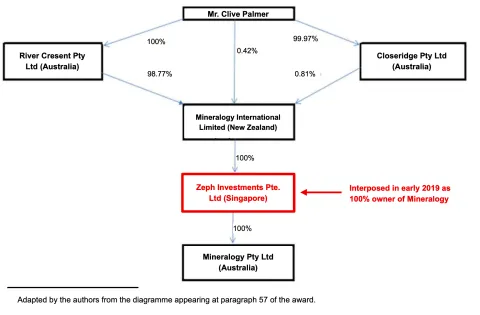
Zeph entered into this chain of ownership through a share swap in which: (i) Zeph issued approximately 6 million shares to MIL, and (ii) in exchange, MIL transferred to Zeph the former’s entire shareholding in Mineralogy. However, at the time of this transfer, Zeph had “no assets and liabilities other than [the] share capital of 1 fully paid ordinary share of SGD $1”. Zeph subsequently initiated arbitration against Australia in March 2023, alleging that the Amendment Act breached the AANZFTA treaty (i.e., the AANZFTA Arbitration).
3. Requirements for Treaty Protection
In the AANZFTA Arbitration, Australia argued that both the definition of “investor” and “investment” require a commitment of resources in respect of the investment. Zeph initially argued that passive ownership was sufficient, before later submitting that “making” an investment included participating in a transaction that brings about ownership or control over the investment, without requiring a commitment of capital or some other contribution to the investment.
a. Is Zeph an “Investor”?
An “investor” protected by the AANZFTA is “a natural person of a Party or a juridical person of a Party that seeks to make, is making, or has made an investment in the territory of another Party”.
The Tribunal in the AANZFTA Arbitration held that the verb to make requires more than passively owning or holding an investment, investors must “engage in conduct that can be deemed investing” which under the AANZFTA necessarily requires a commitment of resources.1
b. Has Zeph Made an “Investment”?
An “investment” under the AANZFTA means “every kind of asset owned or controlled by an investor”, followed by a non-exhaustive list of types of assets, with a “covered investment” being “an investment in [a Party’s] territory of an investor of another Party, in existence as of the date of entry into force of this Agreement or established, acquired or expanded thereafter”.
The Tribunal in the AANZFTA Arbitration considered that in the context of an investment treaty, “established, acquired or expanded” require an investment to involve some commitment of resources. This interpretation was supported by treaty provisions which demonstrated that a “covered investment” typically involves monetary transfers and capital contributions.
Notably, the Tribunal held that a contextual reading of both the definition of “investment” (only requiring ownership or control of an asset by an investor) and “covered investment” (which also relevantly requires the establishment, acquisition or expansion of an “investment”) meant that an investment will not be granted protection under the AANZFTA if it is merely owned or controlled by an investor without anything more.
4. What Did the Tribunal Mean by a “Contribution” and Why Was that Fatal to Zeph’s Claims?
The Tribunal in the AANZFTA Arbitration noted that in international investment law, “contribution” means “the allocation or commitment of economic resources, irrespective of the form of the commitment.” A contribution by an investor may be financial or the commitment of assets, technology, know-how, services or labour as long as the investor incurs “outlays, in some way, in order to pursue an economic objective”.2
Having found that Zeph will only be protected under the AANZFTA if it made a relevant contribution to its purported investment in Australia, the Tribunal rejected Zeph’s arguments that it had, in fact, made the required contribution:
The shares Zeph issued to MIL were “valueless” at the time of the share swap, which meant that nothing of value was contributed by Zeph in exchange for its acquisition of Mineralogy’s shares. The Tribunal dismissed Zeph’s argument that the context of acquiring assets via a share swap exempted it from needing to commit resources of value.
Actions Zeph had taken in its capacity as a shareholder neither constituted “active management” nor a “contribution” to the investment. Zeph’s employment of Mineralogy personnel, who were also Australian residents, was similarly rejected as evidence of the required contribution.
Zeph argued that profits it allowed Mineralogy to retain (as opposed to released as dividends) constituted “reinvested returns”, a protected investment under the treaty. This was rejected, as only profits arising from an existing investment deserved independent protection as “reinvested returns”. The retained profits also did not amount to a contribution as Mineralogy never declared the profits as dividends, Zeph had no entitlement to them.
In declining jurisdiction, the Tribunal opted against addressing Australia’s other preliminary objections, including whether the restructure was an abuse of process.
5. Practical Takeaways
Corporate restructures involving the interposition of a holding company arise with relative frequency in treaty arbitration and can create various problems for claimants.3 Incompatibility with jurisdictional requirements is one such problem, as the Zeph decision illustrates:
For investors, this award highlights the importance of investment structuring advice both at the outset of the investment and prior to any restructuring. In particular, advice should be sought where the restructure involves the interposition of entities in other countries, the absence of any new contribution or the contribution of a nominal amount,4 or the use of shell companies.5
Engaging in a restructuring when a dispute is beginning to crystalise is also very likely to attract close scrutiny and may be fatal to treaty claims.
For respondent States, the award illustrates the value of undertaking a thorough investigation into a claimant’s corporate structure. The cogency of Australia’s explanation of the economic reality of Zeph’s restructure evidently resonated with the Tribunal.
- The Award makes clear that investors cannot simply point to dividends which could have been paid to shareholders as evidence of an investment in the form of reinvested returns. This reasoning should be considered when advising on the existence of a protected investment in analogous circumstances.
Since 2022, Australia has opposed ISDS provisions in future agreements and has sought to wind back such provisions in existing agreements, in order to “strengthen” Australia’s “ability to regulate in the public interest”.6 As Zeph’s claims were dismissed without any scrutiny of regulatory conduct, the impact of this decision on Australian ISDS policy is likely to be limited.
Zeph has filed for annulment of the award in Switzerland. The annulment proceedings are still pending.
This contribution does not express the views of the authors’ firms, employers or their clients.
- 1
Addiko Bank AG v. Montenegro, ICSID Case No. ARB/17/35, Excerpts of Award, 24 November 2021.
- 2
Award, [143] citing Consorzio Groupement L.E.S.I.-DIPENTA v. People’s Democratic Republic of Algeria, ICSID Case No. ARB/03/08, Award, 10 January 2005, § II, ¶ 14(i).
- 3
See e.g.Pacific Rim v. El Salvador , ICSID Case No. ARB/09/12, Decision on the Respondent’s Jurisdictional Objections dated 1 June 2012, [4.60]-[4.92] (denial of benefits following a restructure); Phoenix Action v. Czech Republic, ICSID Case No. ARB/06/5, Award dated 15 April 2009, [135]-[144] (restructure did not result in a bona fide investment).
- 4
C.f.Vannessa Ventures v Bolivarian Republic of Venezuela, ICSID Case No. ARB(AF)/04/06, Award of 16 January 2023, [121] to [127], in which the majority accepted—with considerable reluctance—that a nominal purchase price of USD 50 for a shareholding was sufficient under the relevant BIT.
- 5
See e.g.Europa Nova v. the Czech Republic, PCA Case No. 19 of 2014, Award of15 May 2019, [219]-[252] (where the claimant failed to establish that it had a “permanent seat”.)
- 6
See https://www.dfat.gov.au/trade/investment/australias-bilateral-investment-treaties.
Comments (0)
Your email address will not be published.


You may also like


September 20, 2026
September 19, 2026


September 16, 2026