Law of the Sea Disputes: Empirical Breakdown of Annex VII Arbitration Under the UNCLOS (2026)
September 7, 2026
Recent developments underscore the continued practical importance of the dispute settlement mechanism established by the United Nations Convention on the Law of the Sea ("UNCLOS"). Two inter-State proceedings—between Ukraine and Russia, and between the Marshall Islands and Equatorial Guinea—have recently concluded. The two decisions are now public (here and here). Meanwhile, Ghana has announced its decision to initiate arbitration proceedings against Togo concerning a maritime boundary dispute. A common feature of these disputes is that they were first instituted before (here and here), or could be brought before, arbitral tribunals constituted under Annex VII of the UNCLOS.
To date, more than 20 cases have been initiated before Annex VII tribunals, and a substantial body of legal scholarship has examined their jurisprudence and procedural features. Despite this engagement, there is a paucity of accessible, up-to-date, and comprehensive empirical information regarding these cases. Such information is essential for understanding the usage and workings of these tribunals and for a deeper analysis of dispute settlement under Part XV of the UNCLOS. Against this backdrop, this post examines the use of Annex VII arbitration through an empirical lens, drawing on data relating to cases and proceedings up to 1 August 2026.
This post starts with a brief introduction to the compulsory dispute settlement mechanism under Part XV of the UNCLOS. Subsequently, it offers an empirical breakdown of the following aspects concerning arbitration under Annex VII of the UNCLOS: State parties, including their choices of procedure; number of cases; administering institution; subject matter; parties; non-appearance of a party; outcome; duration; and the appointment of arbitrators. At the end, this post will shed some light on the notable trend of case transfers from Annex VII arbitration to a standing judicial body.
Context: Compulsory Dispute Settlement With a Choice of Procedure
A unique feature of the UNCLOS is its compulsory dispute settlement mechanism (see here). By becoming a State party to the UNCLOS, a State consents in advance to arbitration or judicial settlement for disputes arising under the treaty. As regards the forum for peaceful dispute settlement under the UNCLOS, States may declare their preferred option from a closed list of four available procedures: the International Court of Justice ("ICJ"), the International Tribunal for the Law of the Sea ("ITLOS"), arbitration under Annex VII to the UNCLOS ("Annex VII Arbitration"), or arbitration under Annex VIII to the UNCLOS ("Annex VIII Arbitration"). In the case of an overlap between the choices of two States in a dispute, the chosen forum would have jurisdiction. If these choices do not overlap, or if either State in a dispute has not expressed a choice of procedure, the "fall-back" procedure is Annex VII Arbitration.
States Parties to the UNCLOS
171 States and one international organisation (the European Union) have ratified the UNCLOS. Out of these State parties, 56 States have filed a declaration expressing a choice of procedure for Part XV dispute settlement. Within this group of States, only 11 have mentioned Annex VII arbitration as one of their preferred forums. In addition, States that have not filed a declaration expressing a specific choice of procedure are deemed to have accepted Annex VII Arbitration based on Article 287(3) of the UNCLOS.
Number of Concluded or Pending Annex VII Disputes
Turning to the proceedings before Annex VII tribunals, more than 20 disputes have been instituted before Annex VII tribunals. For these disputes, eight were transferred with the agreement of the disputing parties to a standing judicial body, the ITLOS—either the full Tribunal (four cases) or one of its Special Chambers (four cases). No case has ever been transferred to the other standing judicial body mentioned under Article 287 of the UNCLOS: the ICJ. Of the remaining 15 disputes, 14 have been concluded (through the issuance of an award or by agreement), and one remains pending.
Administering Institution
The Permanent Court of Arbitration ("PCA") has provided its facilities and services for 14 of the 15 Annex VII cases, indicating a clear preference among States for the PCA as the administering institution. Only in the very first Annex VII case did the parties rely on the International Centre for the Settlement of Investment Disputes (ICSID).
Subject Matter of Annex VII Proceedings
The subject matters that Annex VII tribunals have engaged with are wide-ranging and are therefore difficult to categorise. Nevertheless, some of the recurring issues that tribunals have regularly addressed are maritime boundary delimitation, the detention of vessels and crew, and the protection and management of the marine environment and its resources.
Parties to Annex VII Proceedings
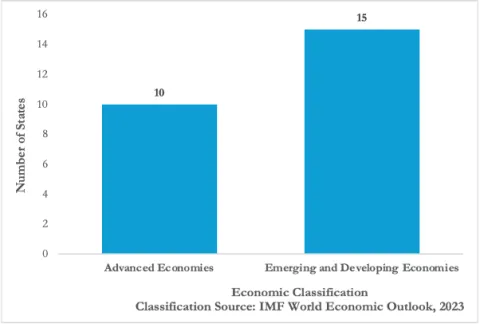
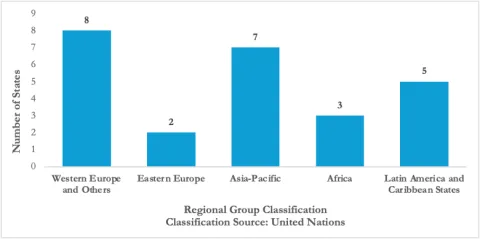
The geographical spread of the States involved in the 15 proceedings conducted under Annex VII is as follows.
By Economic Classification
Image
By Regional Groups
Image
Non-Appearance of a Party
Before Annex VII tribunals, there are two cases in which one party did not appear. While a party’s non-appearance does not prevent proceedings from moving forward based on Article 9 of Annex VII of the UNCLOS, non-appearance "imposes a special responsibility on the Tribunal" (South China Sea Award, para 12). For instance, the Annex VII tribunal may be required to take additional steps to ensure procedural fairness to both parties.
Outcomes
15 Annex VII cases, out of which one is pending, have resulted in several awards. In around one-third of the cases, the Annex VII tribunals addressed the entire dispute in a single award. In the remaining cases, tribunals addressed different aspects of the dispute in separate awards (e.g., awards on jurisdiction, merits, and reparations). These counts do not include separate decisions on provisional measures, which may be issued by the ITLOS pending the constitution of the arbitral tribunal. Finally, a few of these cases were concluded via agreements to terminate the dispute between the parties.
Duration of Annex VII Proceedings
The duration of Annex VII proceedings ranges from less than a year to around five years. Two cases were concluded in less than a year; two cases from one to two years; one case from two to three years; three cases within three to four years; and six cases crossed the four-year mark. One case is pending. However, the duration does not necessarily reflect the tribunals' efficiency in hearing the case, as many cases may get prolonged by factors such as parallel negotiations between the disputing parties, time limits for submissions, and procedural challenges.
Arbitrators in Annex VII Tribunals
Unless the parties agree otherwise, the tribunal consists of five members. There have been five-member tribunals in all but one case, which had a three-member tribunal. Across these 15 cases, there have been 82 appointments. These 82 appointments have included 49 individuals, as some individuals have been appointed in more than one case (repeat appointments). Moreover, among these 49 individuals, 23 have been or are present judges at the ICJ (8) or at the ITLOS (15). Finally, a stark gender disparity persists, as only three women have been appointed.
Trends Emerging From the Data, Specifically the Transfer of Cases to the ITLOS
We wish to address a notable trend in Part XV dispute settlement: the transfer of disputes from Annex VII arbitration to the ITLOS. Other observed trends—including the non-appearance of parties, diversity in arbitral awards, variations in the duration of proceedings, gender disparity in the appointment of arbitrators, and instances of repeat appointments—broadly correspond with trends found in inter-State arbitration and have been much discussed in scholarship (see e.g., here, here, and here). Several factors may explain why parties choose to make this transfer.
First, Annex VII arbitration and the ITLOS differ significantly in their allocation of costs. In an Annex VII arbitration, the parties bear the expenses of the arbitral tribunal. By contrast, parties appearing before the ITLOS do not directly incur these costs. Article 19 of the ITLOS Statute clarifies that the expenses of the ITLOS, in the first place, are borne by the States Parties to the UNCLOS and the International Seabed Authority. If an entity other than a State Party or the Authority submits a case, the ITLOS shall fix the costs for that entity. Therefore, transferring a case from Annex VII arbitration to the ITLOS may reduce the costs borne by the States Parties to the UNCLOS.
Second, parties may prefer ITLOS over the ICJ due to its specialised composition. Article 2(1) of the ITLOS Statute provides that ITLOS judges must be elected "[…] from among persons enjoying the highest reputation for fairness and integrity and of recognised competence in the field of the law of the sea" (emphasis added).
Third, the ITLOS may already have some involvement in a dispute before the constitution of an Annex VII arbitral tribunal. States may request provisional measures from the ITLOS pending the tribunal’s constitution under Article 290(5) of the UNCLOS. Further, the President of the ITLOS may act as the default appointing authority in the arbitral process under Article 3(e) of Annex VII of the UNCLOS. These forms of involvement of the ITLOS may encourage the parties to agree that this standing judicial body should hear the dispute in full.
Fourth, parties still retain some control over appointments if they transfer the case to an ITLOS Special Chamber rather than the full tribunal. Article 15(2) of the ITLOS Statute provides that "[…] the composition of such a chamber shall be determined by the Tribunal with the approval of the parties" (emphasis added).
Finally, the ITLOS is a standing judicial body with established procedures for deciding disputes. In an Annex VII arbitration, by contrast, the parties need to first agree on the procedural framework governing the proceedings. Referring a dispute to the ITLOS can therefore avoid further negotiations over procedure, which might otherwise delay dispute resolution.
In conclusion, States have consistently relied on the Annex VII procedure to resolve disputes concerning the interpretation or application of the UNCLOS. At the same time, the transfer of certain disputes from Annex VII arbitration to ITLOS illustrates the practical, financial, and procedural considerations that may influence the parties’ choice of forum.
Comments (0)
Your email address will not be published.