Editor’s Picks: Latest Additions to the 2026 Yearbook
November 14, 2026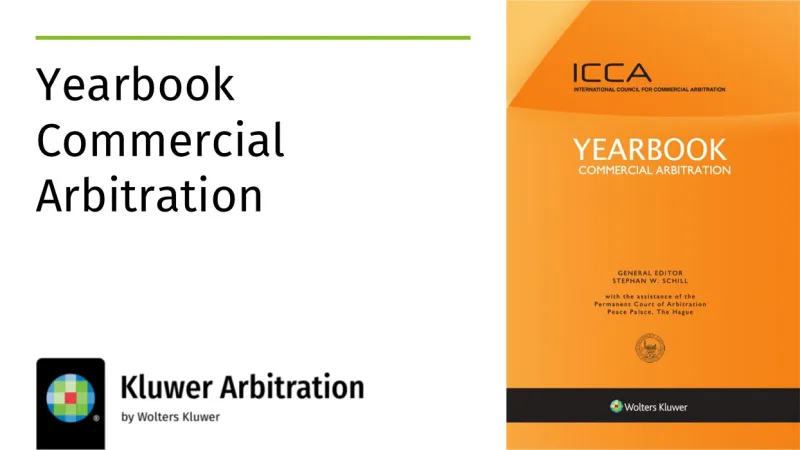
The latest updates to the 2026 Yearbook Commercial Arbitration are available on the Kluwer Arbitration database. These updates feature two selections: one with decisions from Australia, Malaysia, the Netherlands, the United Kingdom, and the United States, many of them chapters in disputes litigated in several jurisdictions at the same time and with a strong focus on State immunity in the enforcement of investment treaty awards; and one on Central and Eastern Europe, with decisions on the application of the New York Convention by the courts of Bulgaria, Hungary, Lithuania, Moldova, the Russian Federation, and Ukraine.
State immunity and multi-jurisdictional enforcement sagas
Among the highlights of the first selection are two recent rulings of the highest courts of the United Kingdom and Australia on whether, by ratifying an international arbitration convention, a State waives its immunity from jurisdiction in enforcement proceedings. In March 2026, in Kingdom of Spain v. Infrastructure Services Luxembourg S.à r.l. et al. and Republic of Zimbabwe v. Border Timbers Ltd et al., the Supreme Court of the United Kingdom dismissed the States’ appeals against the registration of ICSID awards, holding that the obligation under Article 54(1) of the ICSID Convention to recognize awards as if they were final domestic judgments was inconsistent with the preservation of adjudicative immunity, while immunity from execution remained explicitly preserved by Article 55. One month later, in CCDM Holdings, LLC et al. v. Republic of India, the High Court of Australia reached the opposite conclusion in respect of the New York Convention, holding that its ratification was not a clear and unmistakable waiver of immunity under Australia’s Foreign States Immunities Act 1985, since the Convention makes no reference to State immunity and its Article III, by referring to the ‘rules of procedure of the territory where the award is relied upon’, implicitly preserves immunity defenses available under local law.
The High Court of Australia’s decision in CCDM Holdings, LLC et al. v. Republic of India is one of several decisions arising from the enforcement of the India-Mauritius BIT award rendered in the Devas case. The enforcement proceedings for the parallel ICC award rendered in the same dispute are also covered in the first selection. In the Netherlands, in Antrix Corporation Limited v. Devas Multimedia America Inc., the Supreme Court left in place the enforcement of the award notwithstanding its annulment by the courts at the seat, as the annulment rested on a finding of fraud in a judgment that the Dutch courts did not recognize. In the United States, in CC/Devas (Mauritius) Ltd. et al. v. Antrix Corp. Ltd. et al., the Supreme Court reversed and remanded the Ninth Circuit Court of Appeals decision that had set aside the confirmation of the ICC award for lack of personal jurisdiction, holding that personal jurisdiction under the US Foreign Sovereign Immunities Act does not require minimum contacts with the United States.
Also concerning a long-running dispute litigated in several jurisdictions at the same time is the English High Court decision in Hulley Enterprises Limited et al. v. The Russian Federation, in which the English High Court enforced three Dutch awards against the Russian Federation, rejecting public policy objections based on alleged bribery, tax fraud, and illegality, but refused to enforce the award of costs, as the claimants’ concealment of documents in the arbitration would likely have affected the tribunal’s decision in that respect.
The first selection also follows the enforcement of the intra-EU renewable energy awards against Spain. The Federal Court of Australia, in Blasket Renewable Investments LLC et al. v. Kingdom of Spain, having accepted that the rights under two of the awards had been validly assigned from the original investors to Blasket, rejected Spain’s argument that the awards were not binding on it because of their incompatibility with EU law, finding that the TFEU had not modified the ICSID Convention as between EU Member States, and later entered judgment on the awards. The English High Court, however, in Operafund Eco-Invest SICAV PLC et al. v. Kingdom of Spain, refused to substitute Blasket as claimant, holding that neither the ICSID Convention nor the Energy Charter Treaty permit the assignment of awards, and that the Federal Court of Australia’s decision – in which Blasket had been substituted as claimant – did not estop Spain from asserting that the award was non-assignable, as Spain had appeared in the Australian proceedings solely to contest jurisdiction.
The US decisions in this update focus on the arbitration exception to sovereign immunity under the US Foreign Sovereign Immunities Act, which applies where there is an arbitration agreement, an award, and a treaty potentially governing enforcement, such as the New York Convention. Four decisions in this update show US courts reading these requirements broadly and leaving the defendant States’ objections to the merits stage. In Russian Federation v. Stabil LLC et al., the Court of Appeals for the District of Columbia Circuit rejected Russia’s immunity defenses against BIT awards arising from the seizure of Ukrainian investors’ assets in Crimea, finding that whether the BIT covered those investments concerned the scope of the arbitration agreement, not its existence. In Republic of India v. Deutsche Telekom A.G., the same Court likewise rejected India’s immunity defense, holding that India’s objection that the dispute fell outside the BIT went to the scope of the arbitration agreement, not its existence; it found, however, that the district court had erred in treating the arbitral tribunal’s ruling on that issue as binding, so that India could raise the objection as an excess-of-authority defense under Article V(1)(c) of the Convention at the enforcement stage. In Mercuria Energy Group Limited v. Republic of Poland, the District Court for the District of Columbia found that Poland was not immune even though the Energy Charter Treaty award had been annulled in Sweden, but declined to confirm the award, because the annulment, based on the CJEU’s Achmea and Komstroy jurisprudence, should be taken into account as it was not repugnant to fundamental notions of justice. And in Redes Andinas de Comunicaciones S.R.L. v. Republic of Peru et al., the same District Court held that a Peruvian State agency enjoyed no immunity against enforcement of two Peruvian awards under the FSIA arbitration exception and, being under the State’s plenary control, was subject to personal jurisdiction without a showing of minimum contacts.
Rounding out the first selection is a substantial update on Malaysian jurisprudence, with eight decisions of the Court of Appeal rendered in 2024 and 2025. Of particular interest are Gise Kam Kwan International Trade Ltd v. Antara Steel Mills Sdn Bhd and MTC Engineering Sdn Bhd v. VME Process Asia Pacific Pte Ltd, in which the Court of Appeal held that a mere contextual reference to a contract containing an arbitration clause does not incorporate that clause by reference.
Central and Eastern Europe
Turning to the Central and Eastern European selection, many of the decisions bear the imprint of the conflict in Ukraine and the ensuing sanctions regimes. Particularly noteworthy are two Russian decisions in the Lavna case, in which the Arbitrazh Court of the Murmansk Region, on the petition of the North-West Transport Prosecutor’s Office, refused recognition of a Netherlands-seated ICC award that had upheld a defense based on EU sanctions, holding that giving effect to those sanctions would violate Russian public policy, including the prohibition of abuse of rights, and that the presence on the tribunal of two arbitrators from States designated as ‘unfriendly’ indicated a lack of impartiality. The Arbitrazh Court of the North-West District affirmed, holding that the lack of impartiality of a tribunal so composed is presumed absent evidence to the contrary. A different outcome was reached in Certhon Projects B.V. v. Firma ‘Gesheft’, where an ICAC award in favor of a Dutch seller was enforced and, on cassation, the Arbitrazh Court of the North Caucasus District rejected the Public Prosecutor’s Office’s argument that enforcement would contravene the decrees regulating obligations towards parties from ‘unfriendly’ States.
The decisions included in this selection also show that Ukrainian courts upheld the enforcement of foreign awards notwithstanding martial law. In Ukrtatnafta v. Nordwind Trade SA, the Supreme Court held that a claim under a separate award constituted property in Ukraine sufficient to found jurisdiction over a foreign award debtor, and that the suspension of enforcement during martial law did not release the debtor from its obligations under the exequatur decision, while in Agro-Industrial Complex Dokuchaevski Chornozemy v. Soufflet Négoce by Invivo S.A.S. it found that martial-law restrictions on cross-border currency transactions did not make enforcement of a GAFTA award contrary to public policy.
In Hungary, the Budapest Regional Court of Appeal enforced a Ukrainian award, holding that the burden of proving the invalidity of the arbitration agreement lay on the award debtor, and rejecting the debtor’s argument that it could not be expected to attend a hearing in a war zone, noting that the hearing had been held by videoconference.
The Supreme Court of Cassation of Bulgaria held that a certification requirement under the Private International Law Code could not be imposed on parties seeking enforcement of foreign awards under the New York Convention, as Article III prohibits conditions more onerous than those applicable to domestic awards, to which this requirement does not apply.
In Lithuania, the Court of Appeal refused to stay proceedings for the enforcement of a Finnish award rendered under the SCC Arbitration Rules pending annulment proceedings at the seat, holding that a stay under Article VI of the New York Convention is warranted only in exceptional cases, and granted enforcement, rejecting public policy objections based on EU competition law and alleged procedural violations as an attempt to obtain a review of the merits of the award. Finally, the Court of Appeal Centre in Chișinău held in Finagrit SRL v. Crist-Valg SRL that the protective measures available to secure claims in ordinary civil actions could not be ordered in proceedings for the recognition and enforcement of a GAFTA award, where a final decision between the parties – the award itself – already existed, and, in Aecom Inocsa S.L. v. State Road Administration, terminated exequatur proceedings concerning a PCA-administered award after the award debtor paid in full the amount due under a settlement agreement.
The full decisions, including English translations and indexing, are available by accessing the 2026 Yearbook on Kluwer Arbitration.
Comments (0)
Your email address will not be published.