Time-Barred Claims in Indian Arbitration: An Issue of Jurisdiction or Admissibility?
November 11, 2026
An objection that a claim is time-barred is an oft-contested threshold issue in India-seated arbitrations. A referral court's examination at that stage is generally confined to the existence of the arbitration agreement; Aptech (2024) confirms that only a claim that is ex-facie time-barred may be rejected there, leaving everything else for the arbitral tribunal to decide.
Once presented before an arbitral tribunal, the objection is typically addressed through three different procedural mechanisms: (i) as a preliminary issue decided in a partial award (Route 1); (ii) as a jurisdictional plea under Section 16 of India's Arbitration and Conciliation Act, 1996 (“Arbitration Act”) (Route 2); or (iii) together with the merits after the evidentiary record is complete (Route 3).
While the substance of the objection remains the same across all three routes, the timing and standard of eventual judicial review differ. This post argues that the fragmentation in approach is on account of two unresolved issues: whether a limitation objection is a matter of jurisdiction or admissibility, and, fundamentally, what "jurisdiction" itself means in this context.
Doctrinally, jurisdiction concerns an arbitral tribunal's power to hear a dispute. Admissibility, on the other hand, assumes that power exists and asks instead whether the claim in question, given some defect of its own, is fit to be heard.
1. Three procedural routes
The three routes to decide on time bar objections described above are set out in greater detail below:
Image
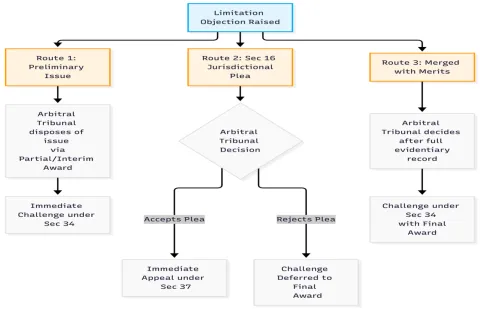
Route 1 is illustrated in the Supreme Court of India’s (“Supreme Court”) judgment in Bhadra (2018) (criticised here). Route 2 is illustrated in the Supreme Court’s judgment in MCM (2026). Route 3 is illustrated in the Bombay High Court’s judgment in Zawar (2026). That said, the distinction between these routes frequently blurs in practice. In Neelkanth (2025), the Supreme Court held that a partial award on limitation cannot be treated as final if reached "on demurrer", i.e., by assuming the claimant's pleaded facts rather than testing them through evidence where the parties are genuinely at odds on the underlying facts. The finding then remains provisional, and the issue must in substance be resolved together with the merits; this blurs routes 1 and 3.
This divergence does not reflect inconsistent application of the law. The fragmentation instead traces to the two issues identified in the introduction, discussed in turn below.
2. Diverging conceptions of the limitation objection
The first line of authority considers that the limitation objection is not a matter of jurisdiction. In NTPC (2007), the Supreme Court held that when a claim is time-barred, it cannot be said to be a case of refusal to exercise jurisdiction. A decade later, Bhadra (2018) maintained this line of reasoning, explicitly concluding that a preliminary award on limitation "does not relate to the Arbitral Tribunal's own jurisdiction under Section 16." This was later formalised in BSNL (2021) and Aptech (2024). In these decisions, the Supreme Court imported the "tribunal versus claim" test as expressed by the Singapore Court of Appeal in Swissbourgh (2018) and followed in BBA (2020) (discussed here), holding that a statutory time bar attacks the claim rather than the arbitral tribunal's authority, and is accordingly an issue of admissibility.
However, a parallel jurisdictional line emerged in Uttarakhand (2019). Seeking to minimise judicial intervention at the appointment stage, the Supreme Court held that limitation is a jurisdictional issue to be decided by the arbitral tribunal. In doing so, the bench attributed to Bhadra a holding it had not made, that limitation is a jurisdictional issue to be decided under Section 16 of the Arbitration Act, and adopted that characterisation as its own ratio.
This misreading of Bhadra was reinforced by a seven-judge bench of the Supreme Court in Interplay (2023). While examining Section 16 jurisprudence to resolve a dispute over unstamped agreements, the bench accepted Uttarakhand's interpretation at face value, noting that Bhadra held a time-bar objection "concerns the jurisdiction of the tribunal" and that NTPC said that the issue of limitation "goes to jurisdiction." The seven-judge bench thus crystallised a misreading of precedent, leaving two conflicting lines of jurisprudence: a doctrinally sound admissibility line and a jurisdictional line based on textual error.
3. Varying meanings of jurisdiction
These separate lines of authority each rely on different definitions of the term ‘jurisdiction’ to arrive at their respective conclusions. Bhadra read jurisdiction under Section 16 of the Arbitration Act as having reference to three criteria: (i) whether the arbitration agreement exists; (ii) whether the arbitral tribunal has been properly constituted; and (iii) whether the matters submitted to arbitration fall within the scope of the arbitration agreement. BSNL’s “tribunal versus claim” test imports a narrower, purpose-built sense of “jurisdiction”: confined to the arbitral tribunal’s power and authority to hear and decide a case. Everything else, however threshold in character, is admissibility or merits.
Uttarakhand interpreted arbitral tribunals’ power to rule on their jurisdiction inclusively, as it “would comprehend all preliminary issues touching upon the jurisdiction” of the arbitral tribunal. Interplay relied on NTPC to hold that “any refusal to go into the merits of a claim may be in the realm of jurisdiction.”
Plainly, these are varying concepts sharing one label. A court (or arbitral tribunal) applying Interplay’s definition and one applying Bhadra’s test are using different thresholds to determine whether an issue is jurisdictional at all.
This is the more fundamental of the two conflicts, and probably the reason the jurisdiction/admissibility question has resisted resolution across many years and several benches. A single authoritative ruling that limitation is admissibility, not jurisdiction, cannot settle anything if the meaning and scope of ‘jurisdiction’ itself remains unsettled. Bhadra already provides such a ruling on the admissibility point, a ruling followed in BSNL and Aptech. Uttarakhand and Interplay did not reject that conclusion; they did not apply it.
4. Conclusion
As illustrated above, the significance of procedural characterisation extends beyond taxonomy. It affects the allocation of authority between arbitral tribunals and courts, and their respective standards of review.
This ambiguity invites tactical use of the label itself. Respondents may seek to characterise limitation as a jurisdictional objection capable of terminating proceedings at the threshold, or as a preliminary issue capable of disposing of the claim early. Claimants may resist that characterisation and contend that limitation requires factual determination together with the merits. The procedural manoeuvring that results has little to do with the law of limitation. It is driven instead by the differing review consequences attached to each route. This delays resolution of the underlying dispute. Whether an issue goes to jurisdiction or admissibility is a question of law, and a tribunal cannot characterise it as jurisdictional merely to dispose of the issue quickly.
Recognising limitation consistently as an issue of admissibility would resolve this fragmentation. Such an approach preserves an arbitral tribunal’s ability to determine time-bar objections early where appropriate, while confining jurisdictional review to the narrow grounds Bhadra sets out. That doctrinal alignment is unlikely to happen on its own: what it requires is a bench prepared to confront Uttarakhand and Interplay directly on the point, or a legislative amendment to Section 16 that removes limitation from its scope entirely. Until either occurs, the label a party attaches to its objection at the first instance (and not the objection itself) will continue to determine how and when Indian courts review it.
Zacarias Joseph is an advocate at the Bombay High Court, practising independently as counsel and arbitrator. He was previously a Principal Associate at Khaitan & Co, trained under Prof. Albert Jan van den Berg, and holds the Geneva LL.M. in International Dispute Settlement (MIDS). He is a member of the YIAG.
Tags:
India,
Jurisdiction
Comments (0)
Your email address will not be published.