Asian International Arbitration Journal, Volume 21, Issue 2 (2025) and Volume 22, Issue 1 (2026) - Special Issues on Ethics
July 4, 2026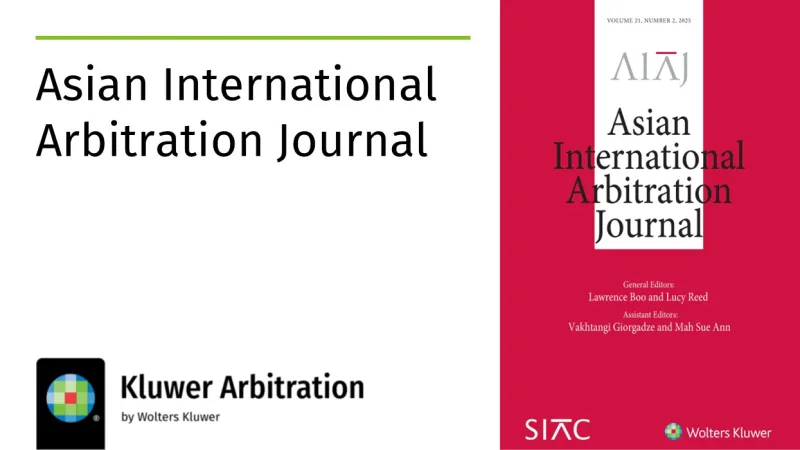
Featuring a special segment on the theme ‘Exploring the Future of Ethics in International Arbitration’, Volume 21 (2025) Issue 2 and Volume 22 (2026) Issue 1 of the Asian International Arbitration Journal (AIAJ) includes a Foreword by Professor Catherine A. Rogers and covers a range of topics including:
- The regulation of arbitrator conduct through soft law instruments in the investor-state dispute settlement context;
- Questions of party autonomy in arbitrator selection;
- Standards for the removal of arbitrators on grounds of bias;
- The admissibility of illegally obtained evidence;
- The ethics of third-party funding; and
- The duties of curiosity and disclosure in the context of arbitrators’ disclosure obligations.
The AIAJ is the flagship publication of the Singapore International Arbitration Centre (SIAC). With a focus on the Asia-Pacific region, the AIAJ is a double-blind peer-reviewed journal that publishes scholarly articles and commentary on international arbitration twice a year, with contributions from leading practitioners, academics, and thought leaders. Interested contributors are invited to visit the AIAJ website for further information on submissions and editorial guidelines.
Catherine A. Rogers, Introduction: Ethics as System Design in the Singapore Arbitration Ecosystem
This essay introduces a symposium on ethics in international arbitration within the Singapore arbitration ecosystem, situating the contributions within a broader account of arbitral ethics as system design. Singapore and Singapore International Arbitration Centre have long been associated with procedural innovation, but their more important contribution may be their sustained attention to the ethical infrastructure that supports arbitral legitimacy. Drawing on six contributions addressing arbitrator selection, disclosure and waiver, duties of curiosity, third-party funding, illegally obtained evidence, and the ICSID-UNCITRAL Code of Conduct, the essay identifies three cross-cutting themes. First, information functions as a regulatory resource. Without reliable information, party autonomy, market discipline, conflict checks, and procedural fairness are impaired. Second, self-regulation in arbitration operates through an architecture of accountability that links institutional rules, soft law, challenge procedures, and court review. Third, legitimacy is a dynamic output of institutional design, dependent on transparency, disclosure, enforcement, and adaptation to new ethical risks. The essay argues that ethical rules should be evaluated functionally, by asking whether they correct identifiable system failures without producing distortions such as exclusion, strategic behaviour, or over-deterrence. It concludes that securing legitimacy in international arbitration requires more than aspirational principles. Legitimacy requires explicit, operational governance at every stage of the arbitral process, supported by institutional leadership, empirical evaluation, and continued attention to the relationship between consent, integrity, and inclusion.
This article critically examines the admissibility of illegally obtained evidence (IOE) in international arbitration, highlighting the doctrinal and practical challenges posed by its use. While national courts often apply flexible balancing tests to IOE – considering factors such as relevance, reliability, and public policy – arbitral tribunals operate within a framework defined by party consent and procedural discretion. The authors argue that the admission of IOE fundamentally undermines the consensual foundation of arbitration and the implied duty of good faith, thereby threatening the integrity and enforceability of arbitral awards.
Drawing on comparative legal analysis and recent case law, the article contends that tribunals should move beyond traditional balancing tests and instead exclude IOE as a matter of principle. The authors propose a two-step approach: first, tribunals should assess whether the illegality taints the arbitral process; if so, the evidence should be excluded outright. The paper concludes that maintaining trust, fairness, and procedural legitimacy in arbitration requires a principled stance against the admission of IOE, both to safeguard party autonomy and to ensure the enforceability of arbitral awards across jurisdictions.
As Third-Party Funding (TPF) continues to shape the landscape of international arbitration, concerns over transparency, arbitrator independence, and ethical governance of disclosures have intensified. The 2024 ICSID-UNCITRAL Code of Conduct and the revised International Bar Association (IBA) Guidelines on Conflicts of Interest reflect a growing consensus for the need to regulate the ethical dimensions of arbitration. This paper explores how these frameworks, along with the forthcoming 2025 SIAC Rules, address the ethical challenges posed by TPF, particularly considering increasing scrutiny over conflicts of interest, arbitrator impartiality, and disclosure obligations. Through a comparative analysis of institutional regulations and recent case law, this paper examines whether existing ethical safeguards are sufficient to mitigate funder influence and uphold the legitimacy of arbitral proceedings. It also engages with broader ethical debates, such as the risks of repeat-player dynamics, arbitrator liability, and the impact of non-disclosure on award enforceability. By proposing a harmonised regulatory model, this paper contributes to the ongoing discourse on the future of ethics in arbitration, ensuring that transparency reforms balance access to justice with procedural fairness. As arbitration moves towards more nuanced and regulated institutionalisation, TPF arrangements have been subsumed into the formal ethical architecture of arbitral bodies – entailing mandatory disclosure duties, binding conflict-of-interest checks and centralised cost-allocation mechanisms. Therefore, this study highlights the need for proactive regulatory measures to sustain public trust in the integrity of dispute resolution.
Juhi Mathur and Sonia Dasgupta, Duty of Curiosity v. Duty of Disclosure: Bridging the Gap
Parties may object to an arbitrator on the basis of a potential conflict of interest, where they have knowledge of the potential conflict and where they raise the objection in a timely manner. While it is widely accepted that ‘knowledge’ in this context encompasses constructive knowledge, there remains some debate as to how ‘constructive knowledge’ should be defined and applied. This paper examines these issues within the broader discussion on the scope of parties’ ‘duty of curiosity’, that is the extent to which parties are required to actively investigate an arbitrator’s independence and impartiality beyond what an arbitrator discloses. In particular, the paper analyses these questions through the lens of the introduction of the ‘duty of curiosity’ in the IBA Guidelines on Conflicts of Interest in International Arbitration 2024.
The paper begins with the limits of the duty of disclosure on arbitrators, which in turn warrants the imposition of the duty of curiosity on parties and then proceeds to trace the development and application of the parties’ diligence obligations, finding that the duty of curiosity extends to such information that is readily accessible (notorious, even). The paper proceeds to attempt to reconcile points of tension between the competing but complementary duties of disclosure and curiosity, concluding that: (1) the arbitrator’s duty of disclosure is paramount, (2) the duty of curiosity provides consequences for parties’ bad faith actions which aim at gaming any gaps in disclosure; and (3) the standard for duty of curiosity must be aligned with the high threshold for waiver. The paper concludes with a practical guide on discharging the duty of curiosity.
Few arbitration users will encounter an arbitrator who openly engages in misconduct. Many, however, will recognise the quieter frustration of dealing with an arbitrator who appears unprepared, unresponsive, or inattentive to the nuances of the case. This article suggests that such experiences are symptoms of a more fundamental structural issue in international arbitration: a lack of effective accountability for the adjudicative services arbitrators provide. It begins by examining whether abolishing or narrowing arbitral immunity could remedy this problem but concludes that such an approach would both unduly threaten arbitrators’ independence and fail to offer a realistic path to reform.
The article instead argues that the more promising solution lies in correcting the current imbalance between the first-hand, experience-based knowledge that arbitrators and a small circle of repeat users possess about arbitrator performance, and the vague, largely anecdotal impressions on which the broader pool of users are often forced to rely when making appointments. Drawing on economic analyses of information failures, efficient markets, and adverse selection, it portrays the market for arbitrators’ services as one in which parties often lack the concrete, qualitative information needed to distinguish between high and low performing arbitrators. In this context, the article calls on arbitral institutions—given their central position in the arbitral ecosystem—to take concrete, institutionally feasible steps to improve access to reliable, qualitative information about arbitrator performance, thereby strengthening party autonomy and improving the quality of arbitral adjudication.
Matthew Harvey, When the Blindfold Slips: A Universal Standard for Removal of Arbitrators for Bias?
Singapore, Australia, and England have each differently legislated for the removal of arbitrators for bias. This paper examines the outcomes of several cases from each jurisdiction to determine whether the law for removal of arbitrators for bias is essentially the same. The paper also considers the influence international ethical guidelines have had in producing a commonality of outcome in this regard.
The UNCITRAL Code of Conduct for Arbitrators in International Investment Disputes (the ‘Code’) was adopted in July 2023 and published in February 2024, and is celebrated as a significant milestone in articulating unified ethical standards for arbitrators in investor-State dispute settlement (‘ISDS’). This article examines, in particular, two central issues in the Code’s scope and development: (I) the regulation of the ‘double-hatting’ phenomenon, where individuals serve concurrently as arbitrators and counsel in separate proceedings; and (II) disclosure obligations that are designed to meet concerns of partiality and bias. The evolution of the Code’s double-hatting provisions is traced over time, from an initial blanket prohibition to a nuanced approach that permits concurrent roles under specified conditions. Acknowledging the Code’s attempts to balance competing interests, the article nonetheless argues that certain provisions may exert a chilling effect on the diversity and sustainability of the arbitrator pool, sidelining arbitrators from under-represented backgrounds. A critical evaluation identifies two major constraints on the Code’s effectiveness: its reliance on voluntary adoption by parties, and the lack of robust enforcement mechanisms in cases of non-compliance. The article concludes that while the Code marks an important step in ISDS reform, its fruitfulness will hinge on integration into binding treaty frameworks, and the political will of states and stakeholders to ensure meaningful enforcement.
Comments (0)
Your email address will not be published.

You may also like



September 30, 2026