When Fame Prevails Without Registration? The Economist v. The Ecolomist and the Protection of Unregistered Foreign Marks in Kazakhstan
July 22, 2026
Two previous posts on this blog examined how Kazakh courts protect famous foreign brands from different perspectives. One showed that worldwide reputation alone was insufficient where ETRO lacked trademark rights in Kazakhstan. The other demonstrated formal recognition as a well-known trademark secured protection.
The dispute between The Economist and The Ecolomist raises a different question: can a foreign company invalidate a trademark registration in Kazakhstan without owning a registered trademark in the country or having its mark recognized as well-known? Although the outcome may be reasonable, the legal reasoning adopted by the Appeal Council of the Ministry of Justice and the Specialized Interdistrict Administrative Court raises important questions.
The background of the dispute
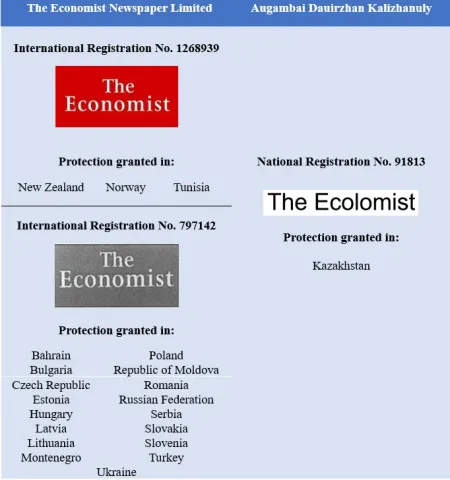
In 2023, an application was filed to register The Ecolomist for goods and services in Classes 16, 35 and 41. During examination, Qazpatent initially refused registration because The Economist was already known in Kazakhstan through its publications and online presence. At the same time, the examination report confirmed that no earlier identical or confusingly similar trademark registrations covered the relevant goods and services. After the applicant responded, however, Qazpatent reversed its position and registered the mark in June 2024.
The Economist Newspaper Limited challenged the registration before the Appeal Council, arguing that The Ecolomist imitated its publication and was likely to mislead consumers into believing that the goods and services were similar. The Appeal Council invalidated the registration, and its decision was upheld by the Administrative Court. However, the case is noteworthy not because of its result, but because of the legal path the authorities took to reach it.
Image
Who is an "interested person"?
The owner of The Ecolomist argued that The Economist Newspaper Limited lacked standing because it neither owned a trademark registered in Kazakhstan nor held an international registration designating Kazakhstan. It relied on the established practice of the Appeal Council and previous court decisions, according to which an "interested person" under Article 23(1) of the Trademark Law generally possesses a protected or pending means of individualization in Kazakhstan, such as a national trademark, an international registration designating Kazakhstan, a pending application, a well-known trademark, or a registered trade name.
The Economist Newspaper Limited relied on the reputation of The Economist among Kazakh consumers, arguing that The Ecolomist was misleading. Notably, it did not rely on a separate trade name claim.
Both the Appeal Council and the Administrative Court rejected the standing objection, but on different grounds.
The Appeal Council emphasized that The Economist was well-known to Kazakh consumers. It also referred to the international registration "The Economist" (№1268939) that did not designate Kazakhstan and therefore provided no trademark protection there. Nevertheless, relying on Articles 6, 7 and 23 of the Trademark Law, which govern misleading designations and conflicts with earlier rights, it concluded that The Economist Newspaper Limited qualified as an "interested person." Before the Court, the Appeal Council further argued that a registered trademark in Kazakhstan was not required where a designation was known to local consumers and used for identical or similar goods and services. On that basis, it maintained The Ecolomist was capable of misleading consumers.
The Administrative Court adopted a different approach, relying instead on Articles 2 and 8 of the Paris Convention to recognize The Economist Newspaper Limited as an "interested person" entitled to challenge the registration.
This reasoning is open to question. Article 2 establishes national treatment but does not create trademark rights or determine standing. Likewise, although Article 8 protects trade names without registration, the dispute concerned the validity of a registered trademark, not the unauthorized use of a trade name. Nor did The Economist Newspaper Limited rely on an independent trade name claim, and the judgment does not explain how the registration of The Ecolomist interfered with trade name rights.
Accordingly, both decisions leave unanswered a fundamental question: on what legal basis can a party without trademark protection in Kazakhstan nevertheless qualify as an "interested person" entitled to seek invalidation of a registered trademark? Before considering whether The Ecolomist was misleading, the authorities should have explained the claimant's standing.
The remaining issues will be examined in Part II.
Tags:
well-known marks
Comments (0)
Your email address will not be published.
Become a contributor!
Interested in contributing? Submit your proposal for a blog post now and become a part of our legal community!
Contact Editorial Guidelines

You may also like




September 1, 2026