


‘My Hermès is at home’: humour does not exclude trade mark infringement in France
April 16, 2026
By a judgment dated 25 March 2026,1the Versailles Court of Appeal ruled on an infringement case brought by Hermès. The defendant was marketing bags imitating the famous Birkin and Kelly models that featured on their front a sign consisting of the phrases ‘Mon Hermès est à la maison’ (‘My Hermès is at Home’) and ‘En attendant mon Birkin’ (‘While waiting for My Birkin’).
Image
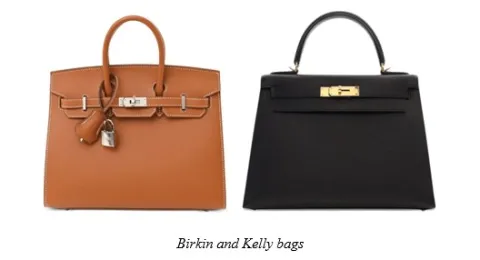
Image

Hermès initiated the action based on: (i) copyrights in the two bags, (ii) a 3D mark representing the signature lock closure of the Birkin bag, and (iii) the word marks ‘HERMÈS’ and ‘BIRKIN’.
At first instance, the court upheld the claims based on copyright and the 3D mark but rejected the action regarding the word marks. The Court of Appeal overturned this ruling and upheld the infringement claim concerning the word marks.
The case draws attention for how Hermès’ word mark claims were evaluated by both courts.
The first instance court held that the words ‘Hermès’ and ‘Birkin’ appeared within longer phrases which needed to be assessed globally in comparison with the registered marks. As a result, the signs used by the defendant were not deemed identical. The court found that these phrases constituted new expressions and that their use was unlikely to cause a likelihood of confusion.
The Court of Appeal upheld the infringement claim under the double identity provision, applicable where the marks and the products are identical, and which does not require confusion. While the Court specifically ruled out a likelihood of confusion due to the humorous tone of the expressions at issue, which left little doubt that the goods did not originate from Hermès, it held that the connection with the ‘Birkin’ and ‘Hermès’ marks enabled the defendant to benefit from their reputation, exploit the investments made in them, and damage their image.
The ruling of the Court of Appeal warrants a few observations.
Firstly, the case reminds us that, as we have known since L’Oréal (C‑487/07), the double identity provision protects not only the distinctive function of a trade mark but also its other functions, in particular its communication, investment and advertising functions. In the Hermès case, the Court of Appeal indeed acknowledged that other functions were affected.
Secondly, this case provides another example of what some might consider a conflict between trade mark rights and freedom of expression. Indeed, it recalls other matters involving parodic or humorous use of a mark, such as the ‘My Other Bag’ case.2 Under EU law, in light of the double identity provision, there is no limitation of trade mark rights that can be invoked to defend against an infringement claim on the basis of freedom of expression. The defendant might only argue that the use of the disputed sign could not affect any trade mark function, which is, however, difficult to prove when it is established that the sign was used in the course of trade and as a trade mark.
Thirdly, the ruling of the first instance court illustrates that if the disputed sign is not considered identical – Art. 9(2)(a) EUTMR, and if, due to the meaning of the sign, there is no likelihood of confusion – Art. 9(2)(b), the trade mark owner could only invoke the enhanced protection of marks with a reputation – Art. 9(2)(c) (which Hermès did not claim). Under these provisions, whether freedom of expression can be invoked as a ‘due cause’ is a matter for referral to the Court of Justice (IKEA, C-298/23). If the CJEU rules that the concept of due cause may serve as a mechanism to protect freedom of expression, the ruling would open the door to defenses against claims based on the enhanced protection of reputed marks in cases where uses are motivated not by public interest but purely by private commercial purposes. It is hoped that, if the CJEU adopts this view, it will also make clear that the scope of the due cause exception is narrow.3
- 1Case 24/00326: https://www.courdecassation.fr/decision/69c4cc11cdc6046d47febfa5.
- 2Louis Vuitton Malletier, S.A. v. My Other Bag, Inc., 674 F. App’x 16 (2d Cir. 2016).
- 3
Further on this see: Awaiting the CJEU’s judgment in IKEA (C-298/23): trade mark rights vs freedom of expression
Comments (2)
Your email address will not be published.
Become a contributor!
Interested in contributing? Submit your proposal for a blog post now and become a part of our legal community!
Contact Editorial Guidelines


You may also like




September 1, 2026

IP
Is there any specific part of the decision wherefrom we can deduct that it is a case of double identity? I mean in terms of the sign it is difficult to see the identity, which is technically necessary in order to apply the double identity rule (which comprises the all functions theory). Otherwise, the Court could protect the other functions only in case of reputed trademark (but i guess it applied the double identity rule here).
IP
The Court of Appeal upheld the infringement claim under the double identity provision? Is there any specific part of the decision in french chich i can use as an argument?