Too Seedless to Infringe? Nador cott v Asda and the Dependent Variety Question
March 31, 2026
As far as the authors are aware, there is, as yet, no dedicated blog to plant varieties. Therefore the following post has been prepared for the Kluwer Patents Blog in the expectation that some of our readers will have an interest in this flourishing area.
In a recent ruling, the English Patents Court (Mellor J) grappled with questions related to two mandarin varieties, Nadorcott and Tang Gold, and the limits of plant variety rights. The Nadorcott variety has a record of litigation, including forming the subject of a decision by the CJEU in 2019 clarifying the scope of the Community Plant Variety Rights under Regulation (EC) No 2100/94.
Nadorcott is a mandarin variety that was first identified in the 1980s. The plant breeders’ right for the Nadorcott variety (UK PVR no. 28016) is held by Nador Cott Protection S.A.S (“NCP”). NCP claimed that Tang Gold (a competitor variety of mandarin sold by Asda) was an “essentially derived” - or in UK terms “dependent” - variety of Nadorcott, such that selling Tang Gold infringed the Nadorcott right. The Court concentrated on two issues: (i) whether Tang Gold retained Nadorcott’s essential characteristics under s.7(3) of the Plant Varieties Act 1997 (the “Act”) such that it is an essentially derived variety (the “EDV” test), and (ii) whether, under s.6(3) of the Act, NCP had already had a “reasonable opportunity” to enforce its rights (the so-called “cascade” principle). In short, Mellor J held that, although derived from Nadorcott, Tang Gold did not retain the expression of Nadorcott’s essential characteristics and was therefore not a dependent variety under s.7(3) of the Act. However, he went on to decide that, if Tang Gold had satisfied the EDV test, Asda’s arguments under s.6(3) of the Act would have failed on the facts.
The EDV issue turned on the statutory definition in s. 7(3) of the Act. A dependent variety under UK law must (i) be “predominantly derived” from the initial variety while “retaining the expression of the essential characteristics” resulting from that variety’s genotype; (ii) be clearly distinguishable from the initial variety; and (iii) save for differences resulting from the act of derivation, conform to the initial variety in the expression of those essential characteristics. Asda did not ultimately dispute that Tang Gold was derived from Nadorcott: the agreed factual position was that the Tang Gold variety was created via irradiating the Nadorcott variety to induce mutations. Nor was there any real dispute that Tang Gold differed from Nadorcott in certain characteristics. The High Court therefore had to ask: what were Nadorcott’s “essential characteristics”, and did Tang Gold retain their expression?
Mellor J answered this question in the negative. He identified two essential characteristics of Nadorcott for the purposes of s.7(3)(a): pollen viability and seediness under cross-pollination. Mellor J noted that the question was whether these characteristics are essential of the Nadorcott variety of mandarin, as opposed to essential to mandarins more generally. Nadorcott produces viable pollen and, if cross-pollinated by compatible citrus varieties, its fruit will form seeds. Because of this, growers must either net trees or plant them sufficiently far from other citrus plants to avoid pollination. Tang Gold, by contrast, produces essentially non-viable pollen and proved essentially seedless even when manual cross-pollination was tested. Crucially, these characteristics were considered to be essential to growers of the fruit. Because those essential characteristics were not retained, Tang Gold failed the EDV test under s.7(3)(a) of the Act and was therefore not a dependent variety of Nadorcott. Consequently, there was no infringement of NCP’s plant breeders’ rights in the UK.
Image
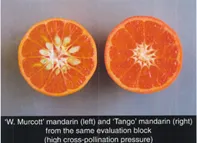
Like Tang Gold, Nadorcott fruit are typically seedless when properly grown, but Nadorcott will form seeds if pollinated while Tang Gold remains seedless. Mellor J’s analysis of s.7(3) of the Act hinged on this difference.
Mellor J did not need to address the issue of “reasonable opportunity” pertaining to s.6(3) of the Act, but did so in case he was wrong on the first issue. Section 6(3) of the Act extends protection to harvested material obtained through the unauthorised use of propagating material, unless the right holder had a reasonable opportunity before the harvested material was obtained to exercise its rights in relation to that unauthorised use of the propagating material. The judge held, obiter, that the references in s.6(3) of the Act to “rights” are to the UK plant breeders’ right, not corresponding foreign rights. He also held that “unauthorised use” can only occur in a territory where the holder has a relevant plant variety right and has not given authority. That meant fruit sourced from countries where NCP had no relevant protection – including Peru, Chile and Egypt – fell outside s.6(3) of the Act. As for Spain and South Africa, Mellor J considered that NCP had not had a reasonable opportunity to exercise its rights there, given that NCP had filed proceedings (which began in Spain in 2008 and in South Africa in 2014), but these proceedings had still not reached a first instance decision. Therefore, NCP would have been entitled to an injunction against the import of Tang Gold into the UK if Tang Gold had satisfied the EDV test.
The decision in Nador cott is significant. It is rare that cases related to plant variety rights make it as far as a decision from the High Court. This is therefore the first UK court ruling that sheds light on the “dependent variety” concept under s.7(3) of the Act, and the decision gives welcome guidance on how the “essential characteristics” criteria is to be interpreted in the UK. In particular, Mellor J emphasised that the statute must be construed by close attention to its language, and that the inquiry is directed to the essential characteristics of the initial variety itself, not to broader characteristics of the species. More broadly, the judgment suggests that the dependent variety concept under the UK legislation is relatively narrow. This does not mean that mutants or derivative lines will never be caught; but it does mean that predominant derivation alone may not be enough where the derived variety no longer retains the expression of characteristics the court regards as essential.
NCP has announced that it will appeal this decision, so the saga will continue.
Comments (0)
Your email address will not be published.
Become a contributor!
Interested in contributing? Submit your proposal for a blog post now and become a part of our legal community!
Contact Editorial Guidelines





You may also like

March 31, 2026


March 24, 2026

March 23, 2026

March 19, 2026