


Tokyo as a Global Hub for SEP Resolution: The Tokyo District Court’s Strategic Guidelines
February 12, 2026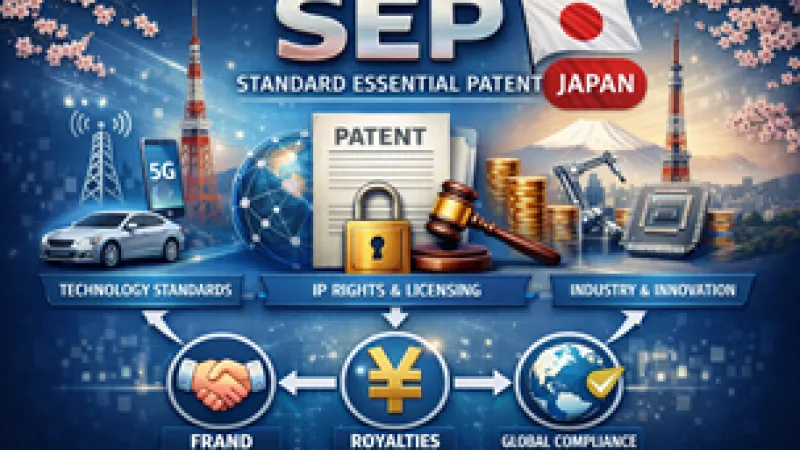
The Tokyo District Court recently released its "Guidelines for Proceedings in Patent Infringement Lawsuits involving Standard Essential Patents" (the "Guidelines"). This is the first time a Japanese court has formalized a specific procedural framework dedicated to Standard Essential Patent (SEP) disputes. The issuance of the Guidelines follows a notable judgment in Pantech Corporation v. Google G.K. (Tokyo District Court, June 23, 2025; Case No. 2023 (Wa) 70501), in which the court ordered an injunction against Google’s Pixel 7 smartphones, finding infringement of an LTE-related SEP-marking Japan’s first-ever court-ordered injunction in an SEP dispute.
Background: The Grand Panel Decision and the Pantech v. Google Case
In Japan, the framework for SEP injunctions was established by the 2014 IP High Court "Grand Panel" decision in Apple v. Samsung (May 16, 2014; Case No. 2013 (Ne) 10043, 2013 (Ra)10007). Under this precedent, an injunction is generally considered an "abuse of right" if the implementer is "willing" to take a FRAND licence. The Grand Panel decision also established a royalty calculation method, calculating royalties starting from the total sales revenue of the final product, setting the maximum cumulative royalties, applying contribution rate of the standard in issue (UMTS standard in the case) and then applying the ratio of the number of the patentee’s patent / total number of SEPs (the “top-down” approach). Due to the difficulty of obtaining injunctive relief and the low levels of damages awarded under this calculation method, Japan was long perceived as a less attractive forum for global SEP disputes.
A central issue in the Pantech case was how to assess an implementer’s “willingness” to enter into a FRAND licence, when the parties maintain fundamentally incompatible royalty calculation methodologies.
During the proceedings, the Court encouraged a settlement based on a global SEP portfolio. Specifically, the Court instructed Google to provide a settlement offer based on the royalty calculation method adopted in the Grand Panel decision above. However, Google declined to follow the court’s instruction and instead proposed a fixed-fee per unit based on its own calculation of a cumulative royalty for a typical smartphone. Google stated that the Grand Panel framework will make the calculation excessively complex in this case and refused to disclose the necessary sales data.
The Court concluded that Google’s refusal to adopt the Grand Panel framework, combined with its non-disclosure of sales data, indicated a lack of "willingness". Interestingly, the Court noted that Google’s conduct prior to the litigation did not necessarily prove a lack of willingness, as Google had engaged in sincere discussions to some extent; however, its procedural conduct during the court-led mediation became the decisive factor leading to the grant of an injunction.
The New Guidelines
The Guidelines formalize the Tokyo District Court’s procedural expectations that emerged from the Pantech experience, emphasizing a structured path toward global resolution:
- Global Resolution: The Court explicitly aims to provide a mechanism for resolving global SEP disputes by facilitating an agreement on "Global FRAND Royalties".
- Early Mediation: The Court will encourage settlement and set an intensive schedule for settlement conferences at the very first oral hearing.
- Focus on the "Abuse of Rights" Defence: As issues regarding infringement and validity are typically less frequently contested in SEP litigation, the determination of the "abuse of rights" defence, specifically the implementer's willingness based on its negotiation attitude from the pre-litigation stage until the termination of court-led settlement procedures, becomes the primary focus.
- Concurrent Proceedings: If infringement or validity is contested, the Court will allow up to two rounds of briefs and may organize technical explanatory sessions. Even during these procedures, the Court will lead intensive settlement negotiations in parallel.
- Respect for Party Intentions: In proposing a settlement, the Court will not unilaterally determine the Global FRAND Royalty. Instead, it will fully hear and respect the intentions of both parties before presenting a settlement plan.
- Initial Proposals and Disclosure: The plaintiff must propose "Global FRAND Royalties" in the complaint. Correspondingly, the defendant must provide a counter-offer in its answer, along with evidence regarding the sales quantity and sales amount of the accused products. As for the calculation methodology, any of the following may be used as long as the basis for the calculation is specified: the top-down approach, the comparable licence approach, or a combination thereof.
- Risk of Withholding Data: The Guidelines explicitly warn that failing to voluntarily submit evidence necessary for calculating royalties may lead the Court to determine that the defendant lacks a sincere "willingness".
Conclusion and Future Outlook
The Pantech case reached a global settlement in December 2025 before an appellate decision, so it is not clear whether the IP High Court would fully endorse the procedural-based assessment of "willingness" used by the Tokyo District Court. Nevertheless, the Tokyo District Court's Guidelines provide critical guidance for future disputes.
Practitioners should keep the following points in mind:
- Tokyo as a Global Forum: With the issuance of these Guidelines, the Tokyo District Court has clearly signalled its ambition to become a forum for resolving global SEP disputes through the facilitation of global FRAND settlements. It remains to be seen whether other district courts in Japan will adopt a similar formalized approach.
- Strategic Disclosure: Defendants who wish to avoid an injunction should basically comply with the court's requests for data disclosure even when developing alternative arguments. Procedural cooperation is now the essential prerequisite for maintaining the FRAND defence in Tokyo.
Comments (0)
Your email address will not be published.
Become a contributor!
Interested in contributing? Submit your proposal for a blog post now and become a part of our legal community!
Contact Editorial Guidelines




You may also like


February 23, 2026



February 2, 2026

January 30, 2026