When the EUIPO Forgets EU Copyright (Twice)
February 18, 2026
A recent dispute before the EUIPO (European Union Intellectual Property Office) first decided by the Cancellation Division (12 June 2024) and then reversed by the Fourth Board of Appeal (5 May 2025) in the “CHUBBY GORILLA” logo case – offers a telling example of how the Office handles the overlap between trademark and copyright protection. The final outcome (finding copyright infringement by the later EUTM holder) is likely correct, but the legal premises in both decisions are highly questionable. The dispute arose from an invalidity application filed by Chubby Gorilla, Inc., a US company active in the e‑cigarette bottling market, against the later EU trade mark registration No 18 170 667 ORGONIZZER figurative, designating various goods in Classes 8, 18, 20, 21 and 28. The earlier right relied upon was a copyright in the “CHUBBY GORILLA” logo, created in 2012, registered with the US Copyright Office in 2017 and, according to the applicant, protected in Spain by virtue of the Berne Convention and Spanish Royal Legislative Decree 1/1996.
The first instance: originality "by certificate"
The Cancellation Division rejected the invalidity application while acknowledging that the “CHUBBY GORILLA” logo had been duly registered with the US Copyright Office (USCO), relying on a chain of assignments and the USCO registration certificate. It then stated that, under US law, registration shows that the deposited work is a “protectable subject matter” and that the applicant had thus demonstrated that the work is original, validly protected and “indisputable” in the US.
This step is doubly problematic:
it conflates the essentially evidentiary/formal function of USCO registration—which, under section 410(c) of the United States Copyright Act (17 U.S.C. § 410(c)), establishes only prima facie evidence of validity (rebuttable in court)—with a substantive determination of originality by the US legal system;
it uses this alleged “originality by certificate” as a basis to automatically project protection into Spain, via the Berne Convention and the principle of national treatment, without any engagement with the autonomous EU notion of a “work” or with the EU Court of Justice’s criteria of originality.
The private international law narrative
Both the Cancellation Division and the Board stress that, in the absence of a fully “uniform” EU copyright law, one must refer to the applicable national law, here Spanish law, as filtered through the Berne Convention and the TRIPS Agreement. The applicable law identified throughout the proceedings is Spanish copyright law. This choice is not arbitrary. Under Article 60(2)(c) EUTMR, an EUTM shall be declared invalid if its use may be prohibited “pursuant to another earlier right under Union legislation or national law governing its protection”. Since the copyright invoked is relied upon as protected in Spain, Spanish law, as the law of the protecting State, operates as the relevant lex loci protectionis and determines both the existence and the scope of the “earlier right” for the purposes of invalidity. However, even when the earlier right is defined by Spanish law and by instruments such as the Berne Convention and TRIPS, Spain – like every Member State – remains bound by the EU‑harmonized notion of a “work” and of "originality" as developed under Directives 2001/29/EC and 2004/48/EC and the case law of the Court of Justice (Infopaq, Painer, Brompton and Mio Konektra). At first instance, the Office correctly recalls the principle of national treatment under Article 5 Berne and cites in detail Articles 10, 17, 21, 26 and 43 of the Spanish Ley de Propiedad Intelectual on the concept of a work, exclusive rights and transformations.
Yet the analytical lens remains entirely national‑international in scope:
The “prior right” relied upon before the EUIPO is constructed through a cumulative sequence of legal elements. First, on the US side, there is a chain of copyright assignments (from the graphic designer to MBB and then to Chubby Gorilla, Inc.) and a registration of the CHUBBY GORILLA artwork with the US Copyright Office, relied upon as evidence that the work is a copyrightable subject matter and that the applicant is the rightholder. Second, by operation of the Berne Convention and the TRIPS Agreement, the same work is claimed to enjoy national‑treatment protection in Spain, so that Spanish law governs the scope and enforceability of that copyright on Spanish territory. Third, under Article 60(2)(c) EUTMR, this nationally‑defined copyright becomes an “earlier right” capable of prohibiting the use of a later EUTM, provided that the conditions laid down by the lex loci protectionis – here the Spanish Ley de Propiedad Intelectual – are met. The EUIPO’s reasoning, however, treats this chain (USCO certificate → Berne/TRIPS → Spanish LPI) as sufficient in itself, without testing the work against the autonomous EU standard of originality, thereby “forgetting” the harmonized EU copyright layer that overlays national law.
What is striking in both the Cancellation Division’s and the Board’s reasoning is not a literal ignorance of EU copyright, but the absence of any engagement with the autonomous EU concept of a “work” and with the Court of Justice’s originality test. The Office builds the entire analysis on US law, the Berne/TRIPS framework and Spanish provisions and case law on plagiarism and transformation, while EU directives and CJEU jurisprudence appear only, at best, as a distant background rather than as the primary interpretative framework binding national law and the EUIPO itself. In this sense, one can speak of a functional “lack of awareness” of EU copyright, in that the harmonized notion of a work and originality never enters the operative reasoning, despite being directly relevant to the qualification of the CHUBBY GORILLA logo as a protected work.
The Board decision: right conclusion, missing EU law
The conflict opposed two figurative signs: on the one hand, the earlier CHUBBY GORILLA logo, a black silhouette of a gorilla in quadrupedal stance on its knuckles, with stylized facial features emphasized by white lines; on the other, the later EUTM ORGONIZZER, also depicting a black gorilla in a similar posture, combined with the word element “ORGONIZZER”.
Image
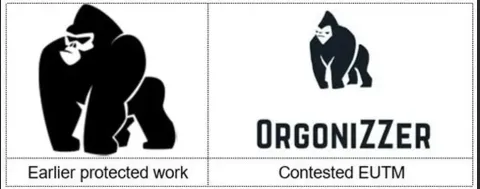
Both are figurative marks, and the Board explicitly compares the drawings, identifying a series of coincidences in body posture, perspective, colour scheme and facial expression, which lead it to conclude that the contested mark is a substantial copy of the earlier work. The Board stresses, inter alia, that in both images the gorilla’s hindquarters appear on the right in perspective, that the chest ends in a downward‑pointing peak, that the rear is particularly pronounced, and that the faces, depicted in a minimalist, geometric style, share an identically “angry” expression (frowning eyebrows, squinting eyelids, downward‑curving mouth, pointed mandible. The Fourth Board of Appeal overturns the first instance, finding that the “ORGONIZZER” mark amounts to an adaptation/plagiarism of the “CHUBBY GORILLA” logo and annulling the later EUTM on the basis of Article 60(2)(c) EUTMR. In doing so, however, it reiterates that there is no “complete harmonisation” and no “uniform EU copyright law”, building its reasoning exclusively on Spanish law and Spanish case law on plagiarism and transformations, without any reference whatsoever to the EU autonomous notion of a “work”.
The terminology used in the Board’s decision — “plagiarism”, “substantial copy”, “transformation”, “derivative work”— is not drawn from EU trade mark or EU copyright legislation, but from Spanish copyright doctrine and case law, which it quotes extensively. In Spanish law, “plagio” is understood as copying the work of others “in substance”, whereas “transformación” requires that the derivative work add original elements while keeping the prior work recognizable, thereby enjoying its own copyright yet remaining dependent on the authorization of the original rightholder. This understanding reflects the interpretation of Articles 17 and 21 of the Ley de Propiedad Intelectual by Spanish courts, in particular the Audiencia Provincial de Madrid (Sección 28ª, judgment No 635/2018; ECLI:ES:APM:2018:14194) and the Audiencia Provincial de Barcelona (Sección 15ª, judgment No 1332/2022; ECLI:ES:APB:2022:9871).The Board does not provide autonomous definitions of “adaptation”, “plagiarism” or “transformation” at EU level, but relies on Spanish case law to articulate these concepts and to characterize the ORGONIZZER sign either as a “copying in substance” or, in the alternative, as a “derivative work” under Article 21 of the Spanish LPI, which governs transformations of pre-existing works and the conditions under which derivative works may be exploited. This reliance underscores the conceptual gap left by the absence of harmonized EU categories for these notions in the trade mark–copyright interface, even though the assessment ultimately concerns an EU trade mark and must be read in light of the harmonized EU notion of a work and of copyright enforcement.
Strikingly absent are:
the requirement of originality as an expression of the author’s personality through free and creative choices embodied in an identifiable result;
the long line of EU Court of Justice judgments (from Infopaq and Painer to Cofemel, Brompton and the more recent Mio Konektra) which consolidated the autonomous concept of a work;
the role of Directives 2001/29/EC and 2004/48/EC, which harmonize essential aspects of copyright and enforcement and impose a binding minimum standard across national systems.
Why it matters when the EUIPO does it
It may be understandable – if regrettable – when parties or national courts read copyright primarily through the lens of their domestic law. It is much more serious when an EU‑level IP agency does so, and on core issues such as the notion of a work, originality and the cumulation of trademark and copyright protection. The implicit message from the decisions is that copyright remains a predominantly “national” field, loosely coordinated by Berne and TRIPS, while EU law is reduced to a kind of optional backdrop rather than a mandatory interpretative framework.
The paradox is clear: in a case where the overlap between trade mark and copyright protection is rightly acknowledged and the copying of the logo as a trade mark is finally sanctioned, the legal reasoning at both levels underplays exactly what should have been the starting point – the autonomous and harmonized notion of a work of authorship in EU law.
The post was originally published here.
Comments (0)
Your email address will not be published.


You may also like


March 30, 2026
March 25, 2026