Training Data, Market Dilution, and the Elephant in the Room: Why the Three-Step Test Matters for Generative AI
March 31, 2026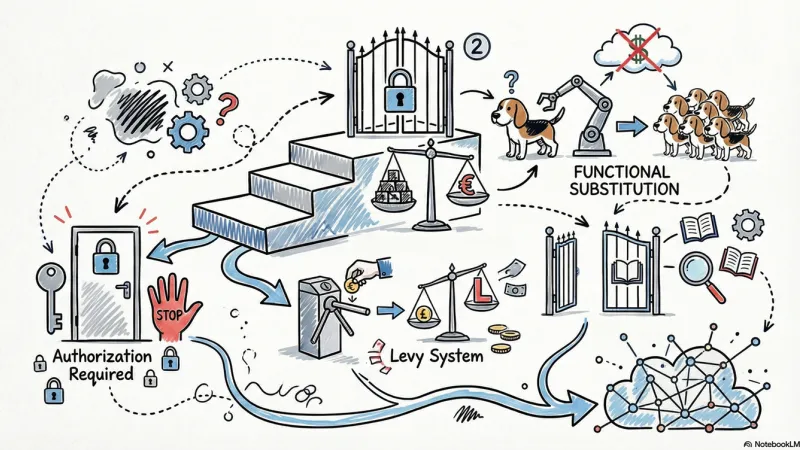
The global debate over generative AI (genAI) and copyright has, by now, produced a voluminous body of commentary. Courts in the United States have wrestled with fair use factors in Kadrey v. Meta and Bartz v. Anthropic (on which, see here). Also, the German Regional Court of Munich I has taken a first swing at the memorization problem and even the CJEU may soon have to rule on some of the issues — most notably in Like Company v. Google, where a preliminary reference on AI-related copyright questions awaits Luxembourg’s attention (see also here). Meanwhile legislators are no longer content with standing on the sidelines: The European Parliament has just urged the Commission to recalibrate EU copyright for generative AI. Moreover, the UK government spent considerable political energy promoting a broad opt-out training exception that would have made the British Isles a kind of AI training paradise — only to quietly shelve that ambition in its March 2026 report after 11,520 consultation responses, most of them considerably less enthusiastic than the AI industry had hoped (see discussion of “option 3” in the Report on Copyright and Artificial Intelligence).
What has remained conspicuously underexplored in all of this ferment is something hiding in plain sight in the TRIPS Agreement and the Berne Convention: the three-step test. Not the vague gesture toward international norms that occasionally appears in a footnote, but a rigorous application of all three cumulative requirements to the various forms of copying that generative AI training entails. Our forthcoming article sets out to remedy that gap. The picture that emerges is more constraining than most participants in this debate have cared to acknowledge.
The Test That Dare Not Speak Its Name
It is a curious feature of the genAI copyright debate that an instrument of binding international copyright law, one that limits the legislative discretion of every WTO member and governs the scope of every copyright exception in the EU and the US, has so rarely been subjected to sustained analysis in this context. The three-step test, requiring that exceptions be confined to “certain special cases” that do not “conflict with a normal exploitation“ and do not “unreasonably prejudice the legitimate interests of right holders,“ is the ceiling above every national legislature’s head. Yet in many policy discussions and academic papers, it is treated either as an afterthought or, more boldly, as a non-problem.
True, some commentators have suggested that the test poses no meaningful obstacle, because AI training does not touch expressive elements but merely extracts statistical patterns, or because an opt-out mechanism returns control to right holders, or because a levy can always be attached to render an exception proportionate. Our analysis challenges each of these arguments, though with the differentiation that the test’s structure demands.
Step Two Is a Threshold, Not a Dial
Perhaps the most consequential and therefore most contested feature of the three-step test for the genAI debate is the threshold function of the second step. The WIPO Guide to the Berne Convention states this plainly enough: if a use would conflict with a normal exploitation of the work, “it is not permitted at all.“ This is not a factor to be weighed and perhaps offset by compensation; it is a gate. Pass it, and step three’s proportionality analysis becomes available. Fail it, and no levy or licensing scheme can rescue the exception.
Under the test’s own internal structure, compensation belongs at step three, and only gets there if step two is satisfied. The Stockholm travaux are explicit on this point, and the WTO panel’s 2000 report, still the only formal decision interpreting Article 13 TRIPS, confirmed the economic competition paradigm. An exception that permits uses entering into significant economic competition with right holders’ normal modes of exploitation fails at step two regardless of what remuneration is subsequently offered.
Three Markets, One Framework
Against this background, our analysis identifies three distinct markets where the training of generative AI creates recognizable conflicts with normal exploitation. The first concerns licensing markets for AI training data, a market that is not merely hypothetical but has been observed by the US Copyright Office and where Anthropic's $1.5 billion settlement in Bartz puts a concrete price tag on the point. The second involves the direct substitution of original works by AI-generated output that reproduces or closely approximates protected expression, the “Snoopy problem,“ as the literature has taken to calling it (although whether downstream output effects should factor into the three-step test assessment of a training-stage exception remains contested).
The third market effect, and the most novel contribution of our analysis, is what we term functional substitution at scale. This goes beyond direct copying or style imitation in the legally irrelevant sense. It describes a situation in which AI-generated outputs, though not individually infringing and not verbatim reproductions, are from the user’s perspective functionally interchangeable with the originals in a defined market segment, and are being deployed at a scale that predictably depresses demand for human-made works in that segment. Three observable indicators converge: purpose overlap, user-perceived interchangeability, and sustained or foreseeable segment-level displacement. Amazon’s decision to restrict self-publishing submissions on Kindle Direct Publishing due to the flood of AI-generated books is one concrete, platform-level signal of exactly this dynamic.
Judge Chhabria’s analysis in Kadrey tentatively engaged with this phenomenon, acknowledging that “indirect substitution is still substitution“: the rapid generation of competing works may constitute cognizable market harm even without verbatim copying. We argue that this insight belongs not only to US fair use doctrine but, more fundamentally, to step two of the three-step test, which was always designed as a market-facing standard anchored in economic competition.
The Opt-Out Fallacy
The EU’s opt-out mechanism under Article 4(3) of the DSM Directive deserves special attention, not because it works but because it has been widely invoked as evidence that the TDM exceptions are compatible with the three-step test. The argument runs: since right holders can unilaterally reserve their works against commercial TDM by appropriate machine-readable means, any conflict with normal exploitation is precluded.
This argument is less comfortable than it looks. It requires ignoring the practical obstacles: the technical burdens on individual authors, the inability to reach works already incorporated in training sets, and the cross-border enforcement problem that renders most opt-outs unverifiable. It also requires setting aside the Berne Convention’s prohibition of formalities under Article 5(2), which forbids conditioning the exercise of rights on affirmative acts by the author. An exception that extinguishes an author’s exclusive right to authorize reproduction unless she has placed a machine-readable reservation on her website is, in functional terms and in our view, exactly the kind of formality that Berne was designed to abolish. Cloudflare’s recent report documenting how Perplexity deployed undeclared crawlers to evade robots.txt signals provides an empirical postscript to the legal argument. While such conduct would formally disregard the rights reservation mechanism of Art. 4(3) DSM Directive, leaving the TDM exception unavailable, the episode illustrates precisely the problem: an opt-out that can be circumvented by simply ignoring it offers right holders no effective protection against unauthorized use.
Where Does This Leave Us?
Our analysis does not conclude that all genAI training is incompatible with international copyright law. That would be as overreaching as the opposite claim that the test poses no real constraint. What the analysis shows, rather, is that the space available for copyright exceptions in this domain is narrower and more structured than is commonly assumed.
Unlicensed training on works specifically created for AI training purposes (curated datasets, structured corpora) likely conflicts with normal exploitation at step two and cannot be rescued by compensation. Training that enables low-transformative outputs entering into functional competition at scale with original works in defined market segments faces the same obstacle. By contrast, training for genuinely non-commercial research purposes, or training that is coupled with effective and verifiable output safeguards preventing (functional) substitution, occupies a different position under the analysis. Between these poles lies the largest category: commercial training producing at least moderately transformative output. Here, step two may be narrowly cleared, but targeted levies, designed with proportionality, transparency, and distribution equity in mind, must supply the step-three solution. Our framework distils this into three tiers: training that can proceed freely, training that requires a levy calibrated to verifiable market impact, and training that can only proceed with the author’s authorization.
The EU’s current TDM framework, taken as a whole, does not satisfy these requirements. The US fair use doctrine, with its inherent flexibility and its increasing judicial engagement with training-data markets and indirect substitution, is better positioned, but only if courts resist the temptation to treat existing licensing markets as hypothetical and give fair weight to functional substitution at the segment level.
Legislative reformers, whether in London, Brussels, or Washington, should take note. Further, the pending CJEU referral in Like Company v. Google makes this exercise urgent: the Court may soon have to pronounce on precisely these market-facing questions under EU law. The three-step test is not a technicality to be footnoted and then forgotten. It is the constitutional ceiling of international copyright, and it is rather lower, over the genAI building site, than many architects of that site appear to have noticed.
The full article “The Three-Step Test in International Copyright - A Global Framework for Generative AI Training” is forthcoming in the American Business Law Journal’s 2026 special issue “Inventing the Future: Intellectual Property and the Rise of Artificial Intelligence.”
The current version of the full text is already available via SSRN: https://papers.ssrn.com/sol3/papers.cfm?abstract_id=6447160
Image generated with NotebookLM
Comments (0)
Your email address will not be published.


You may also like

March 30, 2026

March 25, 2026