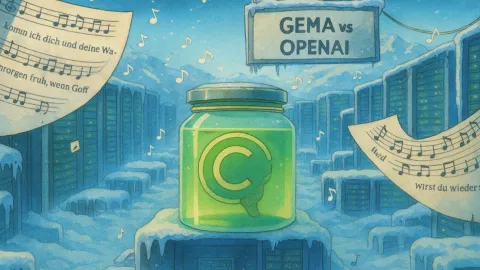
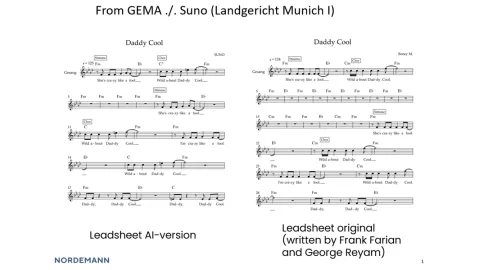
Part 1 of this post outlined the decision in GEMA v OpenAI and placed it in the action workflow of large language models (LLMs) as well as explaining why treating training as “reproduction”, in…
This article is an adapted and shortened English version of the German language article „Haftung für Urheberrechtsverletzungen im Output generativer KI-Systeme“, published in Gewerblicher…
Member States may not require performing musicians to transfer their neighbouring rights without their consent through an administrative order. On 6 March 2025, the Court of Justice of the European…
Photo by Aidin Geranrekab on Unsplash
On 4 March 2025, the London School of Economics (LSE) hosted an event dedicated to exploring the intersection of AI and IP within the creative industries. The…
This blogpost is part of a series marking the publication of the fourth edition of the book Collective Management of Copyright and Related Rights, edited by Daniel Gervais and João Pedro…
Image by Jakub Wyczik, using AI.
Recently, there has been a lot of suggestions that the U.S. Copyright Office is registering “AI-generated works.” Nonetheless, these are not actually AI-…
Image by Mohamed Hassan via PxHere
The debate on the use of copyrighted material to train generative AI models is evolving, shifting its focus from whether compensation is due to creators, to…
Photo by ThisisEngineering on Unsplash
In November 2023, the CJEU cast light on the right to fair compensation under the private copying exception harmonised by Article 5(2)(b) InfoSoc…
Image via Pixabay
The two US class actions against Meta
We have previously analysed US class actions against Open AI (here) and Google (here) for unauthorized use of copyright works in the…
Photo by Markus Spiske on Unsplash
Dear readers,
Happy new year!
Welcome to the fourth (and last) round up of EU copyright law for 2023! In this edition, we update you on what has happened in the…