


From TRIPS to Training Data: Does the WTO Framework Offer Any Answers to the AI-Copyright Crisis?
April 30, 2026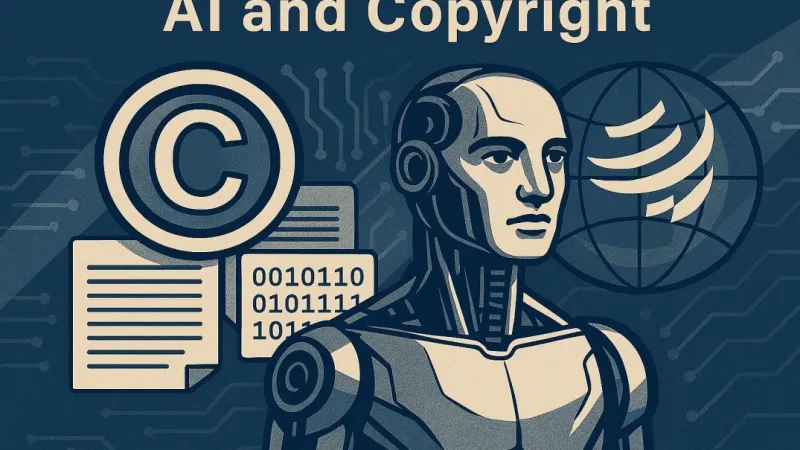
On 10 March 2026, the European Parliament adopted, by 460 votes to 71, a resolution on copyright and generative AI proposing that EU copyright law apply to every generative AI system placed on the EU market, irrespective of where training occurred, and calling on the EUIPO to administer a mandatory register of works used to train AI models, backed by a compulsory remuneration regime. The same week, Universal Music Group, Concord Music Group and ABKCO filed a $3.1 billion lawsuit against Anthropic, the latest addition to what Debevoise & Plimpton counts as more than fifty pending AI-copyright cases in US federal courts.
Both developments are, in legal terms, purely domestic. The Parliament’s resolution is non-binding and addressed to the Commission. The US litigation turns entirely on Section 107 of the Copyright Act. What neither can supply, and what the current moment genuinely requires, is an answer from international law. The operative question is this: what does TRIPS actually require of its 166 members when they legislate on AI training data? And can its existing framework accommodate the fragmentation that is already well underway, or is WTO dispute settlement now only a matter of time?
A Spectrum of National Responses
The dispute is not about whether copyright matters: every TRIPS member is formally committed to protecting authors’ exclusive reproduction rights. The real contestation concerns exceptions, and that contestation has already generated substantial divergence in domestic law.
Japan sits at the permissive end. Article 30-4 of the Copyright Act allows copyrighted works to be used for information analysis (including AI training) without consent and without any opt-out, provided the use does not involve ‘enjoying’ the work’s expressive content. Singapore has enacted comparable provisions. The EU occupies the middle ground: Article 4 of the 2019 DSM Directive permits commercial TDM but preserves a rights-holder opt-out, one the Parliament's 10 March resolution would now fortify through the EUIPO registry and remuneration obligations. The United States provides no clear answer at all. The Thomson Reuters v. Ross Intelligence ruling of February 2025 found AI training not to be fair use on its specific facts, while subsequent cases such as Bartz v. Anthropic PBC and Kadrey v. Meta Platforms, Inc. have split on the same question in different factual settings.
The practical consequences are already apparent. A US-based AI developer training on unlicensed data may be acting lawfully at home, permissibly under Japanese law when deploying there, and, under the Parliament’s proposed extraterritorial extension, potentially in breach of EU copyright law for training conducted entirely outside EU jurisdiction. This is not a coherent international regime. It is the absence of one, and the commercial repercussions are already being litigated.
TRIPS Article 13 and the Three-Step Test
The operative provision is Article 13 of TRIPS, which permits copyright exceptions only where they: (1) are confined to certain special cases; (2) do not conflict with a normal exploitation of the work; and (3) do not unreasonably prejudice the right holder's legitimate interests. The three conditions are cumulative: failure on any one is fatal. The only authoritative WTO interpretation remains the panel in US - Section 110(5) of the Copyright Act (WT/DS160/R, 2000), decided a quarter-century before generative AI existed. Applying that framework today requires deploying categories that were never calibrated for this problem.
The first condition, ‘certain special cases’, demands an exception that is clearly defined and bounded in scope. A blanket TDM authorisation covering commercial AI training at industrial scale, such as Japan’s Article 30-4 read broadly, sits uneasily with that requirement. The Parliament’s EUIPO registry proposal can be read as an attempt to engineer the necessary specificity: by confining the free-use space to works whose holders have not registered an opt-out, the EU is endeavouring to convert a broad exception into a circumscribed one. Whether a panel would accept that framing remains genuinely open.
The second condition of no conflict with normal exploitation is where the analysis cuts deepest. The WT/DS160/R panel understood ‘normal exploitation’ to encompass not merely present revenue streams but uses that, with reasonable plausibility, could acquire ‘considerable economic or practical importance’ in the future. The Parliament’s 10 March resolution articulates the concern directly: large-scale AI training threatens ‘the potential substitution of human creative output by mass-produced AI-generated content.’ If a model trained on a corpus of literary works generates text that competes in the same market as those works, at a fraction of the cost, and the training use that produced that capability is arguably in conflict with the normal exploitation of the originals. This is not a hypothetical risk. It is a description of the technology’s commercial proposition.
On the third condition, the Parliament’s resolution furnishes unusually concrete evidence: it places the cultural and creative sectors at approximately 4% of EU value added and eight million jobs, characterising uncompensated large-scale training as a structural threat to that economic base. A WTO panel assessing ‘unreasonable prejudice’ to legitimate interests would find this kind of sectoral impact data directly pertinent. The question, which the resolution does not resolve, is whether remuneration obligations of the kind the Parliament proposes would be adequate to cure the prejudice, or whether they merely redistribute it.
The Extraterritoriality Problem
The most consequential aspect of the 10 March resolution for international law purposes is not the EUIPO registry. It is the assertion that EU copyright applies wherever AI systems are ‘placed or made available on the Union market’, irrespective of where training occurred, coupled with a rebuttable presumption of infringement for providers who fail to satisfy EU transparency requirements.
This claim engages TRIPS Article 3 on national treatment directly. A US or Chinese AI developer that trains lawfully under its home jurisdiction’s law would nonetheless face EU liability for training conducted outside EU territory, subject to criteria that the EU itself sets and can revise unilaterally. That is not a neutral application of international IP standards; it is the extension of domestic regulatory authority beyond territorial limits as a precondition of market access. Whether such a measure constitutes ‘less favourable’ treatment of foreign right holders, or a discriminatory condition on foreign AI service providers under GATS, are questions a WTO panel would be compelled to address seriously. The EU is not alone in this tendency: the US ‘foreign adversary’ data restrictions and India’s localisation framework both reflect the same regulatory instinct, but the Parliament’s resolution represents the most legally elaborated extraterritorial claim yet advanced in the AI-copyright space.
What Needs to Happen
Three conclusions follow from this analysis, and none of them are comfortable.
The TRIPS Council, mandated under Article 68 to monitor the Agreement’s operation and facilitate consultations, needs to open a formal work programme on AI and copyright exceptions before the first WTO panel is constituted on these issues. This does not require consensus on outcomes. It requires a shared forum in which interpretive principles, particularly regarding the three-step test, can be developed while negotiation remains a viable alternative to adjudication.
The extraterritoriality problem needs to be addressed multilaterally, not left to accumulate as an expanding body of unilateral regulatory assertions from the EU, US, and India in parallel. The WTO Joint Statement Initiative on E-Commerce, with its ninety-plus participants, is the obvious forum. It currently has no mandate on IP exceptions. It should.
And the three-step test needs rethinking. The WT/DS160/R panel’s framework was constructed for photocopiers and cable retransmissions. It can be stretched to cover AI training data (this piece has attempted to show how), but the strain is visible at every joint. The ‘normal exploitation’ of a work carried a tractable meaning in 2000. In a market where AI systems trained on that work may displace demand for the work itself, the concept requires either reinterpretation or renegotiation. WIPO’s ongoing processes on copyright and AI, and the JSI, are plausible vehicles for both. The binding constraint is political will.
The EU Parliament’s vote of 10 March signals that domestic legislatures are advancing faster than multilateral institutions. That divergence, if it continues to widen, will not self-correct.
Image created with AI.
Comments (1)
Your email address will not be published.





You may also like





August 27, 2026

Subhradeep Das
Interesting piece to read.