Copyright protection for electric guitars? - The Düsseldorf Regional Court’s Stratocaster ruling
July 15, 2026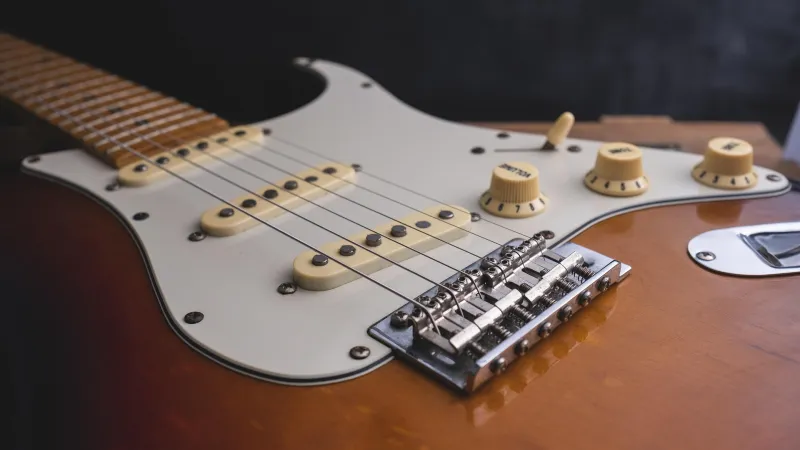
Copyright protection of everyday (utility) objects is one of the most challenging and controversial areas of copyright law. The legal framework for such cases has recently been refined by the rulings of the CJEU in Mio and konektra, and the German Federal Court of Justice (BGH) in Birkenstock Sandal. Lately, a Düsseldorf Regional Court judgment by default on the copyright protection of the iconic Fender Stratocaster has drawn considerable attention. Why? The Fender Stratocaster is the world’s most famous and best-selling electric guitar. It was launched in 1954, but over the past 70 years, copyright protection has never been invoked – until now. Copyright protection could change the landscape of electric guitar design, as the Fender Stratocaster is considered the most copied guitar model; it also inspired the design of many other electric guitars. But is the Düsseldorf default judgment robust enough to recognize copyright protection for the Stratocaster?
I. The judgment of the Düsseldorf Regional Court
Just two weeks after the ECJ’s Mio and konektra ruling, the Düsseldorf Regional Court, in a default judgment dated 22 December 2025, granted a copyright injunction sought by the claimant Fender against a Chinese company offering near-identical Stratocaster replicas via the international online platform ‘AliExpress’.
Referring to the recent decisions of the ECJ in Mio and konektra and the BGH in Birkenstock Sandal on the copyright protection of everyday objects, in its default judgment the Düsseldorf court held that the design of the Stratocaster body (only for which Fender had claimed copyright protection) would be a copyright-protected work of applied art. According to the judgment, the body of the Stratocaster is characterised by a design without edges, featuring soft curves that evoke the image of a female torso. The asymmetrical S-curves and elongated horn were said to evoke a dancer, while the bevel on the left frontside resembled a tilted pelvis. The court concluded that the design was fundamentally new at the time of its creation and therefore not part of the familiar repertoire of forms. The Chinese defendant’s guitar reproduced these defining elements almost identically and was therefore found to be infringing.
II. Controversy surrounding the judgment
Given the long-standing and widespread availability of Stratocaster copies and closely modelled electric guitars, the Düsseldorf Regional Court’s decision has, unsurprisingly, caused significant consternation within the guitar community. The ramifications of extending copyright protection to the Stratocaster body would be considerable: large segments of retailers’ standard product ranges could be rendered infringing, while even the resale of unlicensed copies by private individuals would violate copyright, since the distribution right is not exhausted without Fender’s authorisation of the original sale.
The controversy surrounding the ruling was further fueled by Fender’s public communication, which announced that “The decision creates enforceable rights against any guitars using the Stratocaster body shape that are manufactured, sold or distributed into Germany or other countries of the European Union (EU)”. This is a far-reaching statement. Maybe, too far-reaching?
III. Assessment of the judgment
1. Implications of the default judgment
The fact that the judgment of the Düsseldorf Regional Court is merely a default judgment is of crucial importance to classify the judgment correctly. Under German procedural law (Sec. 331 German ZPO), a judgment by default means: The court was obliged to treat the plaintiff’s (Fender’s) factual submissions as undisputed and could therefore base its legal assessment solely on Fender’s statement of facts. Due to the defendant's failure to respond to the proceedings, the Düsseldorf Court was not allowed to take into account other facts not presented by Fender.
Therefore, notwithstanding its detailed reasoning, the judgment does not amount to a comprehensive substantive assessment of all relevant circumstances. Rather, it constitutes a procedural decision confined to the parties to the proceedings, reflecting the defendant’s failure to file facts in his defense. Insofar as the judgment contains findings such as ‘The Stratocaster body created by Leo Fender [is] an outstanding, original creative achievement which clearly reflects the personality of its creator and thus constitutes a work protected by copyright’, these are limited to the specific legal relationship between Fender and the defendant Chinese company. Contrary to what a layman to electric guitar making might initially assume, they do not constitute a universally valid finding of copyright protection for the Stratocaster. In accordance with general principles of German civil procedure law, the decision also has no binding effect on other German courts adjudicating comparable cases.
2. The crucial role of the factual record for court decisions on copyright protection for everyday objects
The Stratocaster case highlights the crucial role of the facts put before the court in cases concerning copyright protection of everyday objects. According to the CJEU e.g., in Mio and konektra, protection requires the expression of the author’s personality through free and creative choices. Functional or purely technical design elements do not suffice. The BGH similarly held in Birkenstock that everyday objects must go beyond functionally determined form in order to be eligible for copyright protection. Regarding the Birkenstock sandals, copyright protection was denied as their design essentially reflected craftsmanship within known conventions.
It is doubtful whether the Stratocaster meets the criteria set out in the CJEU and BGH decisions when all relevant facts are considered. While tonal requirements impose few limits, ergonomic, functional, and production-related factors clearly influenced the design of the Stratocaster. Body contours, cutaways, horn shape and control placement serve ergonomic and practical purposes to a considerable degree. Also, the pickguard is not primarily a design element but first and foremost serves to cover the electronics and wiring and streamlines production.
A consideration of all relevant facts of the case could therefore reveal that, contrary to the findings of the Regional Court of Düsseldorf, the scope for design did not lead to sufficiently free creative decisions, but that the decisions were largely driven by functional, ergonomic and production-efficiency objectives. In contentious proceedings, a corresponding defense would also require a far more comprehensive examination of the existing repertoire of forms at the time of the Stratocaster’s creation than that undertaken by the Regional Court of Düsseldorf on the basis of Fender’s claim.
Another relevant issue in this regard is the plaintiff’s standing to bring proceedings. Absent any challenge by the defendant, the Düsseldorf Regional Court was not required to call Fender’s chain of title into question. In adversarial proceedings, however, such challenges are to be expected and – particularly in cases involving long and historically layered chains of title – often render proof of the plaintiff’s standing considerably burdensome.
IV. Conclusion
The default judgment of the Düsseldorf Regional Court requires a nuanced assessment. The decision appears plausible, given that – due to the particular circumstances of this case – the court was confined to considering the facts that Fender had put before the court. It is, however, open to question whether the same outcome would have been reached in fully contested proceedings with a carefully developed defense. It seems particularly doubtful whether the court would have interpreted the Stratocaster’s body shape primarily through an artistic lens (‘female torso’, ‘dancer’, ‘tilt-back pelvis’) had the existing ergonomic, functional, and production-related aspects also been taken into account.
Following the recent CJEU and BGH rulings, the Düsseldorf Regional Court’s default judgment underscores the central importance of the factual record in determining copyright protection for everyday objects. In such matters, the prospects of success for either party depend largely on the strength and evidentiary support of their factual submissions. This illustrates that a default judgment under German procedural rules is generally not suitable to provide an authoritative answer to the question of whether an everyday utility object such as an electric guitar qualifies for copyright protection. The judgment of the Düsseldorf Regional Court therefore needs to be interpreted with caution and must not be overstated. Accordingly, the copyright status of the Stratocaster should not be regarded as settled.
Neither author represented a party in the Düsseldorf proceedings. Since preparing the first draft of this manuscript, the co-author Nordemann has been asked to take over representation of companies against Fender in other copyright cases.
Image by Daniel Reche from Pixabay
Comments (0)
Your email address will not be published.




You may also like



October 7, 2026


September 30, 2026