AGA Rangemaster Group Ltd v UK Innovation Group Ltd – The UK Court of Appeal rules in the second instalment of the Aga cooker sAGA
March 23, 2026
In this post we review the recent Court of Appeal decision in AGA Rangemaster Group Ltd v UK Innovations Group Ltd & Anor [2025] EWCA Civ 1622 concerning claims of trade mark and copyright infringement related to retrofitted AGA range cookers.
The first instance ([2024] EWHC 1727) on which we wrote about here provides useful guidance on the boundaries of the exhaustion defence to trade mark infringement under s.12 of the Trade Marks Act 1994. The case offers an interesting example of impermissible marketing of permissible aftermarket practices.
For the purpose of this blog, we focus on the copyright infringement claim and more specifically, the application of the defence to infringement under s.51 of the Copyright Design and Patents Act 1988 (“CDPA”) and the compatibility of s.51 (and the UK’s closed list system) with assimilated EU law, in particular the CJEU’s decision in Cofemel (Case C-683/17).
The defence under s.51 CDPA is intended to delineate between copyright and design protection ensuring that industrial or utilitarian products falling within the remit of design protection do not benefit from extended copyright protection.
Background
The Claimant, AGA, manufactures and since 1929 has been selling AGA range cookers and iterations of the AGA.
The Defendants (referred to together as “UKIG”) convert classic AGA range cookers to run on electricity (“eControl Cookers”), which includes installing UKIG’s proprietary electronic control system, the “eControl System”.
In 2023, AGA issued proceedings in the Intellectual Property Enterprise Court (“IPEC”) alleging:
trade mark infringement resulting from the Defendants’ marketing and sales of eControl Cookers; and
copyright infringement in relation to the design of control panels fitted to UKIG’s eControl Cookers.
The copyright claim and IPEC decision
AGA claimed copyright in a CAD drawing depicting the design of a control panel for electric AGA Cookers, as an original artistic work (the “CAD Drawing”, pictured below).
Image
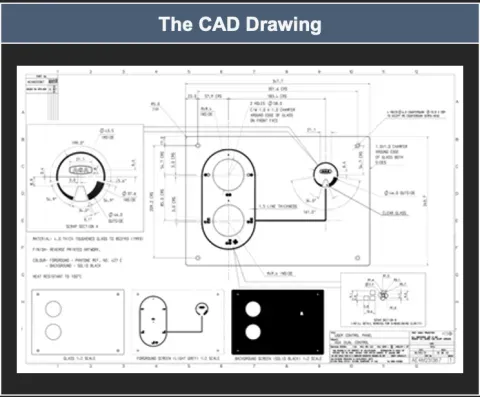
AGA argued that the control panel for UKIG’s eControl System installed on the eControl Cookers infringed the artistic copyright in the CAD Drawing.
Image
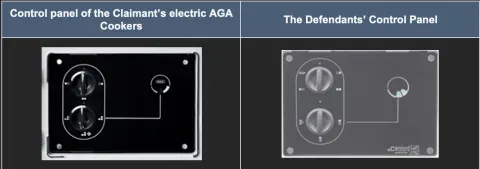
UKIG denied both claims for subsistence and infringement of the reproduction right. Additionally, UKIG relied on s. 51 CPDA as a defence to AGA’s infringement claim. To recap, s.51 provides a defence where a defendant makes an article to a design document for an article that is not an artistic work. In other words, s.51 allows an article in a design document (protectable by copyright) to be copied provided the article in question is not an artistic work itself.
At first instance the IPEC held that copyright subsisted in AGA’s CAD Drawing. The IPEC found that UKIG’s control panel infringed AGA’s copyright because the control panel was indirectly copied from AGA’s CAD Drawing and reproduced a substantial part of AGA’s control panel.
However, the IPEC held that UKIG has a defence under s.51 CDPA. The IPEC accepted the CAD Drawing was a design document recording AGA’s control panel but refused to accept the physical control panel itself qualified as an artistic work. Accordingly, the IPEC concluded that UKIG did not infringe AGA’s copyright in the CAD drawing by making control panels to the design of the AGA’s control panels recorded in the CAD Drawing.
When assessing s.51, the trial judge referred to the decision in Cofemel, however, neither party made submissions as to the impact of Cofemel on the application of s.51. Therefore, the trial was restricted to considering the application of s.51 based on the wording of the provision alone.
The Court of Appeal’s decision
AGA challenged the trial judge’s findings regarding the application of s.51 on two grounds:
Ground 1: the AGA control panel is an artistic work, therefore the CAD Drawing is a design document for an artistic work so s.51 does not apply and cannot furnish UKIG with a defence to infringement; and
Ground 2: if it is wrong about Ground 1 and s.51 does apply, the provision is incompatible with assimilated EU law, specifically the CJEU’s decision in Cofemel.
Lord Justice Arnold gave the leading judgment on the copyright appeal.
In support of Ground 1 AGA relied on the decision in Anacon Corporation Ltd v Environmental Research Technology Ltd [1994] FSR 659. AGA argued that its control panel qualified as a graphic work (a particular sub-species of artistic work) because it was a “thing to be looked at” and satisfying that criteria alone was sufficient to attract protection according to Anacon.
However, Arnold LJ held that AGA’s interpretation of Ancon would involve stretching the word “graphic” beyond its statutory meaning, almost to the point that word would be devoid of any purpose. He also held that being a “thing to be looked at” was not the sole criteria of a graphic work. On that basis, Arnold LJ held that the trial judge was correct to conclude that as a primarily functional object AGA’s control panel did not qualify as a graphic work.
For Ground 2, AGA submitted that according to Cofemel once a work is found to qualify for copyright protection it is impermissible to limit the scope of that protection (as s.51 does) unless the limitation falls within the list of permitted exceptions and limitations in Article 5 of the Infosoc Directive (2001/29/EC). Both sides accepted that s.51 does not fall within any of those permitted exceptions and limitations.
In contrast, UKIG argued that s.51 is consistent with assimilated EU law (the precise reasoning is unclear from the judgment) but if the court reached the contrary conclusion, then it is impossible to read s.51 in a manner which would achieve compatibility.
Unfortunately, the Court of Appeal’s conclusion on Ground 1 meant that AGA’s appeal failed and therefore AGA’s second ground of appeal was purely academic. For that reason, Lord Justice Arnold decided no useful purpose would be served by dealing with the issue (queue a collective sigh of frustration from UK IP practitioners) and declined to decide the issue on that basis.
Closing remarks
The appeal on s.51 CDPA 1988 resurfaced an enduring debate regarding the compatibility of the UK’s closed list system of copyright protection and EU law on subsistence and originality (forming part of assimilated EU law post Brexit). Despite having an opportunity to grapple with this thorny issue, the Court of Appeal decided the issue was ultimately academic, and this was not the opportunity to grasp the nettle and provide clarity on a complex legal issue.
Though the reason for not doing so is hard to criticise, it does feel like another missed opportunity to wrestle with a lingering uncertainty that continues to stalk domestic copyright law.
Comments (0)
Your email address will not be published.