Without Fear or Favour: The European Commission’s DMA Non-Compliance Decision Against Google’s Self-Preferencing (Case DMA.100193)
September 30, 2026
In July, the European Commission issued its non-compliance decision against gatekeeper Google for its breach of the self-preferencing prohibition under Article 6(5) DMA. It was not until September that the enforcer published the non-confidential version of the full decision that sets out how it interpreted the provision. The European Commission relied on a very narrow reading of the requirements embedded in Article 6(5) DMA to establish the finding of an infringement with the DMA, which was then followed with a very unspecific list of remedies to counter the regulation’s breach.
Better, But Not Perfect!
The present case is the latest iteration within the 15 year-long saga that the European Commission has followed against Google’s self-preferencing behaviour. In Google Shopping, the competition authority found that the dominant undertaking had incurred in discriminatory leveraging consisting of i) the preferential positioning and the increase of the visibility of its own specialised search results; and ii) lowering the ranking of competing results. Google’s conduct was objectionable because it treated rival comparison-shopping services (CSSs) less favourably than its own CSS. By doing so, it placed its competitors at an unfair disadvantage. The General Court fleshed out the underlying reasoning of the finding by setting out that the principle of equal treatment forms the very basis of equality of opportunity between competitors, which is a prerequisite of undistorted competition (Case T-612/17, para 180).
Following those findings, Article 6(5) DMA enshrines the regulatory embodiment of the Google Shopping, transforming the anti-competitive conduct into a prohibition that requires designated gatekeepers to “not treat more favourably, in ranking and related indexing and crawling, services and products offered by the gatekeeper itself than similar services or products of a third party”. The provision adds that the gatekeeper must “apply transparent, fair and non-discriminatory conditions to such ranking”.
Google’s compliance implementations followed its reading of the provision, building on its previous obligations relating to Google Shopping where the competition authority compelled it to ensure that rival CSSs were not treated less favourably than Google’s own CSS.
In March 2024, the gatekeeper already pointed out that prior to the DMA’s implementation it “applied fair, reasonable and non-discriminatory criteria to its search results” because “the core considerations that govern the design, format and ranking of Google’s search results are whether the results are relevant for a query, of high quality, and useful for users” (page 176 of Google’s 2024 compliance report). In any case, it decided to operate “subtractive changes” that removed some of the existing search result features, such as the reserved links to separate Google services, deprecating the Google Flights unit or replacing product ads unit.
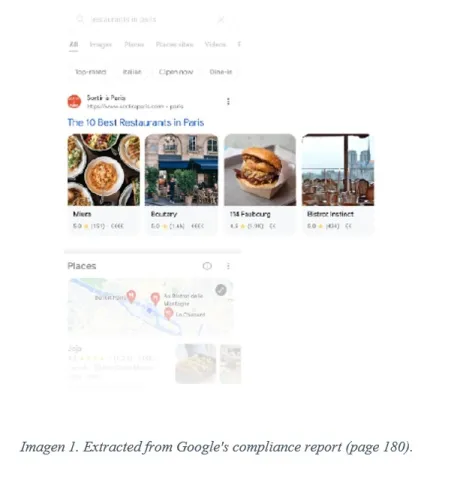
In parallel, Google also introduced new features on its search results, which particular types of vertical search services (VSSs) could benefit from on an opt-in basis. Similar features were also introduced for comparison sites and airlines. VSSs could opt in to include carousels with samples of the business inventory in the search result via displaying images, star ratings and prices, as shown in the image below (referred as rich results in the EC’s non-compliance decision):
Image
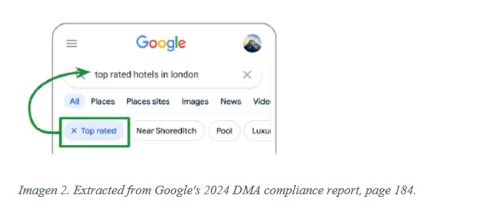
Moreover, Google also introduced query shortcut chips below the search box that operate as a mechanism for users to add terms to their query without having to manually type out those terms. Once the user manually adds the term to the query, those query shortcut chips include the term and a new general search query for an expanded query, which returns a new search results page for that query. See an example of those query shortcut chips below:
Image
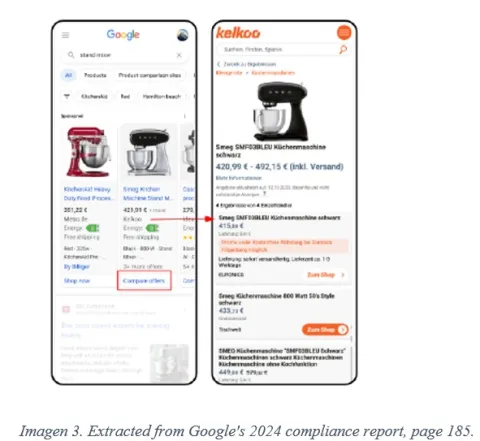
In the case of product-related queries, Google also created a new ad format for CSSs that would link directly to their websites. According to the gatekeeper’s new technical implementation, CSS ads would compete for slots in the new ad unit. See below the product ad unit:
Image
As a result of those changes, Google’s Search engine results page (SERP) delivered a whole list of features once a transactional or product-related query was made, as shown in the image below:
Image
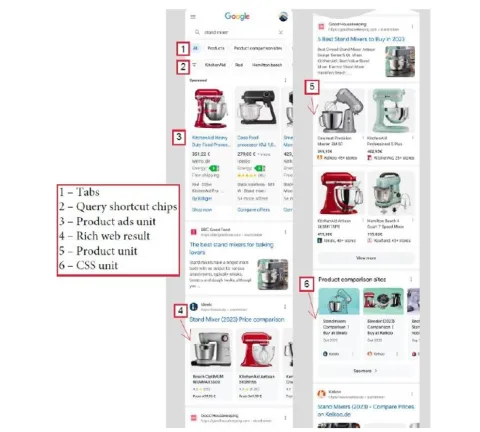
First, tabs lead the user to related searches. Google eliminated references to its separate Google services pursuant to its DMA compliance strategy (page 177 of Google’s 2024 compliance report). Second, the query shortcut chips introduced in 2024 (pages 183-184). Third, the product ads unit, which displays paid results that CSSs compete for via an auction, also tweaked in 2024. To participate in the product ads unit, CSSs must apply and meet the eligibility criteria for Alphabet’s CSS Program (para 98 of the non-compliance decision). Fourth, the rich web results, which are the enhanced formats of search results provided for free by Google to CSSs, introduced in 2024 (para 105). Those rich web results show only one CSS or merchant at a time and rely on structured data in the mark-up of a web page (para 106). Fifth, the products unit containing offers by merchants, which display further information on a scrollable preview page of a particular product upon the user’s clicking (para 108). And finally, the CSS unit, which contains groups of results for CSSs, populated with offers of several CSSs at a time. The results in this unit link directly to the CSSs’ websites and they can participate in this format free of charge (para 110).
Aside from the Shopping-related conduct, the European Commission’s non-compliance procedure comprises a broader scope of application, including six additional types of queries and content-related services. Those distinct types of queries include flights, trains, lodging and places intermediation as well as Google Maps. Those types of queries deliver similar results to transaction-related queries (translation, sports information and games services), as shown below for lodging intermediation:
Image
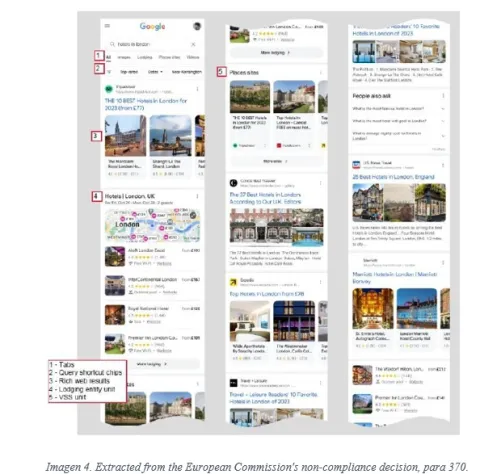
For the sake of clarity, the European Commission did not take an issue with all of those units, but with the dedicated units that Google had introduced subsequent to its 2024 compliance report. Find in Table 1 below the list of units that were the major cause of concern for each of the query types and content-related services catered by third parties:
Table 1. Dedicated units that the European Commission considers problematic when they administer more favourable treatment to Google's own services.
| Query type | Dedicated unit |
| Product-related query | Product ads unit and products unit. |
| Flights intermediation | Airlines unit. |
| Trains intermediation | Trains unit. |
| Lodging intermediation | Lodging entity unit. |
| Places intermediation | Places entity unit. |
| Google Maps | Preview page of the local entity unit. |
| Translation services | Translation unit. |
| Sport information services | Sports pane and preview. |
| Games services | Games unit. |
According to the European Commission, all of those changes did not amount to effective compliance with Article 6(5) DMA. Although they did improve the situation if one compares it with the pre-DMA scenario by “providing more prominence” to CSSs and VSSs, the EC considers them to fall short of being “equivalent to providing the same prominence to Alphabet’s own CSSs as those offered by third parties” (para 250 of the non-compliance decision). This entails a substantial re-focus of the legal standard applied in Article 6(5) DMA vis-à-vis the rationale underlying the Google Shopping case.
Under the antitrust framework, Google generated a clear disadvantage against CSSs in the SERP (or treat less favourably) by providing a more favourable positioning and display of its own CSSs coupled with the demotion of results from CSSs. The consecution of requirements is quite relevant. The Court of Justice recognised that “as a general rule, a dominant undertaking which treats its own products or services more favourably than it treats those of its competitors is engaging in conduct which departs from competition on the merits irrespective of the circumstances of the case” (Case C-48/22, para 186). As a matter of fact, the Court of Justice then went on to characterise the conduct as a deviation from competition on the merits from a bundle of circumstances, including the characteristics of the upstream market and the two components of the conduct (para 187). From this statement one can clearly arrive to the conclusion that absent the demotion of results from CSSs, the conduct at hand would not have deviated from competition on the merits.
Detaching one component of the conduct from the other is exactly what Article 6(5) DMA does. Absent any demotion on the side of CSSs or VSSs, the behaviour of self-preferencing is prohibited under the ex ante regulation. But that’s not all. Instead of showing that the gatekeeper administered less favourable treatment to its competitors, Article 6(5) DMA compels the gatekeeper to “not treat more favourably” its own services vis-à-vis those of third parties. In other words, compliance with Article 6(5) DMA mandates: i) to avoid creating clear disadvantages to third parties; ii) and to not give advantages to its own services. The European Commission reads the provision in this light by assessing Google’s DMA compliance against the benchmark of whether the measures implemented by Google provided equal prominence to similar services of third parties (para 10 of the non-compliance decision).
Under the assumption that the manifestation of that conduct is per se harmful for competition, the enforcer performs a three-pronged test concerning each one of those features proposed by Google as means of DMA compliance. According to the European Commission, Alphabet does not comply with the provision where: i) it offers a service that is distinct or additional to Google Search, and which is ranked on, embedded in, or displayed along search results; ii) third parties offer similar services to Google’s distinct or additional service and they are also ranked on, embedded in, or displayed along search results shown on the SERP; and iii) Google treats its own distinct or additional service more favourably in ranking or related indexing and crawling than those similar services offered by third parties (para 26). It performed this analysis for the seven types of queries and the content-related services.
Delineation of distinct or additional services to Google Search
To determine whether the services catered by Google in the context of the SERP were different from Google Search, the European Commission considered the purpose of each service, to determine whether it was distinct or additional to Google Search. For the seven types of transaction-oriented queries, those services were considered as distinct from Google Search to the extent that they share some of the same features with the online search engine. As the EC recognised, “a specific feature shown on the SERP may at the same time be part of an OSE and of a distinct or additional service to an OSE” (para 160). The distinctiveness of those features originates from their context and the combination of features provided. One salient example that the enforcer uses throughout the non-compliance decision is that of the query shortcut chips. Given that they are designed to filter and compare results for a given group of search results or dedicated unit specialised in a certain topic with a view of facilitating a transaction, their purpose goes beyond that of an online search engine (para 160). The European Commission terms this particular finding as “indicative” of the existence of a distinct service to the online search engine (para 178). When comparing this purpose to the online search engine’s, which is to perform searches of, in principle, all websites, or all websites in a particular language (para 52), it is clear that they satisfy different roles.
To put it in simple words, the enforcer distinguished additional/distinct services catered by Google on its SERP by drawing comparisons with the overarching purpose of delivering searches of all websites. Once a particular query does not deliver a search relating to all websites, that service is considered to be additional/distinct for the purposes of Article 6(5) DMA. The European Commission describes this argument as a “distinguishing factor” for the finding of a distinct service (para 167).
Additionally, the enforcer also draws further attention to other factors to make the determination that a service is catered distinctly or additionally to Google Search. In particular, the European Commission considers as a “decisive factor” the fact that the dedicated units (e.g., the carousels of images or lists of flights) are assembled based on data feeds that are provided by a limited pool of websites pre-defined and selected by Google instead of by searching, in principle, all websites (para 176). For the particular case of the content-related services, it takes into account the fact that data has been licensed from third parties (paras 526 and 559) or that the gatekeeper has coded a particular feature itself (para 585).
Within the proceedings, the gatekeeper contests these findings on different fronts and counts. The enforcer responds to those in turn. In particular, the European Commission is particularly interested in setting apart the DMA’s enforcement from EU competition law and the burden that the EU legislature imposed upon it. In the proceedings, Google submitted a survey to substantiate that most users in Ireland, France and Germany expect an online search engine to show product ads (para 155). Following Google’s reasoning, that would mean that the product ads unit would not be considered as a distinct service from Google’s search engine. To respond to this argument the European Commission was particularly adamant in defending that the effects on users of the application of Article 6(5) DMA “is immaterial to assessing the existence of a distinct service on the SERP” (para 174). Later on, the European Commission clarified that the delineation between services “is a legal question rather than an empirical one” (para 191). Thus, gatekeepers can only seek to contest the EC’s interpretation of the law through legal arguments and not by demonstrating the impacts caused by the application of that particular application in the economic reality. In fact, the EC’s view is that it “under no duty to investigate the possible impact, effect, or harm deriving from non-compliance with Article 6(5) DMA” (para 551).
Notwithstanding, the EC drew on the antitrust logic to undermine Google’s arguments. Once again, the gatekeeper tried to show that both VSSs and merchants confirm that allowing users to update their queries has been a feature of search engine since 2003, which would make the impact of query shortcut chips negligible in terms of the analysis (para 147). Aside from highlighting yet again that this first requirement should be assessed with reference to each services’ purpose, the EC established the relevance of Google’s dominance to discredit the value of user opinions in this context. Drawing on the enforcer’s words, since Google has “consistently held a very large share of European search market (…) users have become deeply accustomed to how Google Search looks and operates, and that they might expect to be shown query shortcut chips on the SERP” (para 181). To put it simply, economic effects are immaterial for the DMA purposes, but they can play a role in discrediting the gatekeeper’s allegations when contesting the EC’s approach towards compliance.
Offering of similar services to Google’s own distinct or additional services
Throughout the non-compliance decision, the European Commission reviewed one by one each of these distinct or additional services from Google Search vis-à-vis their comparability with the services catered by third parties. Of course, and as one could have imagined, questions of substitutability and market definition were left unaddressed, following the EU legislature’s wishes to draw a hard line between EU competition law and the DMA (for example, paras 72, 164, 206, 299 and 350). Instead, the European Commission’s assessment focused on considering the similarities with third parties stemming from the fact that they serve equivalent purposes as those of Google’s additional services (para 205).
The enforcer drew comparisons between Google’s services and those services catered by third parties. The equivalent nature of those services was not particularly contested by Google, aside from the fact that it tried to put forward that certain differences between the services indicated that they could not be held as equivalent. Those arguments were rebutted by the European Commission by stating that the notion of a similar service does not rule out that certain differences between the services exist (para 205). The analysis was not particularly detailed on the Commission’s side to determine how different can two services be so as to establish that they do not serve the same purpose in terms of Article 6(5) DMA.
More favourable treatment administered by Google’s ranking on the SERP
Most of the iterations between the European Commission and Google related to the fulfilment of this last requirement. A number of reasons illustrated the point for all seven types of queries and content-related services, with each one of them contributing to the wider theory of Google’s additional services’ greater advantage vis-à-vis third parties. First, most of the units were embedded and ranked prominently on Google Search, so that they can be seen by a user immediately after entering the specific type of query. Since the dedicated unit is displayed at the top of the SERP, it is especially visible for users navigating through the SERP. As a rule, those dedicated units consisted of a large, dedicated box displaying detailed information in relation to prices or characteristics of the products (for example, see para 210, 293 and 302). Second, the dedicated unit can be seen by a user immediately after entering the specific type of query. This enables users to search and compare several different products or services with a view to initiating a transaction without the need to browse the web any further (para 211). In some cases, a click on the dedicated unit leads the user to a preview page containing further information about the product at issue so that the user can draw a further comparison of the products that are offered (para 212). When the European Commission projected its arguments onto Google’s services, its focus was very much on prominence and user impact generated by such visual prominence.
In addition to that, the European Commission set forth why third parties featured less prominently bearing in mind those dedicated units, even though they had opportunities to feature on the SERP (para 213). To do that, the enforcer drew a clear line between the free and paid search results that third parties could obtain when a specific query type is ran. With respect to free search results, the enforcer established that the capacity of third parties to reach prominent display in the SERP was quite limited. For instance, third-party CSSs can display offers in the product unit’s preview page for free, which is accessible once a user clicks on one of the results in the products unit. Such visibility is not comparable to the third parties’ capacity to have their own boxes, embedded in the SERP and visible immediately after the user enters a product-related query. If they want to benefit from wider prominence on the SERP they must become business partners of Alphabet’s products unit so that they can display their own inventory on equal terms on the SERP (paras 213 and 214). Additionally, even if third parties can appear in free organic search results such as the rich web results, this option does not compensate for the prominence given to Google’s services within its own dedicated units (para 216).
The European Commission puts it in very simple words when it reaches the conclusion that “conditioning equal prominence on requirements that do not apply to the gatekeepers’ own services is not granting equal prominence on the SERP” (para 214) and “does not eliminate favourable treatment” (para 78). When third parties are compelled to fulfil eligibility requirements to access the same features as Google’s distinct services, they are treated less favourably. Normally, those eligibility requirements have to do with the third parties’ identity (e.g., whether it is a CSSs, a VSSs or an airline) and the fact that they provide data feeds to Google, which it then uses to assemble a dataset from which the dedicated units are crafted and ranked using signals that are relevant for drawing comparison between different products and services (for example, see para 272). In these types of cases, Google’s approach to compliance is in breach of Article 6(5) DMA.
This brings us, once again, to the question of what types of arguments can gatekeepers raise when the European Commission presents to it these findings. As far as the product ads unit and products unit were concerned, Google compared the pre-March 2024 result pages to those after March 2024 to demonstrate that they had had a large increase in CSSs’ prominence and visibility and generated more search traffic for CSSs. Specifically, users see CSS results 40 to 50% more often than before March 2024 and click on CSS results 10-20% more often. By providing this data, the gatekeeper attempted to portray that CSSs now get more prominence than what they merit based on user interests and therefore are not disadvantaged (para 231). Aside from the substantial answer that the enforcer provided to the argument, a broader question must be made in terms of how the European Commission must react to these types of arguments. As ever, the economically grounded reasons inform (and also slow down) the EC’s perception and enforcement of a particular type of conduct.
The reasonable response would be to consider that the EC should not waste its time in drawing additional economic evidence to rebut that proof. However, at the same time, the right to defence comes to mind. Economic evidence can be easily dispensable for the EC by highlighting that the DMA is not concerned with economic impacts. Is this the right approach, though? To the extent that EU competition law fines can be considered criminal if one glances at the Engel criteria, it should naturally follow that the DMA sanctions are to be analysed under this same lens, given their nature and the severity of the fines that can be imposed. This necessarily implies that the rights of defence must be particularly observed when it comes to fining a gatekeeper. It is not particularly clear how those rights of defence might be protected when some gatekeeper allegations are left unaddressed on their own merits.
So, what’s next?
Following the EC’s finding of a breach of Article 6(5) DMA, then one would have expected for the enforcer to be precise in the way in which it designed the remedies that would ‘fix’ the situation once and for all. From the EC’s non-compliance decision, the remedies that Google must apply are not particularly clear, aside from the fact that the enforcer does not require it to remove the dedicated unites altogether (see paras 189, 291 and 397). The enforcer defines the remedies that the gatekeeper must apply in the negative. That is, by negating the effectiveness of the compliance solutions that it submitted in 2024 (para 712). However, the European Commission does not provide any further indication on how the gatekeeper must balance the interests of the different stakeholders involved.
Up until now, Google has not publicly announced the changes that it has introduced to the search experience as a consequence of DMA compliance. However, it has already flagged through direct statements that it refined the search experience just hours after the European Commission made its non-compliance decision public. The gatekeeper defends that those changes “will degrade user experience and ratchet up costs for European businesses” given that they “mark the largest reduction in quality of service (…) in its 29-year search history”. Google set out that those changes directly favoured VSSs linked to sectors including hotels, airlines and restaurants, insofar as they are now given more prominence in search results over companies in those sectors that are listed with just a link to their websites.
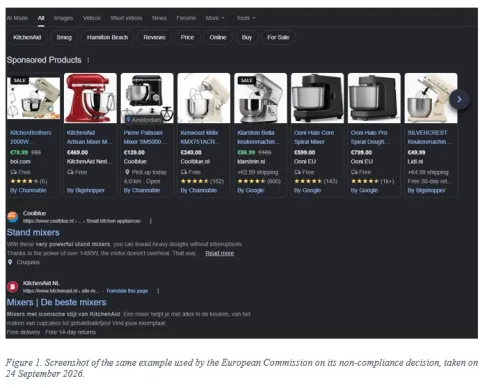
The changes that the gatekeeper has operated depend on the type of query that the user enters. For instance, drawing on the example that the EC used on its non-compliance decision, Google has basically stripped nearly all embedded functionality for product-related queries, aside from the sponsored products unit and the query shortcut chips, as shown below:
Image
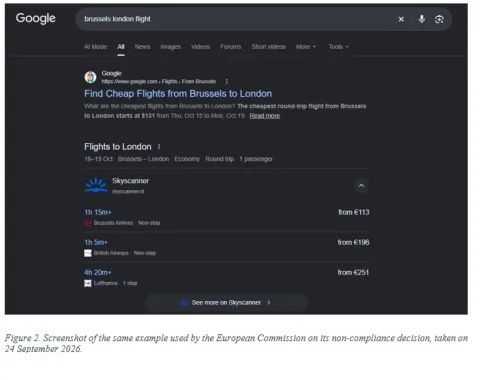
When one turns to the examples in train and flights intermediation, Google has introduced changes by placing prominently the VSSs unit near the top of the page, whilst it lets free search results reach the top of the page before the dedicated units in the case of flights intermediation. When one runs the search engine multiple times with different destinations, the blue links corresponding to Google Flights are always ranked first (and sometimes they are ranked in isolation at the top of the page), as shown in the image below:
Image
The lodging intermediation also follows a similar approach, where Google has eliminated all query shortcut chips and the rich web results that were shown just after. At the moment of writing, Google shows the lodging entity unit at the top of the page revolving around the offerings of VSSs (and not hotels directly), and includes a hotel websites unit just beneath it, as shown in the image below:
Image
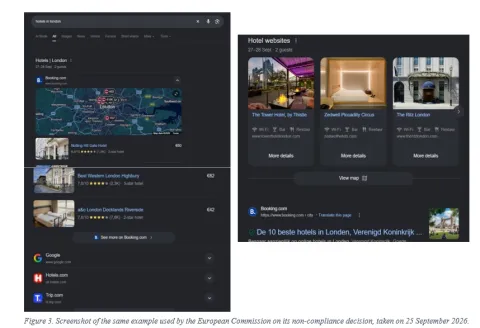
These changes ensure that CSSs and VSSs are shown more prominently in the SERP, when they are compared with direct websites catering to the same services. On top of that, the SERP now selects the most adequate VSS that is presented to the particular user. The criteria by which Google shows on VSS as opposed to another is not particularly clear, since recurring searches of the same destination delivers different VSSs to the same user.
The Google Shopping saga has, therefore, turned a new page. The SERP has suffered, once again, drastic changes following the enforcer’s intervention through the non-compliance procedure. It still remains to be seen whether those changes will demonstrate greater advantages to business users, as Article 6(5) DMA intends and how the European Commission will, in the end, measure their effectiveness.
Comments (0)
Your email address will not be published.
Become a contributor!
Interested in contributing? Submit your proposal for a blog post now and become a part of our legal community!
Contact Editorial Guidelines


You may also like


September 22, 2026

September 21, 2026