The ITA’s 2025 Guide to Latin American Arbitral Institutions: A New Phase of Maturity, Technology, and Diversity
April 9, 2026
In 2011, the Institute for Transnational Arbitration (ITA) published its inaugural Guide to Arbitral Institutions in Latin America and an accompanying “Scoreboard.” That guide concluded that “[t]he era of Latin American arbitral institutions has arrived.” The ITA updated this guide a decade later with its 2023 Guide to Latin American Arbitral Institutions, which tracked the growth in institutions, their rules, and statistics since the inaugural survey, while also identifying key factors that are hot topics in international arbitration. That 2023 Guide identified 170 arbitral institutions in Latin America. Building on these foundations, the Americas Initiative of the ITA has now published its 2025 edition. The 2025 Guide provides a comprehensive reflection of the evolution in the region – highlighting not only the expansion of arbitration but also the refinements that are shaping its future.
Image
ITA’s 2025 Guide
The 2025 survey identified 178 arbitral institutions throughout Latin America and the Caribbean – an increase from 170 institutions identified in 2023 – alongside several leading international institutions with a sustained regional presence. The project is sponsored by the ITA and Reed Smith LLP’s Latin America Business Team. This guide includes information from institutions not necessarily headquartered in Latin America but managing cases seated in Latin America.
The overall conclusion is that arbitration across Latin America and the Caribbean has entered a new phase of maturity – one defined not by expansion alone, but by refinement. Institutions that once focused on establishing legitimacy are now focused on efficiency, technology, and user experience. Proceedings are faster, more digital, and increasingly aligned with global standards while retaining a regional identity.
The following sections highlight key findings and themes from the 2025 Guide, organized by topic. Where possible, comparisons are drawn to the findings of the 2023 Guide to illustrate the continued evolution of arbitration practice in the region.
1. Dispositive Motions, Interim Measures, and Emergency Arbitrators
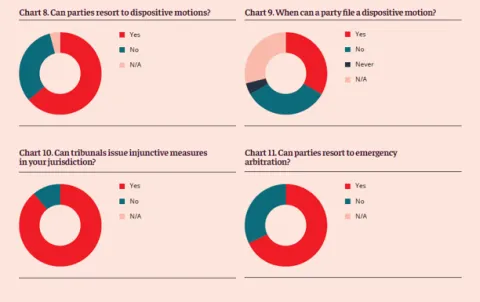
The growing use of dispositive motions, injunctive measures, and emergency arbitrators demonstrates the increasing procedural sophistication and adaptability of international arbitration in the region. Dispositive motions enable arbitral tribunals to resolve specific issues or claims without the need for a full evidentiary hearing, thereby promoting efficiency and reducing time and cost. Emergency arbitrators allow parties to seek urgent relief before the formal constitution of the tribunal.
The 2023 Guide reflected an expansion in the utilization of these mechanisms, with dispositive motions allowed in over 50% of regional institutions and the vast majority of institutions permitting both emergency arbitrators and preliminary measures.
According to the 2025 Guide, it is possible for parties to resort to dispositive motions, injunctive requests, and emergency arbitrators under the rules of the majority of the institutions that replied to the survey. The introduction of emergency arbitrator provisions further strengthens the arbitration framework by allowing parties to seek urgent relief before the formal constitution of the tribunal.
Image
ITA’s 2025 Guide
2. Gender Diversity
Gender diversity in international arbitration aims to ensure that talented and qualified women have equal opportunities to participate in arbitration proceedings, contribute their expertise, and shape the future of international dispute resolution in Latin America and around the world. The 2023 Guide found that while at least one woman sits on a tribunal over half of the time (as reported by some institutions), few arbitrations had a woman as sole arbitrator or the president of an arbitration panel, though the appointment of female arbitrators both on rosters and on panels had increased since prior surveys.
Image
ITA’s 2025 Guide
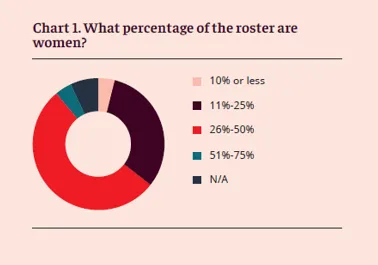
Greater attention is being given to issues of diversity, particularly in the representation of women and younger professionals, marking a shift toward a more inclusive and equitable arbitration landscape. Most institutions participating in the 2025 Guide report that women comprise of up to one-quarter of their rosters, with a growing share reporting 26-50% representation. This suggests meaningful progress since prior surveys, though parity remains elusive. As institutions refine appointment practices and mentoring pathways, sustained gains in both roster composition and appointments to chair or sole roles should follow.
These numbers represent a notable improvement from the findings in the 2011 and 2023 editions.
3. Arbitrating Against Public Entities
Arbitral institutions in Latin America routinely resolve complex and multifaceted disputes. The 2023 Guide found that although the majority of cases involved private entities, an increasing number of cases involved public entities – consistent with the evolution of arbitration practice in the region.
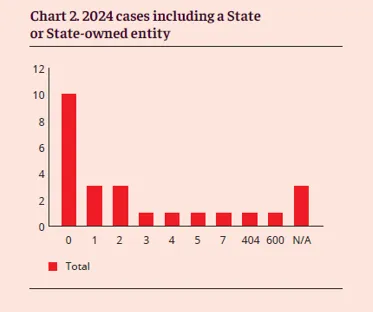
According to the 2025 Guide, there is a higher number of disputes involving public entities, reflecting governments’ growing reliance on arbitration mechanisms. While most of the cases highlighted in the survey concern private parties, there is a growing number of disputes involving public entities, reflecting the ongoing development and maturation of arbitration practice within the region.
Image
ITA’s 2025 Guide
For example, for 2024 alone, the two Peruvian institutions that replied to the survey – Centro de Análisis y Resolución de Conflictos de la Pontificia Universidad Católica del Perú PUCP and Centro Nacional e Internacional de Arbitraje de la Cámara de Comercio de Lima – handled a combined total of 1,004 cases involving a State or a State-owned entity.
4. Seat of Arbitration and International Influence
The choice of the seat of arbitration holds significant importance in international dispute resolution, as it determines the procedural framework governing the proceedings and the degree of judicial supervision by local courts. Parties are increasingly selecting seats within Latin America that offer modern arbitration laws, supportive judicial environments, and efficient institutional infrastructure.
National courts continue to show stronger support for arbitration, and local legislatures are fine-tuning their laws to eliminate uncertainty. The result is a market where multinational companies, state entities, and regional investors now treat Latin American institutions as a natural venue for resolving complex commercial disputes. Cross-border “horizontal” investment, for example, Mexico to Colombia, Peru to Chile – rather than “vertical” investment (U.S. to Latin America or Europe to Latin America) – has solidified this confidence.
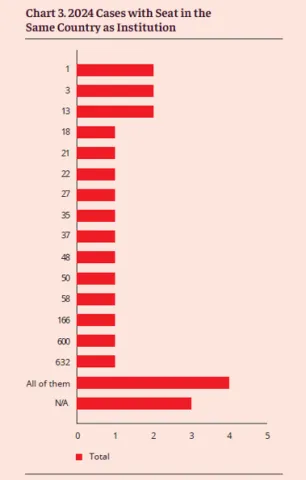
The 2023 Guide found that for most institutions, the venue of arbitration was the same as the institution's country, and less than 10% of registered cases had a venue other than the institution's country – demonstrating the focus of regional institutions on servicing local disputes.
In the 2025 Guide, most reporting institutions did not have a significant number of cases seated outside their country. However, the number of cases seated in the same country as the institution can be very significant, ranging from one case (Arbitration and Mediation Court of the Caribbean – Barbados) to 632 cases (Centro Nacional e Internacional de Arbitraje de la Cámara de Comercio de Lima – Peru) in 2024.
Image
ITA’s 2025 Guide
5. Arbitrator Requirements
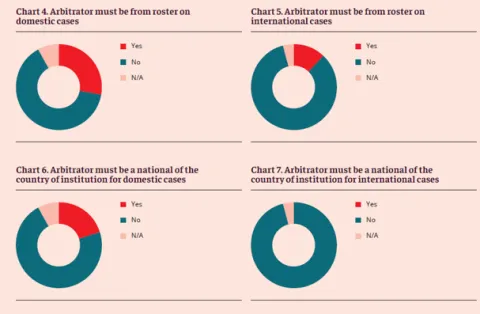
Party autonomy lies at the heart of international arbitration, and the freedom to appoint arbitrators serves as an additional attraction for foreign trade and investment. The relevant message for foreign parties is that restrictive nationality requirements are nearly extinct.
The 2023 Guide showed that in 90% of the institutions, it is not necessary for the arbitrator to be a national of the State where the institution is located. For international cases, only 10% of institutions required the arbitrator to be licensed in the jurisdiction, showing a welcoming atmosphere for international disputes.
Most of the institutions included in the 2025 Guide (93%) have a list of arbitrators, yet the majority of them (61%) do not have a separate list for international cases. Certain appointment requirements may restrict the parties’ freedom of choice and could prevent the selection of the most suitable arbitrator for a particular dispute, such as requirements that arbitrators be drawn from a designated roster or be of a specific nationality.
Image
ITA’s 2025 Guide
6. Publication of Awards
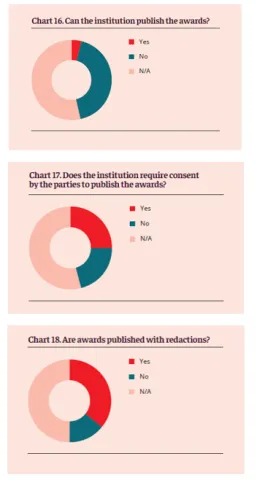
The publication of arbitral awards has become an increasingly relevant aspect of international arbitration – especially considering the involvement of State or State-owned entities in the proceedings – reflecting a broader movement toward transparency and accountability in arbitral practice. While arbitration has traditionally been characterized by confidentiality, many institutions are now adopting policies that allow for the selective publication of awards.
Image
ITA’s 2025 Guide
The publication of awards serves an important educational and institutional function. Publicly available awards contribute to the development of consistent arbitral jurisprudence, enhance predictability for users, and reinforce confidence in the arbitral process.
7. Legal Framework for Commercial Arbitration
The selection of a Latin American arbitral institution usually implies the choice of that jurisdiction as the seat of arbitration – a decision that is critical both juridically and practically. Choosing a seat of arbitration is particularly important with respect to the disposition of that jurisdiction towards alternative dispute resolution, which encompasses both interventionist tendencies during the arbitration and the tendency to enforce arbitral awards.
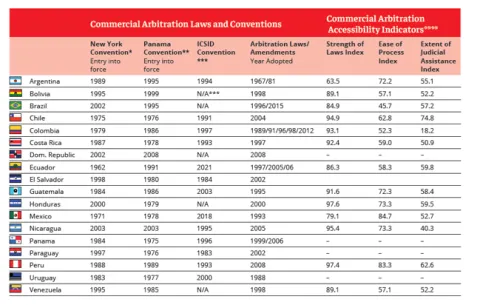
The 2023 Guide assessed the legal framework for commercial arbitration throughout Latin America, including each country's accession to the New York and Panama Conventions, adoption of local arbitration laws, and indicators derived from the World Bank’s Doing Business 2020 report. The 2025 Guide updates this assessment, noting that the Doing Business report was discontinued in 2021, and the successor B-Ready initiative omits several jurisdictions included in the earlier data. As of 2025, the updated framework reflects continued regional adherence to international arbitration conventions, ongoing modernization of domestic legislation, and new indicators measuring the strength of laws, ease of process, and extent of judicial assistance. Additionally, the 2025 Guide notes significant developments regarding ICSID membership: Bolivia and Ecuador have withdrawn from the ICSID Convention (in 2007 and 2009, respectively), while Brazil and Mexico remain non-signatories.
The 2025 Guide includes an updated assessment of the legal framework for commercial arbitration across Latin America and the Caribbean as of 2025. This framework highlights a consistent regional pattern: widespread adherence to international arbitration conventions, continued modernization of domestic legislation, and sustained judicial support for arbitration as a reliable mechanism for commercial and investment dispute resolution.
Image
ITA’s 2025 Guide
8. International Institutions
Although regional arbitral institutions have matured significantly, leading international institutions such as the International Chamber of Commerce (ICC), the International Centre for Dispute Resolution (ICDR), and JAMS continue to register the majority of international cases in Latin America. These institutions have pursued a “global but local” strategy by investing in local infrastructure, staff, and partnerships throughout the region. ICC, ICDR and JAMS have participated in the 2025 edition of the Guide.
The ICC maintains national committees in numerous Latin American countries, as well as a branch in São Paulo, Brazil, and reported 571 international cases and 260 domestic cases in 2024. The highest dispute amount in 2024 reached US$1 billion. Since it was founded, the ICC International Court of Arbitration has handled over 16,000 arbitral proceedings worldwide.
The ICDR, the international branch of the American Arbitration Association (AAA), operates a regional office in Mexico and partners with institutions across the region. In 2024, the ICDR handled 811 international cases globally, with a cumulative total of 12,988 international cases between 2011 and 2024. The ICDR maintains a roster of over 650 independent arbitrators and mediators.
JAMS, established in 1979, handled 266 international cases in 2024 and 761 international cases between 2022 and 2024. JAMS provides a comprehensive selection of arbitrators by considering a wide range of qualifications, experiences, and perspectives through its inclusion initiatives.
Conclusion
Undoubtedly, the ITA Guide to Arbitral Institutions in Latin America shows an interesting picture consistent with considerable development of arbitration in the region. The 2025 Guide confirms that the region’s arbitration institutions have undergone significant transformations. As the demand for more efficient, transparent, and accessible dispute resolution methods grows, so too does the sophistication of the institutions that serve this demand. Where once the primary challenge was establishing legitimacy, today the focus is on delivering services that meet global standards while maintaining regional identities and sensibilities. Although these trends are increasing, international institutions such as the ICC, ICDR, and JAMS continue to register the majority of international arbitration cases in the region, reflecting their sustained investment in local infrastructure and partnerships.
In sum, the Guide provides a concise and consolidated review of the relevant arbitral institutions in the Latin America region, which we hope will lead to the adoption of best practices and an increase in their utilization for cross-border disputes. As head author and contributor to the Guide, we would like to thank all the institutions that participated in this Guide.
Comments (0)
Your email address will not be published.



You may also like

April 8, 2026

April 1, 2026