2026 Australian Arbitration Week Recap: Exploration to Expropriation: Valuing Mining Projects in International Arbitration
October 16, 2026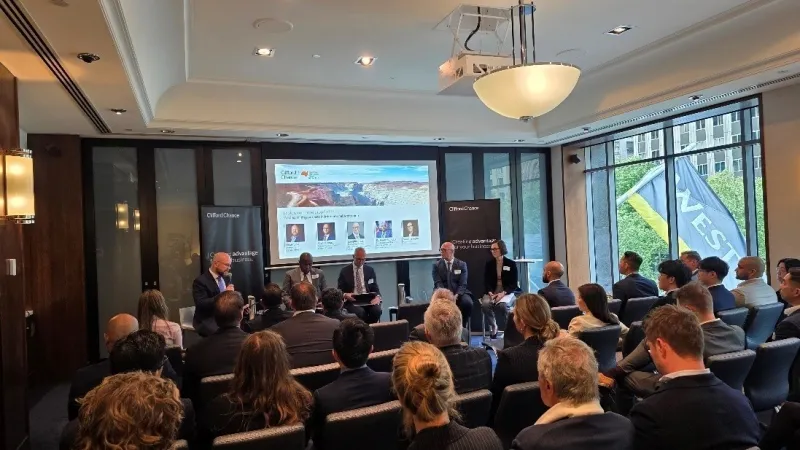
Valuing a mine that has been expropriated before it ever produced anything remains a hotly contested area of international investment arbitration. This issue has particular relevance to Australia: around 35 investor-State cases have been brought by Australian companies, either in their own names or through offshore subsidiaries, many of them in the mining sector, reflecting mining capital and expertise as one of the country's major exports. The challenges of valuing such assets and how experts and tribunals approach it were the focus of Exploration to Expropriation: Valuing Mining Projects in International Arbitration, a session hosted by global law firm Clifford Chance during Australian Arbitration Week on 14 October 2026.
The session covered the current legal and technical standards for valuing a mining project, how those apply to exploration / pre-productive assets, the use of third-party funding and legal insurance in international arbitration, and current trends observed in mining disputes in Africa.
The panel was moderated by Clifford Chance partner, Elliot Luke, and comprised:
Campbell Jaski (Managing Director – Disputes and Investigations, Alvarez & Marsal Australia)
Dr Henry Murigi (Chief Executive Officer, Nairobi Centre for International Arbitration)
Susanna Taylor (Consultant, Toremis Specialty)
Vlada Lemaic (Senior Associate, Clifford Chance)
Image
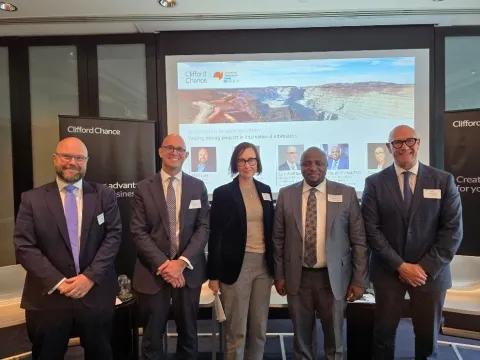
From left to right: Elliot Luke, Vlada Lemaic, Susanna Taylor, Dr Henry Murigi, and Campbell Jaski
The Legal Standard for Valuation
As a starting point, the panel discussed the legal standard for valuation. An innocent party is entitled to full reparation, which must, as far as possible, wipe out the consequences of the unlawful act and re-establish the situation that would have existed had it not occurred. This standard comes from the Permanent Court of International Justice's decision in the Factory at Chorzów case, and was subsequently recorded in the International Law Committee’s Articles on Responsibility of States for Internationally Wrongful Acts.
Reparation can take two forms: damnum emergens, which is sunk costs, and lucrum cessans, which is lost profits. Investors typically seek to claim lost profits, and to succeed they must prove, with sufficient certainty, that the project would have been profitable. The panel pointed to Crystallex v Venezuela, which awarded around USD 1.2 billion to a pre-productive mine on a forward-looking valuation, describing it as one of the leading authorities for using accepted valuation methods for pre-productive mining assets.
The challenge identified for claimants is proving to the tribunal that they would have made profits, but for the state's conduct. Demonstrating that a project would have made profits is typically more difficult for an early-stage exploration project vis-à-vis a near-production or producing mine.
Applicable Valuation Methodologies
The discussion focused on three core valuation methodologies: sunk costs; market valuation; and income or discounted-cash flow ("DCF") valuation. In practice, these methodologies are guided by valuation codes from key mining jurisdictions such as VALMIN (Australia), CIMVAL (Canada) and SAMVAL (South Africa). Each of these codes is similar and provides guidance on how to apply the core valuation methodologies to projects at different stages of development.
Sunk Costs and the Case for a Multiplier
For early-stage exploration projects, sunk costs is one of the key valuation methods and reflects what the investor actually spent on exploration. This approach can undervalue what was lost, and in some cases, a prospectivity enhancement multiplier of one to five times the sunk costs can be a fairer measure of value. Factors that might be considered when applying a multiplier include geology, access to railways or ports, and the stability of the host government, although its application can be subjective.
Only one public award has been identified in which a tribunal applied such a multiplier to sunk costs: Indiana Resources v. Tanzania award. The panel predicted that we will see more investors include a claim for sunk costs with a multiplier, and that more tribunals will apply this as a measure of value.
The Market Valuation
The market valuation looks at what comparable projects have been valued at to derive a value for the asset in question. The real challenge here is identifying appropriate comparators. Campbell Jaski gave an example of comparing two gold projects, one with the resource 1m below the surface and the other which sits 400m below the surface. Each will have a different economic profile and therefore, value. So, while the market approach can be useful, care needs to be taken with how it is applied and selection of comparators.
The Income / DCF Valuation
A DCF valuation should not be relied upon without studies to support it. Ideally, a DCF valuation is supported by a feasibility study or a definitive feasibility study, and a declaration of the level of mineral resources and reserves. Each of these will generally improve a claimant's prospects of securing a lost profits valuation using the DCF method. For claimants with an early-stage exploration project, this can present a challenge where their studies and work are at an earlier stage.
The panel also discussed the application of country risk premiums to DCF valuations, which can add an extra 5 to 15% to the overall discount rate. This premium is predicated on sovereign default indicators such as credit ratings and default swap spreads, which measures the risk of host government default, not necessarily the exact risk facing a particular mine. An example was given of a mine selling its output in US dollars into a global market and not relying on the local economy to buy that output: here, the risks faced could be substantially lower than the host-government country risk, and this argument has been used successfully to reduce country risk premiums in practice.
As such, do social risks, such as protests and land access disputes, belong in the discount rate or are they the State's responsibility alone? This is a live question, particularly whether such risks are double counted against the country risk premium and the social licence considerations already built into resource reporting under codes such as the Australasian Code for Reporting of Exploration Results, Mineral Resources and Ore Reserves (commonly referred to as the “JORC Code”).
Challenges for Claimants
Expropriation often happens between the pre-feasibility and feasibility stages, which is difficult timing for a claimant. Here, the panel discussed the importance tribunals have given to detailed business plans to demonstrate certainty of profits.
If an expropriation occurs before a robust feasibility study and DCF model exists, claimants may have difficulty in seeking damages based on an income approach. In such cases, a tribunal may be more inclined to award damages on a sunk-costs basis with a prospectivity enhancement multiplier or a market valuation basis.
Litigation Funding and Legal Insurance in Investor-State Disputes
The panel discussed litigation funding in the context of investor-State disputes. For single asset claimants that have been expropriated, litigation funding is sometimes their only option to bring a claim against a sovereign.
Susanna Taylor provided insight as to how a litigation funder typically assesses a claim: as a rule of thumb, funders will typically only fund up to around 10% of a claim's value. The reason for that is to ensure that there will be sufficient value in the claim for the funder to be repaid and the claimant to retain the lion's share of the award. As for valuing a claim, funders will typically look at the sunk costs figure as a floor and do not typically take into account any multiples on sunk costs. Funders often use the comparable market analysis method to come up with a conservative figure, particularly where a resource has been identified.
A Growing Suite of Insurance Products
Several insurance products are also available in international arbitration, including: (i) after-the-event insurance for coverage of adverse costs; (ii) arbitration award default insurance if a successful award goes unpaid, with the insurer then taking over enforcement; and (iii) contingent risk insurance to insure against a known legal risk that has not yet been quantified. These products show the growing depth and sophistication in international arbitration.
Current trends in Mining Arbitrations in Africa
On the African context, Africa has 54 jurisdictions and holds roughly 30% of the world's mineral resources, much of it unexplored and in some cases, with limited access to infrastructure. This creates an environment with lots of potential both for exploration and the development of infrastructure. With that potential also comes the risk of an increase in disputes. These trends carry particular weight for Australian mining companies: at least 170 ASX-listed mining and other resource companies currently operate in some 35 African countries, with exploration, extraction and processing investment estimated at more than USD 40 billion, according to the Australian Parliament, a figure still cited as current in industry reporting earlier this year. Arbitral institutions across Africa are also increasingly collaborating with one another, driving an increased push to use arbitration to resolve disputes in Africa, including in South Africa, Nairobi, Cairo, Mauritius, Morocco and Rwanda.
Conclusions
Whether a claimant recovers sunk costs, a multiple of them, or full lost profits can turn on the stage a project had reached, the quality of the underlying feasibility work, and how a tribunal evaluates the likelihood of profits. Potential claimants should take care to ensure they thoroughly and contemporaneously document their business plans and record all correspondence with the host government, should it be required in a future dispute.
More coverage from the Australian Arbitration Week is available here.
Comments (0)
Your email address will not be published.