When Politics Becomes Personal
November 8, 2026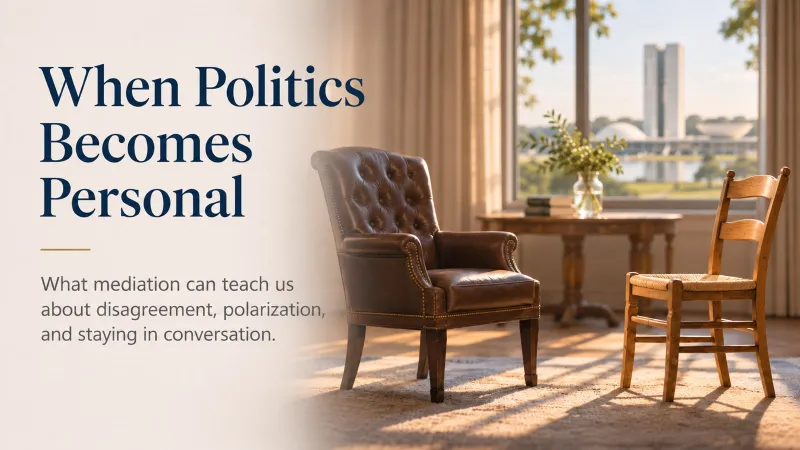
Brazil has just gone through a particularly intense presidential election. I do not intend to discuss candidates, results, or political positions here. What interests me, as a mediator, is what happens when political disagreement begins to occupy so much space that the conflict itself becomes larger than the issue that started it.
Political disagreement is nothing new. Families have always argued about politics, and friends have always held opposing views. What feels different today is the environment in which those disagreements unfold.
Social media has changed the speed, scale, and visibility of conflict. A disagreement that might once have remained around a dinner table can now move through WhatsApp groups, Instagram posts, comments, screenshots, and reposts within minutes. Language hardens quickly. People leave family groups. Friends unfollow one another. Relationships that survived years of differences suddenly seem unable to survive a political disagreement.
And gradually, the conflict stops being about an idea.
It becomes about the person.
Mediators know this dynamic well. Conflict tends to expand. It begins with one issue and gradually absorbs others. The disagreement moves from “what you think” to “who you are.” Curiosity decreases. Certainty increases. The person on the other side stops being someone with a different perspective and becomes someone to defeat, expose, dismiss, or remove.
Digital communication can intensify this process because it eliminates many of the small human signals that naturally regulate difficult conversations. We do not see hesitation in someone’s face. We do not notice the discomfort created by our words. We do not experience the silence that sometimes makes us reconsider the next sentence.
We type. We send. We react.
And the relationship has to absorb the consequences.
What can mediation teach us?
One of the most basic principles of negotiation and mediation is also one of the hardest to practice when emotions are high: separate the person from the problem.
Disagreeing with someone’s position does not require turning that person into the problem itself.
A second useful movement is to look beyond positions and explore interests. Instead of immediately responding to what someone says, we can become curious about what lies behind it.
What concerns you most about this?
What are you trying to protect?
What experience led you to see the issue this way?
These questions do not require agreement. They require curiosity.
And curiosity is often one of the first casualties of polarization.
Reframing can also change the quality of a conversation. Consider the difference between “You do not care about this country” and “It sounds as though we have very different ideas about what would be best for the country.”
The disagreement remains. But the second formulation leaves room for dialogue.
Sometimes another powerful intervention is simply to slow the conversation down.
Not every message requires an immediate answer. Not every provocation deserves a response. Not every disagreement needs to be resolved.
Before replying, it may be worth asking a simple question:
Am I trying to communicate, or am I trying to win?
Those are very different objectives.
A lesson from another Brazil
There is a story I have been using in my mediation classes for years. I first came across it in a documentary about Juscelino Kubitschek, known in Brazil simply as JK, who served as President from 1956 to 1961.
I have always been struck by this particular episode because, long before I started thinking about it in terms of negotiation theory, it seemed to capture something essential about how a difficult conversation can change when one person deliberately changes its conditions.
Early in JK’s presidency, student protests intensified in Rio de Janeiro around an increase in tram fares. The National Students’ Union, UNE, was heavily involved, and tensions between students and public authorities escalated.
Years later, in the documentary, Marcos Heusi, who had been president of UNE at the time, recalled being invited to meet with the President.
His account has stayed with me because, viewed through the lens of negotiation, JK appears to have done several remarkably sophisticated things in that conversation.
First, he shared information.
Heusi recalls JK explaining that, as President, he had access to facts and consequences that the young student leader could not necessarily see from where he stood. Rather than simply insisting that the students were wrong, JK enlarged the picture. He described the political consequences that might follow if the confrontation continued to escalate.
This is an important negotiation lesson. Parties in conflict are often making decisions from different sets of information. Sometimes progress begins not by producing a better argument, but by making sure both sides are looking at a larger part of the same reality.
Then JK did something even more striking.
He invited the young student leader to sit in the presidential chair.
Heusi later recalled the impact of that moment. Sitting there, he felt the weight of the position.
There is something almost literal about the lesson: before asking the other person to reconsider a position, invite them to see the conflict from another chair.
Perspective-taking is not agreement. It does not require abandoning one’s values or interests. It means trying, even briefly, to understand what the conflict looks like from somewhere else.
JK then moved toward common ground.
Instead of framing the conversation simply as government versus students, he appealed to something they could both recognize: concern for the country.
This was particularly powerful because the young man sitting across from him was not indifferent to Brazil. Quite the opposite. He was a student leader precisely because he believed deeply in certain ideas about the future of the nation.
JK did not ask him to stop caring.
He connected the negotiation to something they both cared about.
Finally, according to Heusi’s account, JK returned the decision to him. After presenting information, consequences, and a broader perspective, he told the student leader, in essence, to do what he believed was best for the nation.
That last movement matters.
Good negotiation does not always mean forcing the other person toward your conclusion. Sometimes it means creating the conditions in which they can reconsider the situation themselves.
Heusi’s reflection years later was simple: it had been a very powerful argument.
From the presidential chair to the smartphone screen
The contrast with today is striking.
What JK created in that room was a movement toward a wider perspective: more information, another point of view, shared values, and space for reflection.
Our digital environment often pushes us in the opposite direction.
Instead of inviting us to sit in another chair, it repeatedly reinforces our own.
Instead of searching for common ground, we are rewarded for emphasizing difference.
Instead of allowing time for reflection, the architecture of social media encourages immediate reaction.
And instead of asking what the other person might know that we do not, we often begin from the assumption that we already understand not only their argument, but their motives and their character.
Perhaps this is why conversations that begin with politics so easily end with broken relationships.
The issue itself may be important. But at some point, we have to ask whether the way we are handling the disagreement is consistent with the values we believe we are defending.
After the election
Elections end. Relationships continue.
Democratic societies do not need less disagreement. Disagreement is part of democracy. What they need is a greater capacity to live with disagreement without allowing every difference to become a rupture.
Mediation offers some simple but demanding practices: separate people from problems, become curious about interests, share information instead of only arguments, reframe accusations, search for common values, slow down the conversation, and sometimes allow silence to do its work.
Perhaps we could add one more.
Change chairs.
Not literally, necessarily. But before sending the next message, leaving the family group, unfollowing the friend, or writing the comment we may later regret, we might ask ourselves what the situation looks like from where the other person is sitting.
We may still disagree.
We may even disagree profoundly.
But understanding another perspective does not weaken our own. Sometimes it is what prevents the conflict from taking over everything else.
And perhaps that is one of the most important lessons mediation can offer in a polarized world: the goal is not always to agree.
Sometimes the goal is simply to make sure that, after the disagreement, there is still a relationship left to return to.
Comments (0)
Your email address will not be published.
Become a contributor!
Interested in contributing? Submit your proposal for a blog post now and become a part of our legal community!
Contact Editorial Guidelines


You may also like
October 8, 2026


September 8, 2026

September 6, 2026