


The Ethics of the Co-Pilot: An Update from Brazil and Beyond
July 8, 2026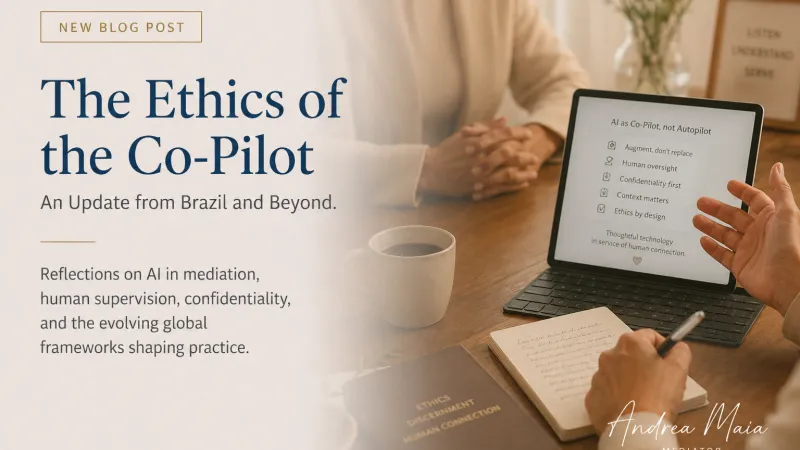
I have been spending some of my recent months inside a conversation I did not fully anticipate. As part of CONIMA, the Brazilian National Council of Mediation and Arbitration Institutions, I have been serving on its AI Committee. Our task, together with colleagues from arbitration and mediation, has been to organize best-practice guidelines on the use of artificial intelligence across both fields. Within that shared effort, I have been working specifically on the mediation section. It is very much a work in progress. But the process of studying, discussing, and drafting has pushed me back into the territory I visited earlier in my article Justice, Governance and Mediation: Insights from Brazil's AI Experience, and I would like to return to it here, updated.
Back then, I wrote that AI should be a co-pilot, not the pilot. That intuition still holds. What has changed, remarkably quickly, is that the world around it has started building a scaffolding.
Consider what has emerged, and what has consolidated. In Brazil, the National Council of Justice (CNJ), the body responsible for overseeing the administrative and financial functioning of the Brazilian judiciary, approved Resolution 615/2025, updating the framework on AI in the judiciary. Among other things, it makes human supervision explicit, prohibits systems that hinder human review, and creates a National Committee on AI in the Judiciary. The Silicon Valley Arbitration & Mediation Center's Guidelines on the Use of AI in International Arbitration, published in 2024, have continued to gain traction as a reference across jurisdictions, offering seven principles that are increasingly cited beyond arbitration. In June 2025, the IBA Mediation Committee released its own Guidelines on the Use of Generative AI in Mediation, one of the first international frameworks dedicated specifically to our field, structured around three parts: applications, risks, and a sample statement for informing parties about AI use. In November 2025, the ICFML (Instituto de Certificação e Formação de Mediadores Lusófonos), active across the Portuguese-speaking world, published the first volume of its Professional Practice Guides, dedicated to the ethical and responsible use of AI in mediation. In late 2025, the International Mediation Institute launched its Global Mediation Dialogues with a session titled Minds vs. Machines, while its Ethics Committee has been consulting publicly on a Draft Code that engages the AI question directly. In Europe, the EU AI Act now interacts with a revised ADR Directive to frame risk in out-of-court resolution. In Australia and New Zealand, the Resolution Institute has been developing specific policy on AI notetaking tools in mediation. Different jurisdictions, different starting points, but a striking family resemblance in what they say.
What stands out, reading these frameworks side by side, is convergence. They repeat, in slightly different vocabularies, the same set of ideas: human supervision must remain intact; whoever uses AI must understand what they are using; confidentiality demands particular care; transparency (often framed as some form of disclosure) matters, though its exact shape remains contested; and bias, quality, and reliability must be interrogated rather than assumed. The specific rules vary. The principles do not.
And yet, reading them carefully from the mediation side reveals something else. With the notable exceptions of the IBA and ICFML mediation guides, most of what is now in place has been written for other rooms. The CNJ Resolution addresses judges. The SVAMC Guidelines address arbitrators. Even the European framework tends to imagine dispute resolution as adjudication in a lighter register. Mediation is present, but rarely central. This matters. Mediation is not a diminished version of arbitration or adjudication. Its confidentiality is more absolute, its process more relational, its texture more emotional. In courts the "human in the loop" is the judge; in arbitration, the arbitrator. In mediation, the human in the loop is not a separate reviewer: it is the mediator, who is at the same time the space in which humanity itself is meant to circulate. That changes what "supervision", "competence", "disclosure" and "confidentiality" actually require.
This is precisely why the mediation section of the work at CONIMA has felt, in the drafting, so different from the arbitration section. What in arbitration reads as procedural discipline, in mediation touches on things that are harder to codify: the voluntariness of the parties, the neutrality of the mediator, the fragility of a caucus, the value of a silence not interrupted by a transcription. Mediation, more than the other paths, is a process conducted by humans over human disputes. And that means the questions AI raises for us are less about what the machine can do, and more about what we should never let the machine displace.
The Brazilian angle deepens the point. CNJ Resolution 615/2025 shapes what happens inside the judiciary, but it does not reach private mediation. Chambers, institutes, and individual practitioners still operate in a space where general principles float without concrete protocols. This conversation is not confined to Brazil: across the Lusophone world, the ICFML has recently formed a Taskforce on AI in Mediation, in which I have been participating as I continue to study this territory. That is where a national initiative like CONIMA's can contribute, not by importing rules from other jurisdictions, but by translating shared principles into the specific grammar of mediation, informed by the pluralism of Brazilian ADR institutions. It is a slower kind of work than announcing a rule. It requires listening to how mediators actually use these tools, and to how parties actually feel about that use.
None of this makes AI less useful. If anything, the deeper I go into this work, the more I recognize the potential: for accessibility, for organization, for reducing friction, for freeing the mediator's attention for what truly matters. But the deeper I sit with the emerging frameworks, the clearer it becomes that principles are not a substitute for discernment. They are a scaffolding built precisely so that the mediator's discernment can keep working under new conditions.
Which brings me back to the co-pilot metaphor. Months ago, it was an intuition. Now, it is close to a consensus. But consensus, on its own, does not fly the plane. In every mediation session, someone still has to notice when to slow down, when to reframe, when to protect a silence, when to insist that the parties speak to one another rather than to a screen. That someone remains, and must remain, human. The frameworks are catching up with what many mediators already sense. Our job, while they do, is to make sure we do not lose the quiet skill that made the co-pilot metaphor make sense in the first place.
Comments (1)
Your email address will not be published.
Become a contributor!
Interested in contributing? Submit your proposal for a blog post now and become a part of our legal community!
Contact Editorial Guidelines


You may also like


September 8, 2026

September 6, 2026

Dr. Kishor Shankar Dere, FCIArb and Mediator
There is absolutely no doubt that mediation attaches the highest level of significance to parties. Disputing parties are at the heart and centre of the entire mediation mechanism. Party autonomy, consent and emotions are crucial in the process of mediation. Active and empathetic listening to diverse, divergent and even conflicting views of parties can be most effectively done only by a responsible human mediator. Therefore, Andrea Maia accurately avers that any technology, including the prevailing Artificial Intelligence, can and should be used only as a co-pilot or an assistant to aid the human mediator. Science and technology need to be pragmatically and judiciously applied by the stakeholders to meaningfully and satisfactorily conclude any of the assigned tasks. Mediation cannot be an exception to it.