


Innovation, Logos, and the Formation of the Mediator as a Practical Philosopher
January 7, 2026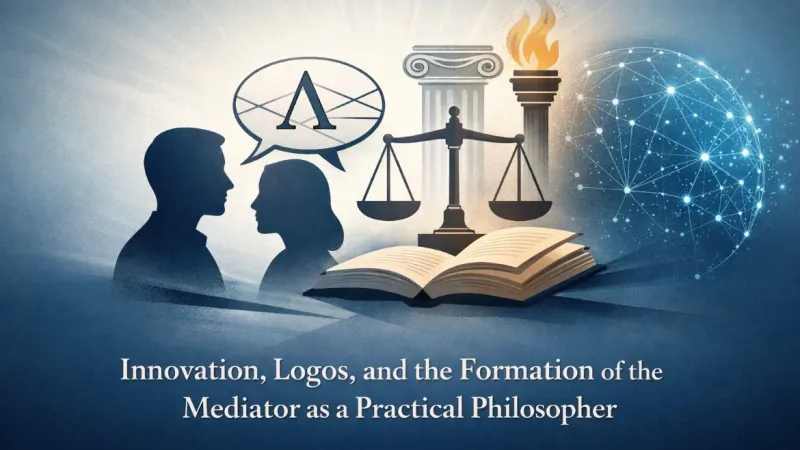
Contemporary mediation has consolidated itself as a highly specialized technical field, whose methods prioritize emotional management, the identification of interests, dialogue facilitation, and the consensual construction of pathways and agreements. These competencies are fundamental and largely respond to institutional demands for efficiency, speed, and social pacification. Although these procedural elements constitute the foundation upon which mediation has built its legitimacy and effectiveness, particularly within the legal sphere, the full understanding and conduct of mediable conflicts also benefit from a broader theoretical reflection capable of illuminating the rational, normative, and linguistic foundations that permeate the mediation process and condition its effectiveness.
When viewed from a broader philosophical perspective, mediation can be seen to benefit significantly from additional reflection on the epistemological and normative foundations that underlie conflict. Such reflection allows the procedure not only to be applied with technical precision, but also to be guided by a deeper understanding of the meaning, rationality, and values involved for the parties. This theoretical expansion does not represent a rupture with technique. On the contrary, it constitutes a movement of conceptual innovation within mediative practice itself, enhancing the quality of interventions in increasingly complex and multifactorial contexts.
In the Brazilian context, this reflection becomes particularly relevant. The country has historically ranked among the most litigious in the world, with an overburdened justice system marked by recurring disputes that persist over time without producing effective solutions. In this scenario, mediation emerges not merely as a procedural response to the crisis of litigation, but as a privileged space for the reconstruction of deteriorated social bonds. Adopting a deeper vision, grounded in philosophical foundations, allows conflict resolution to move beyond a purely distributive logic and reach a genuinely transformative dimension.
Every conflict involves, to some degree, a rupture in shared meaning that goes beyond a simple divergence of interests or communicative failures. In such moments, one can observe a genuine fragmentation of the common rationality that enables the parties to recognize one another as participants in a shared horizon of understanding. This rupture can be adequately understood in light of the philosophical concept of logos, the organizing principle of meaning and the foundation of human coexistence.
In the classical philosophical tradition, logos occupies a central place in the constitution of ethical and political life. It represents the human capacity to confer intelligibility upon the world through rational language to justify positions, to argue, and to deliberate collectively. In Aristotle, for instance, it is logos that distinguishes human beings as political animals, insofar as it enables deliberation about justice and injustice, advantage and harm, thereby grounding communal life.
Where logos remains active, disagreement is possible without dissolving relationships and often contributes to the construction of new forms of understanding. Where it breaks down, conflict assumes the form of incommensurability: the parties no longer share minimal criteria of rationality, legitimacy, or practical truth, speaking instead from normative universes that no longer recognize one another. It is at this point that dialogue, as understood in mediation, must be distinguished from a mere alternation of speech. Dialogue is not reducible to the fact that two parties speak in turn; in its deeper sense, it implies a joint search for something that transcends individual positions. Etymologically, dia-logos refers to a form of reason that passes through subjects, oriented toward the construction of a practical truth that does not fully coincide with what each party thinks in isolation, but can be pursued through justice, mediation, and shared reason.
Nevertheless, much of mediation theory and practice approaches communication as a functional instrument, focusing on techniques such as active listening, neutral reframing, and emotional validation. While these tools are undoubtedly relevant, they often treat language instrumentally, as a means to reach an agreement, rather than as a space for the reconstruction of meaning. Communication, in this framework, is reduced to the exchange of information or the expression of emotions, whereas the core of the conflict frequently lies in the absence of a shared logos capable of sustaining genuine dialogue.
When transposed into the field of mediation, this understanding of logos allows many conflicts to be interpreted not as simple disputes of interest, but as situations in which the capacity for shared deliberation has been compromised. The parties speak, but no longer argue on the same plane; they offer reasons, but those reasons are no longer mutually recognized as valid or legitimate. In such cases, the impasse does not stem from a lack of communication, often acknowledged and validated by the parties themselves—but from the absence of a common rational horizon that renders communication genuinely meaningful.
Mediation, when understood merely as communicative facilitation, runs the risk of operating on the surface of the conflict. It may produce formally satisfactory agreements that are ontologically fragile, as they fail to address the deeper disarticulation that sustains the dispute. In complex conflicts (particularly those marked by identity-based, moral, or existential dimensions) the absence of deliberate work toward reconstructing logos tends to result in unstable solutions, latent resentment, and the recurrence of litigation.
Mediation thus comes to play a role that goes beyond facilitating dialogue: it becomes a space for the reconstruction of logos, in which fragmented narratives, competing values, and divergent normative criteria can be reorganized so as to reestablish minimal conditions of reciprocal intelligibility, conditions indispensable to any durable consensual solution. From this perspective, mediation should be understood as an eminently philosophical practice, even if it is rarely recognized as such. To mediate, beyond the procedural administration of dialogue, involves active participation in the process of rationally reorganizing the parties’ lived world, creating conditions in which fragmented discourses, conflicting narratives, and competing rationalities can once again inhabit a shared space.
This role demands from the mediator something that exceeds technical mastery, whether procedural, legal, or communicational. It requires the ability to operate at the level of practical reason that is, in the domain where facts, values, language, and action intersect. Even when the mediator does not decide the merits of the conflict, they decisively influence how the conflict is understood, narrated, and transformed. For this reason, the formation of the mediator as a philosopher is not merely desirable, but necessary. Practical philosophy, since Aristotle, has concerned itself with human action in contexts of uncertainty, plurality, and value conflict. It does not offer definitive answers; rather, it cultivates the capacity to judge, deliberate, and act reasonably in complex situations. This is precisely the core competence required of the mediator.
Educating mediators as practical philosophers entails integrating them into a reflective tradition that includes ethics, philosophy of language, epistemology, and hermeneutics. Ethics provides criteria for dealing with normative dilemmas inherent to mediative practice, such as impartiality, party autonomy, and responsibility for the process. Philosophy of language enables an understanding of how conflicts are discursively structured and how certain narratives generate exclusion, silencing, or escalation. Epistemology contributes to addressing disputes over facts, versions, and competing truths, shifting the focus from objective verification to the construction of a shareable practical truth. Hermeneutics, in turn, offers tools for interpreting contexts, implicit meanings, and distinct cultural horizons.
This deeper understanding of mediation directly engages with Brazil’s contemporary legal innovation ecosystem. Today, through the work of the Brazilian Association of Lawtechs and Legaltechs (AB2L), the country hosts the largest legal innovation ecosystem in the world, bringing together more than one thousand members who collectively rethink how law is produced, accessed, and applied. At events such as the AB2L Lawtech Experience, this reflective dimension of mediation and appropriate dispute resolution methods has been discussed transversally, highlighting that legal innovation is not limited to technology, but also involves the conceptual sophistication of legal and consensual practices.
Incorporating philosophical formation into mediative practice does not require transforming the mediator into an abstract theorist, nor introducing content alien to the everyday reality of mediation. In practical terms, it translates into the mediator’s ability to identify, throughout the process, which dimensions of the conflict are properly normative, linguistic, or epistemic, and to adjust their intervention accordingly. At certain moments, listening must focus on the implicit values that guide the parties’ positions; at others, on how particular narratives organize reality and produce discursive asymmetries; and at still others, on the need to suspend the search for a definitive factual truth in favor of constructing a sufficiently shared practical truth that enables joint deliberation.
This movement is also reflected in the design of the process itself. The formulation of questions, the choice of the appropriate moment for reframing, the management of silence, and the manner in which statements are returned to the parties cease to be merely neutral techniques and instead function as instruments of rational reorganization of the conflict. Open-ended questions that explore criteria of justice, legitimacy, or reasonableness, for example, do not aim to lead the parties toward a specific answer, but to reintroduce the exercise of practical judgment and argumentation into the mediation space. Likewise, the careful articulation of implicit assumptions or conceptual ambiguities present in the parties’ discourse can help bring to light points of convergence that had remained obscured by the language of conflict.
Finally, this approach requires that mediator training include systematic spaces for critical reflection on practice itself. Case studies, reflective supervision, the use of legal technologies, and interdisciplinary dialogue become central instruments for developing the philosophical sensitivity required for mediation. In this sense, practical philosophy ceases to be an external body of knowledge and becomes one of mediation’s operative foundations. By incorporating these dimensions, mediation moves beyond being merely an alternative dispute resolution technique and comes to be understood as a practice of rational reconstruction of social bonds. The mediator no longer acts as a neutral facilitator alone, but as an agent of practical rationality, capable of sustaining the space of logos even when it appears to have collapsed.
Comments (0)
Your email address will not be published.
Become a contributor!
Interested in contributing? Submit your proposal for a blog post now and become a part of our legal community!
Contact Editorial Guidelines


You may also like


February 20, 2026

February 8, 2026

January 2, 2026

December 30, 2025