


Before the Agreement: The Inner Odyssey of Decision
March 8, 2026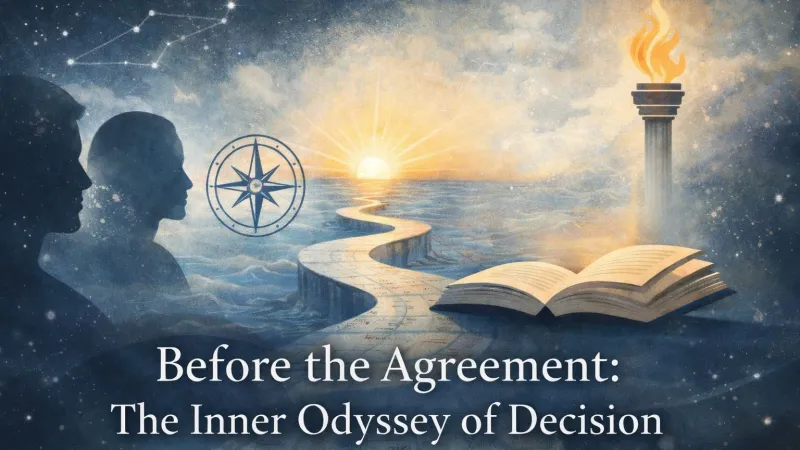
I am particularly happy to know that this year AB2L Congress will take place in Rio de Janeiro: my city. AB2L, the Brazilian Association of Lawtechs and Legaltechs, has become a central space for dialogue on innovation, technology, and the future of the legal profession in Brazil. Hosting this year’s Congress in Rio feels both personal and symbolic.
The central theme of this year event will be the Odyssey, Homer’s epic about a long and uncertain journey home, and this choice has stayed with me. Not as a literary exercise, but as an invitation to reflect on conflict, decision-making, and the long , often invisible, journeys we take before arriving at a meaningful “yes.”
This reflection led me back to a concept that has increasingly shaped my work as a mediator: the possible.
The most difficult journey is not external
In mediation, attention is often directed toward what is visible: positions, proposals, and outcomes. Yet the most demanding journey rarely unfolds at the negotiation table. It happens internally.
Conflicts - particularly complex or high-stakes ones - confront individuals and organizations with uncertainty, loss, fear, and identity shifts. The pressure to resolve them quickly, driven by legal deadlines or business imperatives, often overlooks a fundamental truth: sustainable decisions require internal consent.
In The Odyssey, Odysseus’ journey is prolonged not because the destination is unknown, but because each step tests his ability to remain aligned with himself. Storms, detours, and temptations can be read as metaphors for impulses and shortcuts that threaten to pull him away from his path.
The greatest risk is not getting lost at sea, but losing oneself along the way.
The possible versus the ideal
In mediation, the possible is frequently misunderstood. It is not resignation, nor is it a diluted version of the ideal. Rather, it is what emerges when unrealistic expectations give way to clarity.
The ideal asks: What would I want if there were no limits?
The possible asks: What can I sustain without betraying myself?
This distinction is critical. Parties often enter mediation anchored in imagined outcomes like full vindication, moral victory, or total avoidance of loss. When reality intervenes, frustration intensifies and negotiation hardens.
This understanding of the possible resonates with the work of William Ury, particularly in his book Possible. Ury reminds us that the opposite of conflict is not agreement, but creativity — the capacity to imagine paths that are neither ideal nor destructive, but viable and humane. In this sense, the possible is not a compromise born of weakness; it is a deliberate choice grounded in reality, responsibility, and self-awareness.
Rather than asking parties to abandon their values or ambitions, the possible invites them to clarify what truly matters and what they are willing to carry forward.
This is where the mediator’s most important work often takes place: invisibly.
Before numbers are discussed or terms are drafted, there is a quieter task: creating space for reflection, pauses, and discomfort that is not immediately resolved. Silence, when held with intention, allows insight to surface. Time, when respected, enables parties to recognize what they already know but have not yet accepted.
Mediators do not manufacture agreement. They design conditions for lucidity.
In this sense, mediation is not about persuasion, it is about containment and holding uncertainty long enough for parties to distinguish between what they fear losing and what they truly cannot give up. This internal clarification is not a detour from negotiation; it is what makes negotiation possible.
Saying “yes” to oneself
One of the most overlooked moments in mediation is the internal decision that precedes any external commitment.
Before saying yes to a proposal, parties must say yes to the consequences of that choice. Before conceding, they must accept the limits of control. Before moving forward, they must reconcile with what will not be recovered.
This internal “yes” is rarely comfortable. It often involves grief for expectations, for former versions of relationships or organizations, for imagined futures. Without it, agreements remain fragile, easily revisited, and frequently resented.
Odysseus does not return home unchanged. The journey transforms him. Likewise, meaningful resolution does not restore parties to who they were before the conflict; it leads them somewhere new, more aware, and more aligned.
Mediation as a journey, not a shortcut
In a culture that prizes speed and efficiency, mediation is sometimes framed as a shortcut to resolution. This framing does it a disservice.
Mediation is not effective because it bypasses complexity, but because it engages with it directly. Like the journey in The Odyssey, it requires patience, restraint, and the willingness to resist seductive shortcuts that promise relief but undermine sustainability.
At its best, mediation does not push parties toward agreement. It accompanies them as they discover what kind of agreement they are truly capable of sustaining.
Perhaps this is why the metaphor of the journey resonates so strongly at the beginning of this year. Not all paths are linear. Not all answers come from the outside. And not all resolutions resemble victories.
Sometimes, the most meaningful outcome is the recognition that the “yes” we seek externally must first be reached internally.
Mediation, when practiced with depth and care, honors this process. It does not promise ideal solutions. It sustains the possible and, in doing so, helps parties arrive at decisions they can genuinely stand behind.
And for those who will be in Rio de Janeiro this May, I warmly invite you to continue this journey in person at the AB2L Experience— a space for dialogue, innovation, and reflection on how we navigate conflict, technology, and the futures we are capable of sustaining.
Comments (0)
Your email address will not be published.
Become a contributor!
Interested in contributing? Submit your proposal for a blog post now and become a part of our legal community!
Contact Editorial Guidelines


You may also like


February 20, 2026
February 8, 2026

January 2, 2026