The Contents of Intertax, Volume 54, Issue 5, 2026
May 18, 2026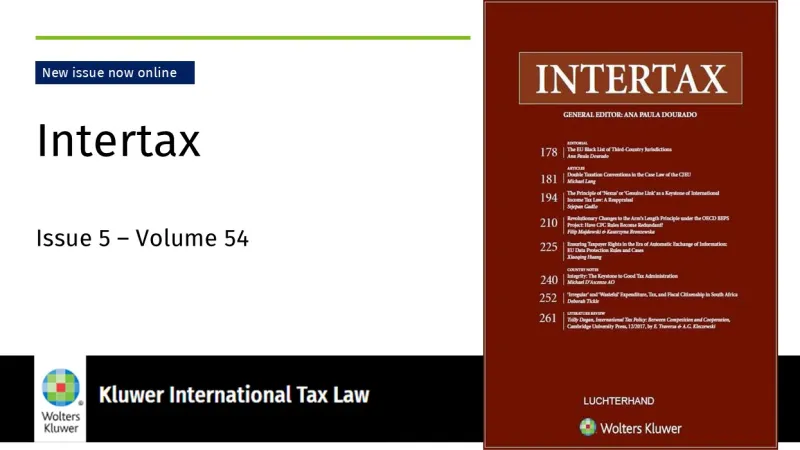
We are happy to inform you that the latest issue of the journal is now available and includes the following contributions:
In an environment where tax compliance is difficult to impose on non-resident service providers resulting in the loss of tax revenue on services rendered to residents, Article 12AA, a newly adopted addition to the UN Model Tax Convention, is to be welcomed by revenue -starved African jurisdictions. However, the drafters appear to have overlooked potential problems of imposing a gross withholding tax on service fees in developing countries with transfer pricing legislation. This paper outlines the prevalence in African jurisdictions of withholding taxes on service fees, the impact of the Double Tax Agreements (DTA’s) on the collection of withholding taxes and the shortcomings of domestic relief for double taxation in African countries, using South Africa’s measures as an example.
The paper then illustrates the distortions that the imposition of withholding tax on service fees on a gross basis, which Article 12AA provides for, could have on the economies of developing countries like South Africa as well as its impact on foreign direct investment into such countries, particularly given the interplay of such a tax with domestic transfer pricing rules. The paper briefly examines some proposals from other academics and scholars to address these distortions caused by a gross withholding tax on service fees. The paper concludes that a withholding tax on service fees should not be imposed as a final tax on a gross basis. Provision should instead be made in domestic law to permit non-resident service providers to register voluntarily for tax, in order that they may file a tax return, claim allowable deductions and accordingly pay their tax on a net basis. The paper ends with a call for more research on strategies to streamline administrative hurdles resulting from registration for foreign service providers before the new Article 12AA is widely implemented in Africa.
The rapid growth of cryptoassets has posed significant challenges for tax administrations worldwide, particularly in detecting taxable transactions, verifying valuations, and linking them to identifiable taxpayers. The pseudonymous and at times anonymous design of crypto assets undermines traditional enforcement models that depend on identifiable intermediaries and jurisdictional oversight. This article conducted a comparative analysis of the European Union’s (EU’s) evolving regulatory framework and considered the lessons that South Africa can draw in strengthening its capacity to administer and enforce crypto taxation. The EU has progressively expanded its approach from the early Anti-Money Laundering Directives (AMLDs) to more integrated instruments, including the Markets in Crypto-Assets Regulation (EU) 2023/1114 (MiCA), the revised Transfer of Funds Regulation (EU) 2023/111 (TFR), and Council Directive (EU) 2023/2226 (DAC8), alongside the Organization for Economic Co-operation and Development (OECD)’s Crypto-Asset Reporting Framework (CARF). Together, these measures demonstrate how prudential oversight, transaction traceability, and tax-transparency obligations can generate verifiable, cross-border data usable for tax assessment and audit. By contrast, South Africa’s framework remains fragmented, relying on isolated provisions under the Financial Intelligence Centre Act 38 of 2011 (FICA), the Financial Advisory and Intermediary Services Act 37 of 2002 (FAIS), and recent commitments to implement CARF. The article argued that South Africa must move beyond formal compliance toward a coherent, layered framework that integrates prudential supervision, fiscal data analytics, and crossborder information exchange. Drawing selectively on the EU’s trajectory, South Africa can strengthen South African Revenue Service’s tax administration, close anonymity gaps, enhance fiscal sovereignty, and promote responsible innovation in its crypto economy.
The EU Tax List Through the Experience of Three African Countries
The European Union (EU) list of non-cooperative jurisdictions for tax purposes, introduced in 2017, screens non-EU countries for alignment with OECD and EU tax standards to curb harmful tax competition. Non-compliance results in blacklisting, with significant reputational and economic consequences. This paper employs a qualitative empirical methodology to examine the experience and perceptions of Namibia, Mauritius, and Seychelles, exemplifying the challenges faced by developing countries in responding to externally imposed tax reforms. Among other trends, it identifies three compliance strategies – apparent, reluctant, and pre-emptive – reflecting semi-compliance driven by reputational concerns. Based on empirical findings, the paper exposes the EU list’s coercive nature and its disregard for developmental priorities, leading to unstable, short-term policy changes. Using a decolonizing lens, the paper interrogates issues of procedural and substantive fairness, arguing that, while the EU tax list aims to foster tax coordination, it reinforces global inequalities, hindering inclusive and equitable cooperation; it therefore risks marginalizing developing countries and undermining its own legitimacy in advancing global tax justice. The paper contributes new empirical data, proposes an analytical framework for assessing compliance responses, and offers recommendations for both (African) developing countries and the EU. It calls for a more equitable and collaborative model of the EU tax list for international tax governance.
This article examines Kenya's transition from its digital services tax (DST) to a significant economic presence (SEP) tax regime that became effective in December 2024 and positioned this development within the broader global and African digital taxation discourse. The analysis addresses three central questions: (1) Is Kenya's SEP constitutionally sound under the fairness principle articulated in Article 201(b)(i) of the Constitution of Kenya 2010? (2) How does the SEP interact with Kenya's existing double taxation agreements (DTAs), and what treaty conflicts may arise? (3) What lessons can Kenya draw from comparative African experiences, specifically Nigeria's pioneering SEP model? This article argues that the shift from DSTs to the SEP is a formal legal advance with significant implications for treaty interaction and constitutional defensibility rather than a substantive change in the economic burden imposed on digital service providers.
The contribution concludes that, while Kenya's SEP represents a pragmatic assertion of fiscal sovereignty addressing immediate revenue needs, its long-term success depends on strengthening domestic administration, managing treaty conflicts through strategic renegotiation, and contributing to global tax reform that is more equitable. The SEP should be viewed not as a final destination but as a transitional measure to secure immediate revenue and leverage in global negotiations while Kenya continues to advocate for a more equitable multilateral solution.
Comments (0)
Your email address will not be published.
Become a contributor!
Interested in contributing? Submit your proposal for a blog post now and become a part of our legal community!
Contact Editorial Guidelines


You may also like

October 8, 2026

September 30, 2026
September 1, 2026