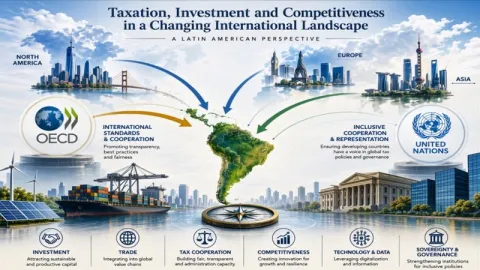
BEPS Action 5: harmful tax competition What is “substance”?
July 13, 2026
BEPS Action 5: Countering Harmful Tax Practices More Effectively, Taking into Account Transparency and Substance, Action 5: 2015 Final Report defined a “preferential” tax regime as one that offers some form of tax preference in comparison with the general principles of taxation in the country. To counter tax harmful tax regimes, countries with preferential tax regimes were required to attach a “substantial activity” requirement to such regimes in order to avoid a “harmful” classification.
Mauritius, in common with many jurisdictions that offer a preferential regime, introduced a requirement that to benefit from a tax exemption:
· the core income generating activities must be in Mauritius;
· an adequate number of suitably qualified persons must be employed to conduct the core income generating activities; and
· a minimum expenditure proportionate to its level of activities must be incurred.
The decision in Alteo Energy Ltd and another v Director-General, Mauritius Revenue Authority [2026] UKPC 27 is the first consideration of the meaning and application of these rules anywhere. The Judicial Committee of the Privy Council (the highest appellate court in a number of Commonwealth countries).
The taxpayer, a resident of Mauritius, was a member of a multinational corporate group which mostly operated in the sugar industry. The taxpayer’s principal activity was electricity generation and its sale to the Central Electricity Board of Mauritius. It also earned interest on loans made by the taxpayer company as an incident to its main activity. Interest income made up only about 0.25% of the taxpayer's total income.
The taxpayer argued that it was entitled to exemption on interest income under a special regime for interest earned by non-bank lenders that met the preferential regime requirements described above.
The Mauritius Revenue Authority (MRA) argued that the interest was fully taxable on the basis that the “core income generating activities” were not carried out in Mauritius. The dispute thus turned on the proper interpretation of that term. At its heart, the dispute turned on what the word “core” meant and what it applied to.
The core activities which generated Alteo's total income (from electricity generation) were carried out in Mauritius. Indeed, the curious aspect of the case is that all of the taxpayer’s activities were carried out there.
Which income?
The Mauritius Supreme Court had held that the income question was all income generated by the company which would mean that the interest income qualified for exemption.
Before the Privy Council, it was not in dispute that the income in question, capable of qualifying for the income tax exemption, was the interest income. The Privy Council agreed. First, "income generating activities" referred to activities of the company which generate income that might benefit from the exemption, i.e. interest income, and not income which cannot benefit from the exemption: that income is logically irrelevant to whether the exemption applies.
Second, the purpose of ensuring that the regime complies with the substantial activity requirement in the BEPS Action 5 Final Report requires a link between the income qualifying for the preferential treatment and the core activities necessary to earn that income. Any other income of the company is irrelevant.
Third, the Privy Council noted that the same core income generating activities test applied to other specifically identified tax privileged activities in the same way. These are the kinds of geographically mobile activities addressed in Chapter 4 of the BEPS Action 5 Final Report.
Which activities are core?
The MRA argued that the activities that are central to the main operations of the company are the relevant "core" business activities. Because the taxpayer's core business activities were the production and sale of electricity and not interest generating activities, it did not have any qualifying core income generating activities relevant to the type of income qualifying for the exemption, according to the MRA.
The Privy Council rejected that argument. It said that "core" signifies that, even if the company does not carry out all the activities generating the relevant income in Mauritius, it must carry out the "core" activities which generate that income there.
The clear purpose of the requirement was to ensure that the regime satisfies the OECD's "substantial activity" requirement in the Action 5 Final Report. Thus, the condition for exemption does not mean that the company's core business activities must include money lending or similar activities. In addition, the other requirements, namely, identifying where people conducting the relevant activities are employed and where expenditure is incurred are similarly to ensure that the income qualifying for preferential treatment in fact arises from the core activities required to generate it.
The Privy Council found the inclusion of specific money lending activities such as "agreeing funding terms, setting the terms and duration of any financing" (derived from the Action 5 Final Report), difficult to explain. The least unsatisfactory explanation, they thought, could be to make clear that the exclusion of banks did not prevent other, non-excluded companies engaged in financing as their principal or sole field of operation from claiming the benefit of the exemption for interest income. In my view, the specific functions that are relevant to the preferential regimes identified in the Action 15 Final Report are largely illustrative.
Application to the facts
The Privy Council noted that the loans and interest generated were essentially a by-product of the taxpayer's principal business activity, so that a broader view of its activities as a whole was justified. They therefore decided that the relevant activities which generate all the company's revenue including, indirectly, interest derived from lending some of its money were located in Mauritius. It had an adequate number of suitably qualified employees and incurred proportionate expenditure there.
Concluding observations
Readers may wonder why the MRA challenged the exemption in a case where all the activity, employees and expenditure of a substantial business was in Mauritius, with an ingenious but unsuccessful argument both in the Supreme Court and Privy Council. Their argument ultimately failed because of an over-literal reading of the legislation. The Privy Council decision makes sense in the context of income which is just a byproduct of a business that requires assets, employees and activity. The decision leaves open the approach where income that benefits from a preferential regime is more than incidental to another activity and what qualifies as incidental.
It may also be noted that the preferential regime and the manner of complying with BEPS Action 5 in Mauritius differs from that found in other offshore centres in that the benefits of the regime are conditional on meeting the substance requirements. The sanction, for example, in the Channel Islands where non-compliance results in exchange of information and in extreme cases to prosecution or winding up of entities.
Enduring and wider significance is the court’s reliance on the BEPS Action 5 Final Report in providing the evident purpose of the legislation in providing the meaning of a much used expression.
Comments (0)
Your email address will not be published.
Become a contributor!
Interested in contributing? Submit your proposal for a blog post now and become a part of our legal community!
Contact Editorial Guidelines


You may also like

October 8, 2026

September 30, 2026
September 1, 2026