Exploring EU Labour Law Article by Article
January 28, 2026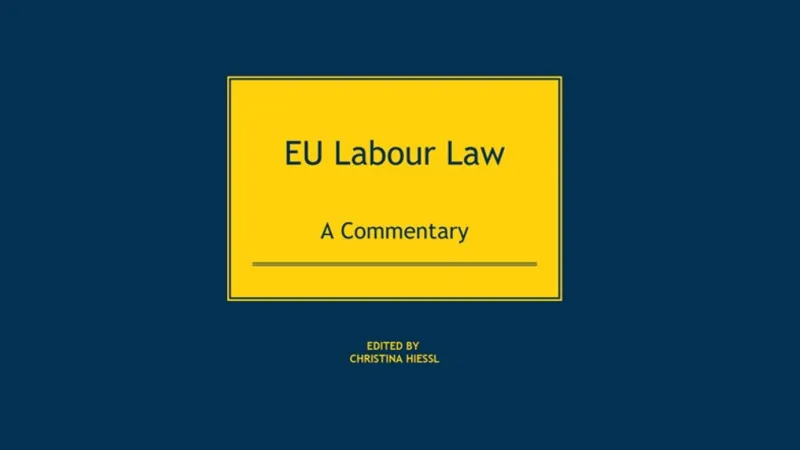
Even at a time where deregulation approaches dominate EU-level policy discussions,1EU labour law is alive and kicking. The Pillar of Social Rights, proclaimed almost a decade ago, has accelerated the move towards the harmonisation of minimum labour law standards across Europe. Since then about a dozen relevant instruments have been adopted; many of which can be considered milestones in terms of the EU’s social dimension (and triggered and continue to trigger substantial reforms at national level) – such as the Transparent and Predictable Working Conditions Directive, the Work-Life Balance Directive, the Whistleblower Directive, the Women on Boards Directive, the Pay Transparency Directive, the Platform Work Directive and many more.
The CJEU’s recent judgment on the Adequate Minimum Wages Directive has confirmed that the Union’s competences in the social field are indeed considerably more extensive and versatile than many would have expected (a discussion of this judgment was provided here soon after the decision). If anything, this will most likely serve to further encourage lawmaking that ensures a minimum floor of social rights within the common market – and sometimes beyond.
At the same time, our understanding of the social acquis communautaire keeps expanding, notably with a view to the 3-4 dozen judgments which the Court of Justice has rendered on cases with a social dimension in each of the past years.
In this rapidly evolving legal environment, keeping track of EU labour law – the existing instruments, their interpretation by authoritative EU-level precedents, as well as the main scholarly opinions on the many questions unaddressed by case law – is a challenging task, even for those of us whose research agenda includes a special focus on EU social law.
To provide scholars as well as legal practitioners and students with a sound and up-to-date basis of orientation in this field, a group of 47 renowned experts from almost all EU Member States has recently accomplished the feat of uniting all of the relevant legal instruments in a single volume and providing an article-by-article commentary on all of the most important provisions. EU Labour Law: A Commentary (Wolters Kluwer) – now available as a printed book, a pdf e-version, and an interactive e-version containing thousands of internal and external links – offers expert commentary on the 50 legal instruments that constitute the core of EU labour law, including primary law, various directives, a handful of regulations, as well as the key framework agreements concluded by the European social partners. The commentary on each article starts by giving an overview of all EU-level cases dealing with its interpretation, thereby incorporating about 1000 judgments across the manuscript.
As this book’s editor, accompanying the exercise of a systematic exploration of EU labour law has been a fascinating journey. It has laid bare not only the plethora of questions remaining on the interpretation of individual provisions of EU labour law, but also just how much there is to gain from an interconnected view.
The now available first edition reflects the status quo of EU Labour Law in early 2025. Regular updates are planned over the coming years – and work on them has already begun. Below is the table of contents for the book.
Table of Contents
1 Introduction
Christina Hiessl
2 General Concepts
Christina Hiessl
2.1 Worker/Employee
2.2 Effet utile
2.3 Direct Effect
2.4 Horizontal Applicability
2.5 Equivalence and Effectiveness
2.6 Victimisation/Retaliation
2.7 General Principles of EU Law
2.8 Application Ratione Temporis of EU Law
3 EU Primary Law
Christina Hiessl, Marc Steiert, Kristina Koldinská, Marco Rocca, Martha Verner, Elena Gramano, Antonio García-Muñoz Alhambra, Nastazja Potocka-Sionek, Dominik Leist
3.1 Treaty on European Union (TEU)
3.2 Treaty on the Functioning of the European Union (TFEU)
3.3 EU Charter of Fundamental Rights
4 Free Movement and Cross-Border Sourcing of Labour
Kristina Koldinská, Stan Bruurs, Christina Hiessl, Marco Rocca, Martha Verner, Jean-Baptiste Farcy, Aria Huys
4.1 Free Movement of Workers
4.1.1 General Remarks/Related Provisions
4.1.2 Rome I Regulation (593/2008)
4.1.3 Free Movement Regulation (492/2011)
4.2 Free Movement of Services and Establishment/Posting of Workers
4.2.1 General Remarks/Related Provisions
4.2.2 Posting of Workers Directive (96/71/EC)
4.2.3 Enforcement Directive (2014/67/EU)
4.2.4 Public Procurement Directive (2014/24/EU)
4.3 Rights of TCN Workers in the EU
4.3.1 General Remarks/Related Provisions
4.3.2 Single Permit Directive (2024/1233/EU)
4.3.3 Employer Sanctions Directive (2009/52/EC)
4.3.4 Blue Card Directive (2021/1883/EU)
4.3.5 Seasonal Work Directive (2014/36/EU)
4.3.6 Intra-corporate Transfer Directive (2014/66/EU)
4.4 Obligations of MNEs Active Outside the EU
4.4.1 General Remarks/Related Provisions
4.4.2 Corporate Sustainability Due Diligence Directive (2024/1760/EU)
5 Equal Treatment
Raphaële Xenidis, Adrijana Martinović, Christina Hiessl, Eleni De Becker, Christiana Cleridou, Sara Benedí Lahuerta, Laura Carlson, Emma Lantschner, Iván Rodríguez Cardo, Diego Álvarez Alonso, Sonja Bekker
5.1 EU Non-discrimination Law: A Transversal Introduction
5.2 Gender
5.2.1 General Remarks/Related Provisions
5.2.2 Recast Directive (2006/54/EC)
5.2.3 Self-Employed Directive (2010/41/EU)
5.2.4 Social Security Directive (79/7/EC)
5.2.5 Women on Boards Directive (2022/2381)
5.2.6 Pay Transparency Directive (2023/970)
5.2.7 Equality Bodies Directive (2024/1500)
5.3 Race/Ethnicity
5.3.1 General Remarks/Related Provisions
5.3.2 Race Equality Directive (2000/43/EC)
5.4 Religion/Belief, Disability, Age, Sexual Orientation
5.4.1 General Remarks/Related Provisions
5.4.2 Employment Equality/Directive (200078/EC)
5.4.3 Framework Agreement on Active Ageing
6 Atypical Work
Raluca Dimitriu, Ann-Christine ‘Ankie’ Hartzén, Nuna Zekić, Amélie Sutterer-Kipping, Effrosyni Bakirtzi
6.1 Part-Time Work
6.1.1 General Remarks/Related Provisions
6.1.2 Part-Time Work Directive (97/81/EC)
6.2 Fixed-Term Work
6.2.1 General Remarks/Related Provisions
6.2.2 Fixed-Term Work Directive (1999/70/EC)
6.3 Temporary Agency Work
6.3.1 General Remarks/Related Provisions
6.3.2 Temporary Agency Work Directive (2008/104/EC)
6.4 Platform Work
6.4.1 General Remarks/Related Provisions
6.4.2 Platform Work Directive (2024/2831/EU)
6.5 Telework
6.5.1 General Remarks/Related Provisions
6.5.2 Framework Agreement on Telework
7 Restructuring of Undertakings
Piotr Grzebyk, Miriam Kullmann, Tamás Gyulavári
7.1 Collective Redundancies
7.1.1 General Remarks/Related Provisions
7.1.2 Collective Redundancies Directive (98/59/EC)
7.2 Transfer of Undertakings
7.2.1 General Remarks/Related Provisions
7.2.2 Transfer of Undertakings Directive (2001/23/EC)
7.3 Employer Insolvency
7.3.1 General Remarks/Related Provisions
7.3.2 Employer Insolvency Directive (2008/94/EC)
8 Working Conditions
Emanuele Menegatti, Luca Ratti, Gábor Kártyás, Leszek Mitrus, Effrosyni Bakirtzi, Vera Pavlou Antonio Aloisi, Ana Teresa Ribeiro, Frank Hendrickx, David Mangan, Erika Kovács, Mijke Houwerzijl, Katja Nebe, Berit Kristin Dose, Ivana Vukorepa
8.1 Transparency and Predictability
8.1.1 General Remarks/Related Provisions
8.1.2 Transparent and Predictable Working Conditions Directive (2019/1152/EU)
8.2 Minimum Wage
8.2.1 General Remarks/Related Provisions
8.2.2 Adequate Minimum Wages Directive (2022/2041)
8.3 OSH, Working Time, Harassment
8.3.1 General Remarks/Related Provisions
8.3.2 OSH Framework Directive (89/391/EEC)
8.3.3 Working Time Directive (2003/88/EC)
8.3.4 Road Transport Regulation (561/2006)
8.3.5 Young Workers Directive (94/33/EC)
8.3.6 Framework Agreement on Harassment and Violence at Work
8.3.7 Framework Agreement on Work-Related Stress
8.3.8 Framework Agreement on Digitalisation
8.4 Privacy and Data Protection
8.4.1 General Remarks/Related Provisions
8.4.2 General Data Protection Regulation (2016/679)
8.5 Whistleblowing
8.5.1 General Remarks/Related Provisions
8.5.2 Whistleblowing Directive (2019/1937)
8.6 Reconciliation of Work and Family Life
8.6.1 General Remarks/Related Provisions
8.6.2 Directive 92/85/EEC (Maternity Directive)
8.6.3 Work-Life Balance (WLB) Directive (2019/1158)
8.7 Supplementary Pensions
8.7.1 General Remarks/Related Provisions
8.7.2 Safeguarding Supplementary Pension Rights Directive (98/49/EC)
8.7.3 Acquisition and Preservation of Supplementary Pension Rights Directive (2014/50/EU)
9 Social Dialogue, Information and Consultation
Antonio García-Muñoz Alhambra, Elena Gramano, Elisabeth Brameshuber, Adam Sagan, Christina Schnittler, Attila Kun
9.1 Social Dialogue
9.1.1 General Remarks/Related Provisions
9.1.2 Guidelines on Collective Agreements for Solo Self-Employed
9.2 Information and Consultation
9.2.1 General Remarks/Related Provisions
9.2.2 I&C Framework Directive (2002/14/EC)
9.2.3 European Works Council (EWC) Directive (2009/38/EC)
9.2.4 SE Directive (2001/86/EC)
9.2.5 Company Law Directive (2017/1132/EU)
- 1Cf. the ever-expanding “Omnibus” process, including on sustainability (on which a compromise has already been reached between the co-legislators) and digitalisation (see recent blog).
Tags:
EU Labour Law
Comments (0)
Your email address will not be published.
Become a contributor!
Interested in contributing? Submit your proposal for a blog post now and become a part of our legal community!
Contact Editorial Guidelines

You may also like




December 24, 2025